The Existence of God
And rational justification for belief
III

Arguments from Religious Belief
And rational justification for belief
III
Arguments from Religious Belief
III. Religious Belief is Normative for Human Natureand Experience
Note: Normative does not mean "normal" it means to set the standard. The distinction being that it is not a mere insult that the unbeliever is abnormal, but it is a statement tha religious belief is the standard given human nature and it does not have to be justified. We are fit to be religious. Our basic nature as humans is "designed" to cause us to seek God. We are made to be religious belief requires no further justification.
A. Relgious Belief is a Transcultural Experience
There has never been a culture that was not religious. To say this another way, never at any time in human history has any culture ever been atheistic. All cultures have always been religious. As far back as Neanderthal, we find artifacts which imply religious concepts and thoughts of after life.
1) Atheists Theories of Religious Origin outmodedSince Religious belief Transcends culture it is not a mere product of culture.If religion was merely cultural, it would probably be the case that some culture at some point would have been atheistic, but none ever has been. The favorite Atheistic expalintion for the origin of religion is the outmoded sturctural functionalist appraoch form the 19th century. This Notion argues that if something exists in social sturcture it is because it serves a function toward the promotion of the sturcuture. But this is a theory designed to rule out religion to begin with. It is based upon the assumption of reductionsim, that everything can be reduced to mere social function. Many atheists on the internet often through in the idea that religion was "invented" for the purpose of keeping social order. But this is empirically not ture.
2) Religious Belief Does not Serve as Expoianatoinhttp://wri.leaderu.com/offices/loons/docs/Lillegard.html
Are Religious Beliefs Explanations?
Norman Lillegard
B. Arizes Out of a Sense of the Numenous...Scientific explanations get started generally with hypotheses (at least on a Popperian account) which are then put to various tests in attempts to get independent evidence for the explicans. Now there surely is something quite odd in the suggestion that such a religious belief as that God created the universe, or guides its development, is in any way a hypothesis. This belief is normally aquired in "dogmatic" contexts, it is not held in a tentative fashion, and its function in a believer's life is, arguably, quite distinct from the function of hypotheses, and thus of explanations, in the lives of scientists. Does this show that religion and science simply bypass one another? Perhaps.It will no doubt be argued that even if religious beliefs are not hypotheses they still have a definite cognitive content, are true or false, and thus are capable of contradicting scientific claims. To deny this would seem to be tantamount to endorsing some kind of emotivism with respect to religious belief, and in fact suspicions of emotivism have undoubtedly contributed to what I think are premature dismissal of Wittgensteinian approaches in the philosophy of religion. ... I will argue that the dynamics of belief change in the sciences and in religion are distinct in ways that support the idea that religious beliefs do not generally function as hypotheses or indeed function as explanations at all.
1) Sense of higher presence universal human experienceWilliam James, Varities of Religoius Experience (The Gilford Lectures)."It is as if there were in the human consciousness a sense of reality, a feeling of objective presence, a perception of what we may call 'something there,' more deep and more general than any of the special and particular 'senses' by which the current psychology supposes existent realities to be originally revealed. If this were so, we might suppose the senses to waken our attitudes and conduct as they so habitually do, by first exciting this sense of reality; but anything else, any idea, for example, that might similarly excite it, would have that same prerogative of appearing real which objects of sense normally possess. So far as religious conceptions were able to touch this reality-feeling, they would be believed in in spite of criticism, even though they might be so vague and remote as to be almost unimaginable, even though they might be such non-entities in point of whatness, as Kant makes the objects of his moral theology to be.The most curious proofs of the existence of such an undifferentiated sense of reality as this are found in experiences of hallucination..... "
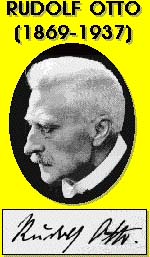
2) The Origin of Religion in the Sense of the HolyRudolf Otto (1869-1937) produced his own notion of the religious a pariori based upon the experience of the numinous or the Holy. This sense "combines both rational and non-rational elements. In his book The Idea of The Holy "Otto saw the origin of religion in what he called the mysterium tremendum et fascinans...some particular experience, usually for primative people some confrontation with natural forces, but for the more sophisticated some depth of personal relationship, where simultaneously one is both attracted and repelled by a sense of awe..." [R. Jones "Numinous" Westminster Dictionary of Chrsitian Theology..(405)]This is apt to be taken as a disproof by internet atheists. The argument would say that the sense of awe at encountering the holy is merely the fear of the unknown expeirneced by primative people.while it no doubt does cotain that, the argument is merely reifying the experience. First, it is centered upon a prejudice against premative people; O, they don't have sicence so how can they know anying? Secondly, it is reducing the experience to an alleged coutner causality which we have no right to do. The "primative" who intuites a sense of awe is taken for a dumy whis only frightened by the thunder. But that is merely modernist prejudice. Premiative people know what thunder is, the encounter it all the time, it is the added element of what they attach to nature that the senes in thunder (or whatever the case may be) so there is an added dimension that we are reducing and losing in the "explaintion" (and explaination which is just ideolgically based).a) Criticisms based on the primativeb) the Sophisticated version
In more developed world religions there is a more "sophisticated" sense of the holy that derives from a host of things, including ritual, the sense of the numenous that obtains to holy ritual, doctrine and understanding. This may contian a sense of personal relationship with the Divine. Again, while the explaination of it may be culturally conditioned, the experiencing of the thing itself must be taken on its own terms. We cannot say, without getting into the consciousness of the believer, that a particular bliever has not had a particular experience.
3) Religion as the Externalization of the ArchetypicalReligions, Values, and Peak-Experiences
Abraham H. Maslow
Appendix I. An Example of B-Analysis
Maslow talks about the psychological necessity of being able to maintain a tranformative symbology. He is not merely saying that we should do this, but that we do it, it is universal and through many different technqiues and psychological schools of thought he shows that this has been gleaned over and over again. What Jung called the Archetypes are universal symbols of transfomration which we understand in the uncoscious, and we must be able to hold them in proper relation to the mundane (the Sacred and the Profane) in order to enjoy healthy growth, or we stagnate and become pathological. It is crucial to human psychology to maintain this balance. Far from merely being stupid and not understanding science, striving to expalin a pre-Newtonian world, the primatives understood this balance and held it better than we do. Religious beleif is crucial to our psychological well being, and this fact far more than social order or the need for examplianation exaplians the origins of religion.
For practically all primitives, these matters that I have spoken about are seen in a more pious, sacred way, as Eliade has stressed, i.e., as rituals, ceremonies, and mysteries. The ceremony of puberty, which we make nothing of, is extremely important for most primitive cultures. When the girl menstruates for the first time and becomes a woman, it is truly a great event and a great ceremony; and it is truly, in the profound and naturalistic and human sense, a great religious moment in the life not only of the girl herself but also of the whole tribe. She steps into the realm of those who can carry on life and those who can produce life; so also for the boy's puberty; so also for the ceremonies of death, of old age, of marriage, of the mysteries of women, the mysteries of men. I think that an examination of primitive or preliterate cultures would show that they often manage the unitive life better than we do, at least as far as relations between the sexes are concerned and also as between adults and children. They combine better than we do the B and the D, as Eliade has pointed out. He defined primitive cultures as different from industrial cultures because they have kept their sense of the sacred about the basic biological things of life.We must remember, after all, that all these happenings are in truth mysteries. Even though they happen a million times, they are still mysteries. If we lose our sense of the mysterious, or the numinous, if we lose our sense of awe, of humility, of being struck dumb, if we lose our sense of good fortune, then we have lost a very real and basic human capacity and are diminished thereby.
Now that may be taken as a frank admission of a naturalistic psychological origin, except that it invovles a universal symbology which is not explicable through merely naturalistic means. How is it that all humans come to hold these same archetypical symbols? (For more on archetypes see Jesus Chrsit and Mythology page II) The "prematives" viewed and understood a sense of transformation which gave them an integration into the universe. This is crucial for human development. They sensed a power in the numenous, that is the origin of religion.
C. Humans Fit to Be Religious
1) Normative human Psychology
a. Religious geninus not neurotic"What, then, is more natural than that this temperament should introduce one to regions of religious truth, to corners of the universe, which your robust Philistine type of nervous system, forever offering its biceps to be felt, thumping its breast, and thanking Heaven that it hasn't a single morbid fibre in its composition, would be sure to hide forever from its self-satisfied possessors?If there were such a thing as inspiration from a higher realm, it might well be that the neurotic temperament would furnish the chief condition of the requisite receptivity. "--William James (Gilford Lectures)
J. Gartner, D.B. Allen, The Faith Factor: An Annotated Bibliography of Systematic Reviews And Clinical Research on Spiritual Subjects Vol. II, David B. Larson M.D., Natiional Institute for Health Research Dec. 1993, p. 3090b. Religious attendence not corrolated with psychosis"As for psychosis, the authors notied that those with psychotic ideation are not necessarily preoccupied with religious concerns, nor do they frequently attend religious services; rather they are less frequent attenders than those in the general population..."
c.Religous Pepole are More Self Actualized
Dr. Michale Nieson,Ph.D. Psychology and religion."http://www.psywww.com/psyrelig/ukraine/index.htm"
"What makes someone psychologically healthy? This was the question that guided Maslow's work. He saw too much emphasis in psychology on negative behavior and thought, and wanted to supplant it with a psychology of mental health. To this end, he developed a hierarchy of needs, ranging from lower level physiological needs, through love and belonging, to self- actualization. Self-actualized people are those who have reached their potential for self-development. Maslow claimed that mystics are more likely to be self-actualized than are other people. Mystics also are more likely to have had "peak experiences," experiences in which the person feels a sense of ecstasy and oneness with the universe. Although his hierarchy of needs sounds appealing, researchers have had difficulty finding support for his theory."
d. Christian Repentence Promotes Healthy Mindedness
Within the Christian body, for which repentance of sins has from the beginning been the critical religious act, healthy-mindedness has always come forward with its milder interpretation. Repentance according to such healthy-minded Christians means getting away from the sin, not groaning and writhing over its commission. The Catholic practice of confession and absolution is in one of its aspects little more than a systematic method of keeping healthy-mindedness on top. By it a man's accounts with evil are periodically squared and audited, so that he may start the clean page with no old debts inscribed. Any Catholicwill tell us how clean and fresh and free he feels after the purging operation. Martin Luther by no means belonged to the healthy-minded type in the radical sense in which we have discussed it, and be repudiated priestly absolution for sin. Yet in this matter of repentance he had some very healthy-minded ideas, due in the main to the largeness of his conception of God. -...
e. Recent Empirical Studies Prove Religious Believers have less depression, mental illness lower Divorce rate, ect.J. Gartner, D.B. Allen, The Faith Factor: An Annotated Bibliography of Systematic Reviews And Clinical Research on Spiritual Subjects Vol. II, David B. Larson M.D., Natiional Institute for Health Research Dec. 1993, p. 3090"The Reviews identified 10 areas of clinical staus in whihc research has demonstrated benefits of religious commitment: (1) Depression, (2) Suicide, (3) Delinquency, (4) Mortality, (5) Alchohol use (6) Drug use, (7) Well-being, (8) Divorce and martital satisfaction, (9) Physical Health Status, and (10) Mental health outcome studies....The authors underscored the need for additional longitudinal studies featuring health outcomes. Although there were few, such studies tended to show mental health benefit. Similarly, in the case of teh few longevity or mortality outcome studies, the benefit was in favor of those who attended chruch...at least 70% of the time, increased religious commitment was associated with improved coping and protection from problems."[The authors conducted a literature search of over 2000 publications to glean the current state of empirical study data in areas of Spirituality and health]2) Psychologists No Longer Assume Religious Experience is the Abnormality, but unblief is the abnormality."A non spiritualized person is a sick person, even if she doesn't show any symptom described by traditional medicine. The supernatural and the sacredness result from an elaboration on the function of omnipotence by the mind and can be found both in atheist and religious people. It is an existential function in humankind and the uses each one makes of it will be the measure for one's understanding."
Dr. Jorge W.F. Amaro, Ph.D., Head psychology dept. Sao Paulo
[ http://www.psywww.com/psyrelig/amaro.html]
a) Unbeliever is the Sick Soul
b. psychotheraputic discipline re-evalutes Frued's criticism of religion2) BION, W. R. Atenção e interpretação (Attention and interpretation). Rio de Janeiro: Imago, 1973."Nowadays there are many who do not agree with the notion that religious behavior a priori implies a neurotic state to be decoded and eliminated by analysis (exorcism). That reductionism based on the first works by Freud is currently under review. The psychotherapist should be limited to observing the uses their clients make of the representations of the image of God in their subjective world, that is, the uses of the function of omnipotence. Among the several authors that subscribe to this position are Odilon de Mello Franco (12), .... W. R. Bion (2), one of the most notable contemporary psychoanalysts, ..."
12) MELLO FRANCO, O. de. Religious experience and psychoanalysis: from man-as-god to man-with-god. Int. J. of Psychoanalysis (1998) 79,
c. Maslow's view of religious expereince and helthy mindedness promoted creation of phsycological disciplineNeison on Maslow"One outgrowth of Maslow's work is what has become known as Transpersonal Psychology, in which the focus is on the spiritual well-being of individuals, and values are advocated steadfastly. Transpersonal psychologists seek to blend Eastern religion (Buddhism, Hinduism, etc.) or Western (Christian, Jewish or Moslem) mysticism with a form of modern psychology. Frequently, the transpersonal psychologist rejects psychology's adoption of various scientific methods used in the natural sciences."
"The influence of the transpersonal movement remains small, but there is evidence that it is growing. I suspect that most psychologists would agree with Maslow that much of psychology -- including the psychology of religion -- needs an improved theoretical foundation."
"Doctrors find Power of faith hard to ignore3) Religion is Physically Healthy for Us.
By Usha Lee McFarling
Knight Ridder News Service
(Dec. 23, 1998)
Http://www.tennessean.com/health/stories/98/trends1223.htm
see also: The Faith Factor: An Annotated Bibliography of Systematic Reviews And Clinical Research on Spiritual Subjects Vol. II, David B. Larson M.D., Natiional Institute for Health Research Dec. 1993 For data on a many studies which support this conclusion.Some suspect that the benefits of faith and churchgoing largely boil down to having social support &emdash; a factor that, by itself, has been shown to improve health. But the health effects of religion can't wholly be explained by social support. If, for example, you compare people who aren't religious with people who gather regularly for more secular reasons, the religious group is healthier. In Israel, studies comparing religious with secular kibbutzim showed the religious communes were healthier."Is this all a social effect you could get from going to the bridge club? It doesn't seem that way," said Koenig, who directs Duke's Center for the Study of Religion/Spirituality and Health .Another popular explanation for the link between religion and health is sin avoidance.The religious might be healthier because they are less likely to smoke, drink and engage in risky sex and more likely to wear seat belts.But when studies control for those factors, say by comparing religious nonsmokers with nonreligious nonsmokers, the religious factors still stand out. Compare smokers who are religious with those who are not and the churchgoing smokers have blood pressure as low as nonsmokers. "If you're a smoker, make sure you get your butt in church," said Larson, who conducted the smoking study.
IV. The Religious a priori and Its Affects Imply Reality of its Co-Determinate4) Religion is the most powerful Factor in well being.
Poloma and pendelton The Faith Factor: An Annotated Bibliography of Systematic Reviews And Clinical Research on Spiritual Subjects Vol. II, David B. Larson M.D., Natiional Institute for Health Research Dec. 1993, p. 3290.
"The authors found that religious satisfaction was the most powerful predicter of existential well being. The degree to which an individual felt close to God was the most important factor in terms of existential well-being. While frequency of prayer contributed to general life satisfaction and personal happiness. As a result of their study the authors concluded that it would be important to look at a combindation of religious items, including prayer, religionship with God, and other measures of religious experince to begin to adequately clearlify the associations of religious committment with general well-being."
Willam James
D. Anticipating Atheist Objections
1) Appeal to AuthorityThis is not an appeal to popularity, although atheists on the internet will say it is.In fact some already have. One little group of snots put it on their little mochery website where they make fun of things they dont'understand. But it is an appeal to the way we are made. If I argued that humans are made to see the color red, and the proof is that 90% of all humans see red and always have, would that then merely be an appeal tot he popularity of the color red? No, it is not an appeal to popularity. I am not saying religion is right just because everyone thinks so. I am saying that we think so because we are made to think so. Evolution in and of itself could not produce a moral standard, a sense of well being that opporated around a merely cultural idea, and one that was consistantly good for us over and above other options.
2) "It's just Placebo"Now of course the other sketpical response will be, "It's just a placebo!" Some have even resonded, on the boards, "they just feel better because they think some big powerful person is watching out for them." Dah! Of course, but why would that be? Moreover, the effects are not realized if the person doesn't actually believe. This is how we know it is not merely the benifit of social participation. Studies show that religious social participation outwieighs all other forms, even when smoking and other health factors are controled for, and the effects are not relaized if the person believes it is merely a placebo. (Konenig, see prayer pages).
In a sense the placebo argument is right. Obviously it is a placebo. But that should work for anything that people believe increases their well being, but it doesn't. Nothing else provides the benifits of religious belief. This tells us not only that these people feel better because they believe some power is caring for them, but that humans are universally made to feel this way. If religion is merely a social construct invented to keep order or gain power for a preistly elite, how could this be the case? Apparently our physiology is constructed in such a way as to obey our psychology, but our psychology is constructed in such a way as to be responsive to our metaphysical beliefs. If these beliefs have no validity one would expect this to either not function, or to function just as well in the case of other strongly held beliefs. Therefore we are made to be religious.
E. The Skeptic Must Justify Unbelief
The skeptic must justify his/her skepticism. Of course if a person does not believe, he or she simpley doens't believe and no one can compell them to. Nevertheless, in terms of argumentation, it is not the skeptic who has the right to label religious belief as irrational and groundless and to demand absolute empirical proof of the believer. On the contrary, the skeptic must first demonstrate rational grounds for skepticism before trying to take a skeptical attitude accorss community bounderies and inflict it upon the believer.
It is just as though 10% of the world population found it obnoxious to live in houses or any kid of shelter. That's fine for those who like it, but when they start insisting that there is something wrong wtih those of us who enjoy being protected from the elements, that we are weak minded because we don't like being cold, that we need a crutch for life because we don't enjoy sitting the rain, it is the skeptic who must first demonstrate why his/her rebellion against the eons old practice of taking shelter form the elements is right a priori and our human normality to be protected form the wind and rain is somehow silly, illogical, and unjustified.
Some skeptics who have seen me argue this way think it is soooo stupid because they have heard the atheistic slogan spouted that the believer has the burden of proof. Not understanding the rules of evidence, they think this slogan makes for a true dictim of logic. But it largely an ideological slogan, not a true principle. The one who asserts an argument has the burden to prove that argument. But, when a case has been establsihed as prime facie it is the burden of the other party to overturn that status of the case. I have met my evidental burden in establishing the narmative nature of bleief. This is not to say that religion is "normal" and thus popular so it's not an appeal to popularity either. Normative does not mean normal, it means that it sets the standard. The sketpic must overturn the normative nature of belief by indicating why we should be skeptical of something that the vast majority of people recognogize as true. Now this can be done perhaps but the atheist has tto do it.
Are we justified in believing something for which there is no direct empirical proof? Yes!A. Religious a priori: The Trace of God in The Universe
God is not found directly in empirical data or in direct obsrevation. It is foolish to demand such data, because God is the ground of being, and thus exists beyond the limits of human rationality (beyound our ability to understand or percieve). Yet there are expereinces of God's presence, and other experiential phenomena which indicate that God is real.These constitute an a priori understanding of God, that is to say, an experinece which transcends sense data and indicates to the believer that God is real. The basic argument then is that: The sense of religious experience offers an a priori reason to assume the existence of God.Obviously religious belief is tuaght through culture, and there is a good reason for that, because religion is a cultural consturct. But that does not diminish the relatiy of God. Culture teaches religion but God is kown to people in the heart. This comes through a variety of ways; thorugh direct expeirnece, through miraculous signs, through intatuve sense, or through a sense of the numinous. The Westminster's Dictionary of Christian Theology ..defines Numinous as "the sense of awe in attracting and repelling people to the Holy."Please note:I'n not necessarily talking about miracles, in fact most of what I am talking about is not "miraculous" at all.
1) Definition of the a priori
It cannot be summed up by the use of ethics or any other field, it cannot be reduced to explaintion of the world or to other fields, or physiological counter causality."This notion [Religious a priori] is used of philosopers of religion to express the view that the sense of the Divine is due to a special form of awareness which exists along side the cognative, moral, and aesthetic forms of awreness and is not explicable by reference to them. The concept of religion as concenred with the awreness of and response to the divine is accordingly a simple notion which cannot be defined by reference other than itself." --David Pailin "Religious a pariori" Westminster Dictionary of Chrisian Theology (498)a) Culturally constructed nature of religion does not negate a priori.
"Even though the forms by Which religion is expressed are culturally conditioned, religion itself is sui generis essentially irreduceable to and underivable from the non-religious." (Ibid.)
b) The Religious a priori cannot be reduced to anything else
Of course that is going to invite a lot of dispute from internet atheists and many other kinds of atheists, as well as social scientists. But no control can ever be established. Any study would only be studying the culturally constructed bits (by definition since language and social sciences are cultural constructs as well) so all the social sciences will wind up doing is merely reifying the phenomena and reducing the experience. In other words, This idea can never be studied in a social sciences sense, all that the social scineces can do is redine the phenomena until they are no longer discussing the actual expereinces of the religious believer, but merely the ideology of the social scientist (see science and religion page--link).
Schleiermacher, (1768-1834) in On Religion: Speeches to it's Cultured Dispisers, and The Chrisitian Faith .sets forth the view that religion is not reduceable to kowledge or ethical systems. It is primarily a phenomenoloigcal apprehension of God consciusness through means of religious affections. Affections is a term not used much anymore, and it is easily confussed with mere emotion. Sometimes Schleiermacher is udnerstood as saying that "I become emotional when I pay and thus there must be an object of my emotional feelings." Though he does vinture close to this position in one form of the arugment, this is not exactly what he's saying.2) Forms of the a priori.
a) Schleiermacher's "Feeling of Utter Dependence."
In the earlier form of his argument he was saying that affections were indicative of a sense of God, but in the Christian Faith he argues that there is a greater sense of unity in the life world and a snese of the dependance of all things in the life world upon something higher.
What is this feeling of utter depenedence? It is the sense of the unityin the life world and it's greater reliance upon a higher reality. It is not to be confussed with the stary sky at night in the desert feeling, but is akin to it. I like to think about the feeling of being in my backyard late on a summer night, listening to the sounds of the freeway dying out andrealizing a certain harmony in the lfie world and the sense that all of this exists because it stemms form a higher thing. There is more to it than thatbut I don't have time to go into it. That's just a short hand for those of us to whom this is a new concept to get some sort of handle on it. Nor does"feeling" here mean "emotion" but it is connected to the religiousaffections. In the early version S. thought it was a corrolate between thereligious affections and God; God must be there because I can feel love for him when I pray to him. But that's not what it's saying in the better version.
The basic assumptions Schleiermacher is making are Plaontic. He believes that the feeling of utter dependence is the backdrop, the pre-given, pre-cognative notion behind the ontological argument. IN other words, what Anselm tried to capture in his logical argument is felt by everyone, if they were honest, in a pre-cognative way. In other words, before one thinks about it, it is this "feeling" of utter dependence. After one thinks it out and makes it into a logical arguemnt it is the ontological arguement.a1) Platonic background
LIfe world, or Labeinwelt is a term used in German philosophy. It implies the world of one's culturally contructed life, the "world" we 'live in.' Life as we expeirence it on a daily basis. The unity one senses in the life world is intuative and unites the experiences and aspirations of the individual in a sense of integration and belonging in in the world. As Heidegger says "a being in the world." Schleiermacher is saying that there is a special intuative sense that everyone can grasp of this whole, this unity, being bound up with a higher relatiy, being dependent upon a higher unity. In other words, the "feeling" can be understood as an intuative sense of "radical constingency" (int he sense of the above ontolgoical arugments).a2) Unity in the Life world
He goes on to say that the feeling is based upon the ontological principle as its theoretical background, but doesnt' depend on the argument because it proceeds the argument as the pre-given pre-theorectical pre-cognative relaitzation of what Anslem sat down and thought about and turned into a rational argument: why has the fools said in his heart 'there is no God?' Why a fool? Becasue in the heart we know God. To deny this is to deny the most basic realization about reality.
The sense of power in the neuminous which people find when confonted by the sacred. The speicial sense of presence or of Holiness wich is intuative and observed in all religious expereince around the world.b) Otto's Sense of the Holy
We are going to die. We cannot avoid this. This is our ultimate concern and sooner or latter we have to confont it. When we do we realize a sense of trasnformation that gives us a speicial realization existentially that life is more than material.c) Tillich's Object of Ultimate Concern
B. Freedom from the Need to prove
Schleiermacher came up with his notion of the feeling when wrestling with Kantian Dualism. Kant had said that the world is divided into two aspects of relaity the numenous and the pheneomenal. The numenous is not experienced through sense data, and sense God is not experineced through sense data, God belongs only to the numenous. The problem is that this robbs us of an object of theological discourse. We can't talk about God because we can't experience God in sense data. Schleiermacher found a way to run an 'end round' and get around the sense data. Experience of God is given directly in the "feeling" apart form sense data.
This frees us form the need to prove the existance of God to others, because we know that God exists in a deep way that cannot be assertatied by mere cultural consturcts or reductionist data or feified pehenomena. This restores the object of theological discourse. Once having regained its object, theological discourse can proceed to make the logical deduction that there must be a co-determinate to the feeling, and that co-determinate is God. In that sense Schleiermacher is saying "if I have affections about God God must exist as an object of my affections"--not merely because anything there must be an object of all affections, but because of the logic of the co-determinate--there is a sense of radical contengency, there must be an object upon which we are radically contingent.
(It's an argument of justification for belief)
1) Reductionism loses the phenomenaWhen scientific reductionism is applied to these expereinces they reduced to something else, the pehonmena is lost. This does not mean that they are disproven. It means that here we are dealing in the phenomenological realm and this cannot be subjected to scientific reductionism. Like the problem of quantum physics and the study of light particles, to study the problem is to change it so that it cannot really be studied in that way.
William James, The Varities of Religious Expereince, (The Gilford Lectures)
The world interpreted religiously is not the materialistic world over again, with an altered expression; it must have, over and above the altered expression, a natural constitution different at some point from that which a materialistic world would have. It must be such that different events can be expected in it, different conduct must be required.This thoroughly 'pragmatic' view of religion has usually been taken as a matter of course by common men. They have interpolated divine miracles into the field of nature, they have built a heaven out beyond the grave.
By being faithful in my poor measure to this over-belief, I seem to myself to keep more sane and true. I can, of course, put myself into the sectarian scientist's attitude, and imagine vividly that the world of sensations and of scientific laws and objects may be all. But whenever I do this, I hear that inward monitor of which W. K. Clifford once wrote, whispering the word 'bosh!' Humbug is humbug, even though it bear the scientific name, and the total expression of human experience, as I view it objectively, invincibly urges me beyond the narrow scientific bounds. Assuredly, the real world is of a different temperament,- more intricately built than physical science allows. So my objective and my subjective conscience both hold me to the over-belief which I express. Who knows whether the faithfulness of individuals here below to their own poor over-beliefs may not actually help God in turn to be more effectively faithful to his own greater tasks?
Neilson on Maslow
"An important criticism that Maslow leveled at psychology concerned scientists' efforts to keep values out of their work. Most psychologists see this as an attempt to avoid bias, but to Maslow it reflects a lack of value for things that are important. According to Maslow, a science without values can not be used to show that murder or genocide is bad. This can be remedied by adopting a broader approach to the subject matter, and by concerning ourselves with people's choices and values."
2. The demand for "empirical data" is irrational(given the phenomenological nature of religious belief)
a) Scientific Reduction of experience is mere genetic phallasyWilliam James, Gildford Lectures.[Though his work in The Varieities of Religious Experience is very dated (turn of the century) this work is still looked upon as a classic and guide to framing of modern reasearch paradgims. Jame's overall conclusion, that religious experience was healthy and universal to human experienice]James--Medical materialism seems indeed a good appellation for the too simple-minded system of thought which we are considering. Medical materialism finishes up Saint Paul by calling his vision on the road to Damascus a discharging lesion of the occipital cortex, he being an epileptic. It snuffs out Saint Teresa as an hysteric, Saint Francis of Assisi as an hereditary degenerate. George Fox's discontent with the shams of his age, and his pining for spiritual veracity, it treats as a symptom of a disordered colon. Carlyle's organ-tones of misery it accounts for by a gastro-duodenal catarrh. All such mental over-tensions, it says, are, when you come to the bottom of the matter, mere affairs of diathesis (auto-intoxications most probably), due to the perverted action of various glands which physiology will yet discover.And medical materialism then thinks that the spiritual authority of all such personages is successfully undermined."
b) Reduction to physiological cause is ideological assumption
"Let us ourselves look at the matter in the largest possible way. Modern psychology, finding definite psycho-physical connections to hold good, assumes as a convenient hypothesis that the dependence of mental states upon bodily conditions must be thorough-going and complete. If we adopt the assumption, then of course what medical materialism insists on must be true in a general way, if not in every detail: Saint Paul certainly had once an epileptoid, if not an epileptic seizure; George Fox was an hereditary degenerate; Carlyle was undoubtedly auto-intoxicated by some organ or other, no matter which,- and the rest. But now, I ask you, how can such an existential account of facts of mental history decide in one way or another upon their spiritual significance? According to the general postulate of psychology just referred to, there is not a single one of our states of mind, high or low, healthy or morbid, that has not some organic process as its condition. Scientific theories are organically conditioned just as much as religious emotions are; and if we only knew the facts intimately enough, we should doubtless see 'the liver' determining the dicta of the sturdy atheist as decisively as it does those of the Methodist under conviction anxious about his soul." "When it alters in one way the blood that percolates it, we get the methodist, when in another way, we get the atheist form of mind. So of all our rapturer, and our drynesses, our longings and pantings, our questions and beliefs. They are equally organically founded, be they of religious or of non-religious content.....It is needless to say that medical materialism draws in point of fact no such sweeping skeptical conclusion. It is sure, just as every simple man is sure, that some states of mind are inwardly superior to others, and reveal to us more truth, and in this it simply makes use of an ordinary spiritual judgment. It has no physiological theory of the production of these its favorite states, by which it may accredit them; and its attempt to discredit the states which it dislikes, by vaguely associating them with nerves and liver, and connecting them with names connoting bodily affliction, is altogether illogical and inconsistent.
The Religious A priori, being irreduceable to other forms of inquarry, demands that religous experience be taken on its own terms. to try and ascribe it to some counter causality or alternative explination merely involves one in an infifnite regress of trying to justify reduction from the actual phenomenon observed to some other phenomenon until the original thing being studied is lost. The argument is that most people experience some form of God or some form of numinous such that they have a sense of a higher reality. This cannot be denied in terms which explain it away by some other means. To attempt to do so is merely to critique the culturally constructed manifestations of religion. Unless the critic can actually get inside the consciousness of the beleiver he/she has no way of knowing the validity of the claims. (see Schleiermacher The Theologican by Williams)c) Reductionism reifies phenomena.
This does not mean that the mere claim of religious epxeirnece of God consciousness is proof in and of itself, but it means that it must be taken on its own terms. It clearly answers the question about why doesn't God reveal himself to everyone; He has, or rather, He has made it clear to everyone that he exists, and He has provided everyone with a means of knowing Him. He doesn't get any more explicit because faith is a major requirment for belief. Faith is not an arbitrary requirement, but the rational and logical result of a world made up of moral choices.
Note: The bottom line on this point is that religious experience belongs to the phenomenological realm, not to that of empiricial "objective" investigation. Therefore, attempts to reduce it to counter causality are misplaced and even irrational because in so doing they reify (change the nature) of the experiences.William James: The Varities of Religous Experience, form Gilford Lectures.
James"To pass now to religious phenomena, take the melancholy which, as we shall see, constitutes an essential moment in every complete religious evolution. Take the happiness which achieved religious belief confers. Take the trance-like states of insight into truth which all religious mystics report. 8 These are each and all of them special cases of kinds of human experience of much wider scope. Religious melancholy, whatever peculiarities it may have qua religious, is at any rate melancholy. Religious happiness is happiness. Religious trance is trance. And the moment we renounce the absurd notion that a thing is exploded away as soon as it is classed with others, or its origin is shown; the moment we agree to stand by experimental results and inner quality, in judging of values,- who does not see that we are likely to ascertain the distinctive significance of religious melancholy and happiness, or of religious trances, far better by comparing them as conscientiously as we can with other varieties of melancholy, happiness, and trance, than by refusing to consider their place in any more general series, and treating them as if they were outside of nature's order altogether? -I hope that the course of these lectures will confirm us in this supposition. As regards the psychopathic origin of so many religious phenomena, that would not be in the least surprising or disconcerting,..."
d) Empirical demands Irrational because of assumptions
"To plead the organic causation of a religious state of mind, then, in refutation of its claim to possess superior spiritual value, is quite illogical and arbitrary, unless one have already worked out in advance some psycho-physical theory connecting spiritual values in general with determinate sorts of physiological change. Otherwise none of our thoughts and feelings, not even our scientific doctrines, not even our dis-beliefs, could retain any value as revelations of the truth, for every one of them without exception flows from the state of their possessor's body at the time"
[For a read treat see how this argument played out on the boards against my greatest nemesis, Mutalito, on "Metacrock in Action."]
C Real Affects Imply Co-determinate
1) There is a "co-determinate to the Feeling of Utter dependence.
"It is the original pre-theoretical consciousness...Schleiermacher believes that theoretical cognition is founded upon pre-theoretical intersubjective cognition and its life world. The latter cannot be dismissed as non-cognative for if the life world praxis is non-cognative and invalid so is theoretical cognition..S...contends that belief in God is pre-theoretical, it is not the result of proofs and demonstration, but is conditioned soley by themodification of feeling of utter dependence. Belief in God is not accquiredthrough intellectual acts of which the traditional proofs are examples, but rather from the thing itself, the object of religious experience..If as S...says God is given to feeling in an original way this means that the feeling of utter dependence is in some sense an apperition of divine be ingand reality. This is not meant as a Bartia fiedeism or appeal to revelation but rather as a natualistic eidetics"] or a priori. The feeling of utter dependence is structured by a corrolation with its whence." Robert R. Williams, Schleiermacher the Theologian, p 4.
In other words, I have this sense of being utterly dependent upon a higher reality, this thing that created not only me, but the world around upon which I am also dependent. Because I sense that I am dependent upon this, there must be something there upon which I am dependent. Now course the skeptic will, and not without good reason, say that this is circular reasoning. It is not circular, but it cannot be advanced as a formal proof. There is nothing in the expereince itself which proves that it's "whence" is one thing and not another. If I choose to regard it as so, that is not unjustified, but I cannot advance it as proof. However, I if it has real and lasting effects I can advance those as proof, so long as there is no other causal agent that can be demonstrated.
2)Effects indicate that Mystical expereince cannot be reduced to Mental Illness.Mental illness is usually either teatable or progress (gets worse), but it is not positive over a long term. Mentally ill people do not gian long lasting postive effects from thier illness that gives them a heightend sense of well being and lasts for long term. Mental illness does not improve the sense of self-actualization or make one a "whole" person. Religious experience does this and mystical expereince or "peak experience" so so all the more. Evidence to document this point is found above under argument III, but more studies can also be sited.[see above, Larson, The Faith Factor, Study search]
Noble's study of Mystics shows mystical experience more productive of mental health than illness
[Noble, Kathleen D. (1987). ``Psychological Health and the Experience of Transcendence.'' The Counseling Psychologist, 15 (4), 601-614.]
Council on Spiritual Practices
a) Not the restult of deprivation or fantasy; mystics tend to be successful people.State of Unitive Consciousness
http://www.csp.org/experience/docs/unitive_consciousness.html
"Furthermore, Greeley found no evidence to support the orthodox belief that frequent mystic experiences or psychic experiences stem from deprivation or psychopathology. His ''mystics'' were generally better educated, more successful economically, and less racist, and they were rated substantially happier on measures of psychological well-being. "
b) Mystisicm offers therapeutic insights
``Within the Western model we recognize and define psychosis as a suboptimal state of consciousness that views reality in a distorted way and does not recognize that distortion. It is therefore important to note that from the mystical perspective our usual state fits all the criteria of psychosis, being suboptimal, having a distorted view of reality, yet not recognizing that distortion. Indeed from the ultimate mystical perspective, psychosis can be defined as being trapped in, or attached to, any one state of consciousness, each of which by itself is necessarily limited and only relatively real.'' [-- page 665 ) [Roger Walsh (1980). The consciousness disciplines and the behavioral sciences: Questions of comparison and assessment. American Journal of Psychiatry, 137(6), 663-673.See Also:
Lukoff, David & Francis G. Lu (1988). ``Transpersonal psychology research review: Topic: Mystical experiences.'' Journal of Transpersonal Psychology, 20 (2), 161-184.
Charles T. Tart, Psi: Scientific Studies of the Psychic Realm, p. 19.
D. Cannot be reduced to Drug inducement
Most Skeptics are not going to argue that all mystics take drugs. But many will argue that since drugs can induce mytical expereince this proves it is merely a chemical reaction in the brain, wheather naturally occurring or induced by some foreign agent. However, this is a mistake. Mystical experience cannot be induced by taking drugs. This is a popular fallacy and many studies disprove it.
The Religious Experience: A Social-Psychological Perspective.Batson, C. Daniel, and Ventis, W. Larry. (1982).
New York: Oxford University Press.
If this analysis is correct, two implications follow. First, drugs can facilitate but cannot produce creative religious experience. They can facilitate it if they are used in the context of an ongoing intrapsychic process that includes not only self-surrender (incubation) and new vision (illumination) but also a preceding struggle with one or more existential questions (preparation) and a subsequent new life (verification). If the individual is not already wrestling with existential concerns, psychedelics are not likely to evoke a creative transformation. This point is underscored by the findings of Masters and Houston, of the Spring Grove project, and of Pahnke; in each study religious insight seemed limited to those actively addressing existential questions (preparation). At the same time, if the experience is to be more than psychic "fireworks," there must be positive consequences for one's everyday life (verification). (page 115)
Ecstasy in Secular and Religious Experiences.Laski, Marghanita. (1990).
Los Angeles: J. P. Tarcher.
http://www.csp.org/chrestomathy/ecstasy_in.html
"I conclude, then, that though mescalin may occasionally give momentary ecstatic feelings, as it may have done to Mr. Mayhew, it does not typically do so and that mescalin experiences do not feel like ecstatic experiences. This is not affected by the fact that some people may believe that what they have experienced under mescalin is religious experience; but I should have thought that for anyone seeking the Beatific Vision (which was, before Mr. Huxley, granted only to Moses and St. Paul) there were surer and pleasanter ways of attaining it than by taking mescalin. "(pages 271-271)
Laski complies quite a lengthy list of differences between mescaline use and spiritual ecstacies, to summarize:Ecstatics always unanimous about high value of their experince, mescaline users are not. (pages 263-264) Mescaline experience is always extrovertive, extacy of the highest type introvertive Escstatic experience always goes either from escstacy to extacy or despair to ecstacy, never the reverse. The Mystical experience may be momentary or last a half hour, but it is never hours, and it is always transformative, leaving a long term sense of the highest value, the Mescline user may feel very casual approach, last for hours. Also mystic in introvertive state cannot function, Mescaline user do any ordingary things (pages 264-265) Feelings about time are vastly differnce. Mescaline user has casual attitude, but the mystic systeses eternity. (page 265) Major differences in triggers are recorded, the escatic usually taking the trigger form that which is found to be beutiful or valuable, the Mescaline user form whatever ordinary object seems inhanced. (pages 267-268) Differences toward a sense of a transformed world, (page 269) pleasure and pain (page 269-270)
The Evidential Force of Religious Experience.Davis, Caroline Franks. (1989).
Oxford: Clarendon Press.
There is a great deal of evidence that drugs cannot produce religious experiences on their own, in the way that, say, a blow to the head produces an experience of 'stars'. At the most, it appears they can act as a catalyst, and so it is open to the theist to argue that it was other, nonpathological factors which were crucial to the religious content of the experience. John Bowker informs us, for instance, that drugs do not introduce anything new into the mind or behavior or affect stored information in a discriminatory and meaningful manner, but can only initiate or inhibit brain activity. ...
Davis also adds that subjects given drugs do not have mystical experiences in sensory deprivation, another indication that the convetional triggers have to be in place, that the drugs merely facilitate but cannot cause the experiences; the setting has to be appropriate."The discussion in the previous section showed that, in some respects, typical drug-induced experiences are like psychotic experiences in the way they differ from typical mystical experiences. It is, moreover, clear from the literature that drug-induced mystical experiences are almost always extrovertive rather than the introvertive type extolled by most mystical traditions, and there is rarely a sense of personal presence or of union with another being. The use of drugs to induce religious experiences cannot be recommended, partly because of the dangers of drug use, and partly because experiences produced in such a way tend to be regarded as something separated from normal life and so may not become properly integrated into the subject's religious, psychological, and cognitive development."[Ibid.(pages 218-221)]
E. Knolwedge Gained in Peak Experience Self-Validating And Trnasformational
Religions, Values, and Peak-Experiences
Abraham H. Maslow
Appendix I. An Example of B-Analysis
1) Valuable as End in itself
"The question has to be differentiated still further. There is no doubt that great insights and revelations are profoundly felt in mystic or peak-experiences, and certainly some of these are, ipso facto, intrinsically valid as experiences. That is, one can and does learn from such experiences that, e.g., joy, ecstasy, and rapture do in fact exist and that they are in principle available for the experiencer, even if they never have been before. Thus the peaker learns surely and certainly that life can be worthwhile, that it can be beautiful and valuable. There are ends in life, i.e., experiences which are so precious in themselves as to prove that not everything is a means to some end other than itself."
2) Ego and Identity Issues...Another kind of self-validating insight is the experience of being a real identity, a real self, of feeling what it is like to feel really oneself, what in fact one is&emdash;not a phony, a fake, a striver, an impersonator. Here again, the experiencing itself is the revelation of a truth...
3) Life Transforming Experience...My feeling is that if it were never to happen again, the power of the experience could permanently affect the attitude toward life. A single glimpse of heaven is enough to confirm its existence even if it is never experienced again. It is my strong suspicion that even one such experience might be able to prevent suicide, for instance, and perhaps many varieties of slow self-destruction, e.g., alcoholism, drug-addiction, addiction to violence, etc. I would guess also, on theoretical grounds, that peak-experiences might very well abort "existential meaninglessness," states of valuelessness, etc., at least occasionally. (These deductions from the nature of intense peak-experiences are given some support by general experience with LSD and psilocybin. Of course these preliminary reports also await confirmation. )...
...This then is one kind of peak-knowledge of whose validity and usefulness there can be no doubt, any more than there could be with discovering for the first time that the color "red" exists and is wonderful. Joy exists, can be experienced and feels very good indeed, and one can always hope that it will be experienced again....
...Perhaps I should add here the paradoxical result&emdash;for some&emdash;that death may lose its dread aspect. Ecstasy is somehow close to death-experience, at least in the simple, empirical sense that death is often mentioned during reports of peaks, sweet death that is. After the acme, only less is possible. In any case, I have occasionally been told, "I felt that I could willingly die," or, "No one can ever again tell me death is bad," etc. Experiencing a kind of "sweet death" may remove its frightening aspect. This observation should, of course, be studied far more carefully than I have been able to. But the point is that the experience itself is a kind of knowledge gained (or attitude changed) which is self-validating. Other such experiences, coming for the first time, are true simply because experienced, e.g., greater integration of the organism, experiencing physiognomic perception, fusing primary-and secondary-process, fusing knowing and valuing, transcending dichotomies, experiencing knowing as being, etc., etc. The widening and enriching of consciousness through new perceptual experiences, many of which leave a lasting effect, is a little like improving the perceiver himself....
F. Long-Term Effects
Noble:[Noble, Kathleen D. (1987). ``Psychological Health and the Experience of Transcendence.'' The Counseling Psychologist, 15 (4), 601-614.]* Experience more productive of psychological health than illness
* Less authoritarian and dogmatic
* More assertive, imaginative, self-sufficient, intelligent, relaxed
* High ego strength, relationships, symbolization, values, integration, allocentrism, psychological maturity, self-acceptance, self-worth, autonomy, authenticity, need for solitude, increased love and compassion
Wuthnow's study:G. Data Validating Peak Experience* Say their lives are more meaningful, think about meaning and purpose
* Know what purpose of life is
* Meditate more
* Score higher on self-rated personal talents and capabilities
* Less likely to value material possessions, high pay, job security, fame, and having lots of friends
* Greater value on work for social change, solving social problems, helping needy
* Reflective, inner-directed, self-aware, self-confident life style
[Wuthnow, Robert (1978). Peak Experiences: Some Empirical Tests. Journal of Humanistic Psychology, 18 (3), 59-75.]
Religions, Values, and Peak-ExperiencesAbraham H. Maslow
Appendix D. What is the Validity of Knowledge Gained in Peak-Experiences?
V. Argument from Consistancy and Regularity of ExperinceThe history of science and invention is full of instances of validated peak-insights and also of "insights" that failed. At any rate, there are enough of the former to support the proposition that the knowledge obtained in peak-insight experiences can be validated and valuable....This all seems very obvious and very simple. Why has there then been such flat rejection of this path to knowledge? Partly I suppose the answer is that this kind of revelation-knowledge does not make four apples visible where there were only three before, nor do the apples change into bananas. No! it is more a shift in attention, in the organization of perception, in noticing or realizing, that occurs.In peak-experiences, several kinds of attention-change can lead to new knowledge. For one, love, fascination, absorption can frequently mean "looking intensely, with care," as already mentioned. For another, fascination can mean great intensity, narrowing and focusing of attention, and resistance to distraction of any kind, or of boredom or even fatigue. Finally, what Bucke (10) called Cosmic Consciousness involves an attention-widening so that the whole cosmos is perceived as a unity, and one's place in this whole is simultaneously perceived.
In Appendix I and elsewhere in this essay, I have spoken of unitive perception, i.e., fusion of the B-realm with the D-realm, fusion of the eternal with the temporal, the sacred with the profane, etc. Someone has called this "the measureless gap between the poetic perception of reality and prosaic, unreal commonsense." Anyone who cannot perceive the sacred, the eternal, the symbolic, is simply blind to an aspect of reality, as I think I have amply demonstrated elsewhere (54), and in Appendix I.
For "ought perception," "ontification" and other examples of B-knowledge, see my article "Fusions of Facts and Values" (54). The bibliography of this paper refers to the literature of gestalt psychology for which I have no room here. For "reduction to the concrete" and its implications for cognition of abstractness in various senses, Goldstein (23, 24) should be consulted. Peak-experiencers often report something that might be called a particular kind of abstract perception, i.e., perception of essence, of "the hidden order of things, the X-ray texture of the world, normally obscured by layers of irrelevancy" (39, p. 352). My paper on isomorphism (48) also contains relevant data, of which I will mention here only the factor of being "worthy of the experience," of deserving it, or of being up to it. Health brings one "up to" higher levels of reality; peak-experiences can be considered a transient self-actualization of the person. It can therefore be understood as lifting him "higher," making him "taller," etc., so that he becomes "deserving" of more difficult truths, e.g., only integration can perceive integration, only the one who is capable of love can cognize love, etc.
H. Logic of the co-determinate
Peak expereince is validated through a varitiey of data. It is proven to be a true consciousness change. Moreover, it has powerful and postive affects which last a life time. Since it is an expereince of "someting" (transcendence at leat if not of "God") we must concude that there is a real external cause at work producing the expereince. Religous expereince is expereince of something, something we usually call "God," thus it is logical to conclude that there really is a God to be experienced. At this stage we cannot argue that this is the God of the Bible, but that will be established on other pages. Religious experience is not merely a change in feeling or a veg indefinable sense of niceness set off by beutiful clouds or something of that nature, if that were the case it could not be life changing. That is is subjective is obvious, but that is merely subjective is belied by the fact that is and has been shared my millions of people (in fact on some level by the vast majority of people) thoughout human history.
The Reid Projecthttp://www.abdn.ac.uk/cpts/reidstu.shtml
Thomas Reid (1710-96) is internationally known as the chief representative of the Scottish School of Common Sense. Born near Aberdeen, Reid was a student at Marishall College. He was ordained into the Church of Scotland and became the minister of New Machar in Aberdeenshire. It was during this period that he studied Hume's Treatise, and by the time he was appointed to a Regentship at King's College Aberdeen, though his duties required him to teach a wide range of subjects, his principle interest lay in philosophy. In 1764 he was appointed Professor of Moral Philosophy at the University of Glasgow. His major works are An inquiry into the Human Mind on the Priniciples of Common Sense (1764), Essays on Intellectual Powers of Man (1785) and Essays on the Active Powers of Man (1788). These established him both as a trenchant critic of Hume and a major figure in the formulation of the Common Sense alternative.Reid's philosophical ideas remain of great interest. They are marked by a striking lucidity of thought and expression.
A. How do we Know the external wrold exists?
Philosophers have often expressed skepticism about the external world, the exitence of other minds, and even one's own exitence. Rene Descartes went so far as to build an elaborate system of rationalism to demonstrate the existence of the external world, begining with his famous cogito, "I think, therefore, I am." Of course, he didn't really doubt his own existence. The point was to show the method of rationalism at work. Nevertheless, this basic point, that of epistemology (how we know what we know) has always pleauged philsophy. It seems no one has ever really given an adequte account. But the important point here is not so much what philosphers have said but what most people do. The way we appraoch life on a daily basis the assumptions we make about the external world.
Sketpics are fond of saying that it is irrational to believe things without proof.I would argue that they, an all of us, believe the most crucial and most basic things without any proof whasoever, and we live based upon those assumptions which are gleaned with no proof of their varacity at all!
B. Consider Thomas Reid's Common Sense Philsophy of Foundatinoalism and Fallibalism.
The point of departure here is Reid's discussion of Hume and the problem of justification of the external world. This is discussed in lecture notes of a contemporary philospher, G.J. Mattey, in his lecture notes.
1) Skepticism about the External WorldThomas ReidTheory of Knowlege lecture notes.
G.J. Mattey
Philosophy, UC Davis
http://www-philosophy.ucdavis.edu/phi102/tkch4.htm
"Consider the question whether we are justified in believing that a physical world exists. As David Hume pointed out, the skepticism generated by philosophical arguments is contrary to our natural inclination to believe that there are physical objects."
"Nonetheless, after considering the causes of our belief in the existence of body and finding them inadequate for the justification of that belief, Hume admitted to be drawn away form his orignal assumption that bodies exist. 'To be ingenuous, I feel myself at present . . . more inclin'd to repose no faith at all in my senses, or rather imagination, than to place in it such an implicit confidence,' because ''tis impossible upon any system to defend either our understanding or senses." His solution to these doubts was "carelessness and in-attention,' which divert the mind from skeptical arguments."[T]he skeptic . . . must assent to the principle concerning the existence of body, tho' he cannot pretend by any arguments of philosophy to maintain its veracity. Nature has not left this to his choice, and has doubtless esteem'd it an affair of too great importance to be trusted to our uncertain reasonings and speculations. We may well ask, What causes induce us to believe in the existence of body?, but 'tis in vain to ask, Whether there be body or not? That is a point, which we must take for granted in all our reasoning. (A Treatise of Human Nature, Book I, Part IV, Section II)
2) Reid's Defense of Common-Sense Beliefs"If there is no philosohical account of justification of beliefs about the physical world, how could Reid claim that they are justified at all? The answer is the way in which they support common sense."
Mattey again:
"Thomas Reid, who was a later contemporary of Hume's, claimed that our beliefs in the external world are justified.'I shall take it for granted that the evidence of sense, when the proper circumstances concur, is good evidence, and a just ground of belief' (Essay on the Intellectual Powers of Man, Essay IV, Chapter XX). This evidence is different from that of reasoning from premises to a conclusion, however."
That the evidence of sense is of a different kind, needs little proof. No man seeks a reason for believing what he sees or feels; and, if he did, it would be difficult to find one. But, though he can give no reason for believing his senses, his belief remains as firm as if it were grounded on demonstration.Here Reid shows himself to have foundationalist tendencies, in the sense that our beliefs about physical objects are not justified by appeal to other beliefs. On the other hand, all he has established at this point is what Hume had already observed, that beliefs about physical objects are very hard to shake off. Hume himself admitted only to lose his faith in the senses when he was deeply immersed in skeptical reflections. But why should Reid think these deeply-held beliefs are based on "good evidence" or "a just ground?" One particularly telling observation is that a philosopher's "knowledge of what really exists, or did exist, comes by another channel [than reason], which is open to those who cannot reason. He is led to it in the dark, and knows not how he came by it" (Essay on the Intellectual Powers of Man, Essay IV, Chapter XX). Philosophers "cannot account for" this knowledge and must humbly accept it s a gift of heaven.Many eminent philosophers, thinking it unreasonable to believe when the could not shew a reason, have laboured to furnish us with reasons for believing our senses; but their reasons are very insufficient, and will not bear examination. Other philosophers have shewn very clearly the fallacy of these reasons, and have, as they imagine, discovered invincible reasons agains this belief; but they have never been able either to shake it themselves or to convince others. The statesman continues to plod, the soldier to fight, and the merchant to export and ijmport, without being in the least moved by the demonstations that have been offered of the non-existence of those things about which they are so seriously employed. And a man may as soon by reasoning, pull the moon out of her orbit, as destroy the belief of the objects of sense. (Essay on the Intellectual Powers of Man, Essay IV, Chapter XX)
C. In other words, We accept the existence of the external world as a matter of course merely because we percieve it.Such original and natural judgments [based on sense-experience] are, therefore, a part of that furniture which Nature hath given to the human understanding. They are the inspiration of the Almighty, no less than our notions or simple apprehensions. They serve to direct us in the common affairs of life, where our reasoning faculty would leave us in the dark. They are part of our constitution; and all the discoveries of our reason are grounded upon them. They make up what is called the common sense of mankind; and, what is manifestly contrary to any of those first principles, is what we call absurd. (An Inquiry into the Human Mind, Chapter VII, Section 4)"One might say that judgments from sense-experience they are justified insofar as they justify other beliefs we have, or perhaps because they are the output of a perceptual system designed by God to convey the truth. (Of course, if the latter is what gives these beliefs their justification, the claim that we are designed in this way needs to be justified as well.)"
1) Acceptence of Perceptions about the world.But it is not merely because we percieve it that we accept it. It is becasue we percieve it in a particular sort of way. Becasue we percieve it in a regular and consistent way. This has been stated above by Reid. The common man goes on with his lot never giving a second thought to the fact that he can no more prove the varacity of the things around him than he can the existence of God or anthing else in philsophy. Yet we accept it, as does the skeptic demanding his data, while we live out our lives making these assumptions all the time.But it is not merely that we percieve things, it is that we percieve them in a regular and consistant way. If everytime we woke up in the morning it was in a differnt house, with a different family, but one which make the assumption that we did nevertheless belong there and always had, and if the route to work changed every morning, if we never went to the same job twice, if our names and our looks were always different each day, we might think less of direct observation. But because these things are always the same from moment to moment and they never differ, we learn to trust them and we trust them implicitly as a matter of course. We do not try to prove to our selves each day when we get up "I am the same person today that I was yesterday," perciesly because we learn very early that we always are the same person. We observe ealry on that we cannot penitrate phsyical objects without leaving holes and so we do not try to walk though walls; we know that doens't work because it never works.2) Consistancy and Regularity
Hume observed that when we see two billiard balls we do not really see the cause of one making the other one move. What we really observe is one stopping and the other one starting. But, in practicle terms, we do not observe the causality of a car running over the pedestrian as doing causing the pedestian to fly accorss the road, but we know from experince that these two factors usually go hand in hand and so we don't play in the street.
In making this argument on boards many skeptics have argued "I see that the world is real with my own eyes." That's the point, why trust your eyes? You cannot prove they are seeing thngs prperly. Everything could be an illusion everything we observe could be wrong. We cannot prove the existence of the external world, we assume it becuas it is always there. Some try to claim this direct observation as empirical proof. But they are confussing the notion of scientific empiricism with epistemologcial empiricism. Before we make the assumption that scientific data is valid we first make the epistemological assumption that perception is valid. Otherwise there would be no point in assuming the data. So epistemological empriicism is prior to scientific methods. In fact we have to simpley make this assumption a priori with no proof and no way around the problem in order to able to make the assumptions necessary to accept scientific data. WE do usually mkae these assumptions, but they are assumtions none the less.a) Empirical proof?
Still others try to content that empirical scientific evidence proves the reality of the external world. But of course if the world were an illusion than any scientific evidence we gather woudl be part of the illusion as well. So there is no other way to demonstate the truth of the external world, the existence of other minds, or the reality of our own existence except through the consistency and regularity of our sense data.b) Science cannot prove reality
D. Religious belief Justified prima facie based upon Religious Expereince
1) Prima Facie JustificationMattey again:
"Far from concluding that our senses are "fallacious," Reid placed them on the same footing as memory and reason, though they are "undervalued" by philosophers because "the informations of sense are common to the philosopher and to the most illiterate. . . . Nature likewise forces our belief in those informations, and all the attempts of philosophy to weaken it are fruitless and in vain."But I will argue that such further evidence is not forth coming. This is because no amount of evidence can ever prove the basis of the external world. If the world is an illusion everyting we have access to as evidence of its varacity is always going to be inside the illusion. This is because we can never break out of the empistemologist dilemma, we cannot step outside of our own perceptions to check them. The consistency of experience itself is no guarontee of their truth content, but we live as though it is because we cannot live otherwise.Reid pointed out that when we fall into error regarding the objects of sense, we correct our errors "by more accurate attention to the informations we may receive by our senses themselves." So the "original and natural judgments" that are made on the basis of our constitution lose their original justification in the presence of additional information. Contemporary philosophers call this kind of justification "prima facie," a term from law which describes an initially plausible case that could prove to be entirely implausible given further evidence. A belief of common sense, then, is justified "on the face of it."
According to the doctrine of prima facie justification, one is justified in accepting that things are the way they appear, when
* it does appear to one that they are that way, and
* there is no reason to think that something has gone wrong.
"But if there is such a reason, one's justification is "defeated." Thus prima facie justification is "defeasible."
For Reid, our beliefs about physical objects are justified by sense-experience, which he took to be a product of the interaction between the senses and physical objects. Twentieth-century philosophers have been somewhat more cautious, however, and have followed more closely the account of perceptual knowledge given by Reid's predecessors such as Descartes, Locke and Hume: that what justifies our beliefs about physical objects is a mental state such as:
* looking like something is red
* a sensation of red
* seeing red-ly"
"For example, what justifies a person in believing that he sees something red is that it looks to him as though there is something red. The mental state of that person is one in which there is an appearance of red, and just being in this mental state is enough to give prima facie justification to the belief that he really sees something red. On the other hand, what confers justification might be a belief about how things appear."
2) No contradiction to prmia facie case
Religious epxeirnece is properly basic, it is built upon experinces that are regular and consistent in the same way that our expeirnces of the external world are, and thus they are justified prima facie. observe the two criteria:
3) Prima Facie justification for Religious experince
E. Objection: Is The PF case is overturned with further examination?
1) Is religious expereince consistant and regular?Sektpics have argued that religious experince is not regular or consistent because such expeirnces are all different. Not only do you have so many differnt religions, but even from mystic to mystic things differ.
Over the years as one develops a disciplined life of prayer, one does encounter growing diversity and newness, but a certain sense of the familar as well. Expereinces become regular and consistent in that the presence of God is usually found in prayer, the sense of the presence is always the of the same quality (although varying intensity) and the sense of God can become familar enough that it is always recognized as the same.a) Consistancy and over time
This sense of the familar is communicable and can be recognized form one believer to another. The mystical and devotional literature presents a kind of orderd sameness. One can read accounts as different form one expericer to another as those between St. Augustine and A.W. Tozer and still find passages that seem to be talking about the same things. This is amplified times millions of believers in the history of the chruch who have experinced the same things. Even though there is diversification and difference there is still a sameness.This is not even confined to mystics. The same can be said of conversion accounts, that the same aspects keep poping up. Once can recognize the work of God from one person to another, form one time to the next, from one culture to all cultures.b) Times millions of believersBut what about the vast aray of different religions? These differences are due to cultural constructs. One expeirnces God beyond words, and when one tries to speak of such expeirnces one must encode them in a symbolic unvierse, that is to say, in culture. These differences in synmbolic universes over time have spelled out the differnces in the many religions. But there is a certin unity even between all the differnces in religion. The data presented above on long term effects represents typologies which can be used to compare "peak experince" with that of other phenomina. The Peak experinecers can be grouped together into a collection of those who have expeirneces X. They are not isolated assortments of differing phenomena. These studies do represent differing cultures and times. Thus, religious expeirnce has a consistency to it even between cultures.c) across traditions
c1) Archtypical symbology univrsalReligions, Values, and Peak-Experiences
Abraham H. Maslow
Appendix I. An Example of B-Analysis
...Jungian archetypes which can be recovered in several ways. I have managed to get it in good introspectors simply by asking them directly to free associate to a particular symbol. The psychoanalytic literature, of course, has many such reports. Practically every deep case history will report such symbolic, archaic ways of viewing the woman, both in her good aspects and her bad aspects. (Both the Jungians and the Kleinians recognize the great and good mother and the witch mother as basic archetypes.) Another way of getting at this is in terms of the artificial dream that is suggested under hypnosis. It can also probably be investigated by spontaneous drawings, as the art therapists have pointed out. Still another possibility is the George Klein technique of two cards very rapidly succeeding each other so that symbolism can be studied. Any person who has been psychoanalyzed can fairly easily fall into such symbolic or metaphorical thinking in his dreams or free associations or fantasies or reveries.The link from Archtypes to religious experince is supplied by Maslow as well, in a quotation alreay sties in Argument III. above. He argues that the ability to relate "B knowlege" to "C knowlege" where the female (Or the male) is blanced in the perception of the other between goddess and whore, and the proper ego reliation is sorted out, is the manging of the sacred and profane. He points out that anyone can learn to see in this manner and that it is indicative of premative people in their religious expeirnces as they expalined the world thorugh the sense of the numenous.c2) Archtypical Symbology linked to Peak experince
d) Anyone can have peack expirence --universal to humanity
Religions, Values, and Peak-ExperiencesAbraham H. Maslow
Appendix D. What is the Validity of Knowledge Gained in Peak-Experiences?
To summarize, the major changes in the status of the problem of the validity of B-knowledge, or illumination-knowledge, are: (A) shifting it away from the question of the reality of angels, etc., i.e., naturalizing the question; (B) affirming experientially valid knowledge, the intrinsic validity of the enlarging of consciousness, i.e., of a wider range of experiencing; (C) realizing that the knowledge revealed was there all the time, ready to be perceived, if only the perceiver were "up to it," ready for it. This is a change in perspicuity, in the efficiency of the perceiver, in his spectacles, so to speak, not a change in the nature of reality or the invention of a new piece of reality which wasn't there before. The word "psychedelic" (consciousness-expanding) may be used here. Finally, (D) this kind of knowledge can be achieved in other ways; we need not rely solely on peak-experiences or peak-producing drugs for its attainment. There are more sober and laborious&emdash;and perhaps, therefore, better in some ways in the long run&emdash;avenues to achieving transcendent knowledge (B-knowledge). That is, I think we shall handle the problem better if we stress ontology and epistemology rather than the triggers and the stimuli.
2) Why Does God seem Hidden toSo many people?According to Hartshorne, "[o]nly God can be so universally important that no subject can ever wholly fail or ever have failed to be aware of him (in however dim or unreflective fashion)." Now the issue of why God doesn't hold a "press conference" has do do with the fact that God does not communicate by violating normal causal principles. In process terms, the "communication" of God must be understood as the prehension of God by human beings. A "prehension" is the response of an occasion to the entire past world (both the contiguous past and the remote past.) As God is in every occasion's past actual world, every occasion must "prehend" or take account of God.a) God is not strictly speaking "invisable."
It should be noted that "prehension" is a generic mode of perception that does not necessarily entail consciousness or sensory experience. Inprevious postings I explained that there a two modes of pure perception --"percption in the mode of causal efficay" and "perception in the mode of presentational immediacy". If God is present to us, then it is in the presensory perceptual mode of causal efficacy as opposed to the sensory and conscious perceptual mode of presentational immediacy. That is why God is "invisible", i.e. invisible to sense perception. The foundation for expereince of God lies in the nonsesnory nonconscious mode of prehension. So now, there is the further question: Why is there variablity in our expereince of God?. Or, why are some of us atheists, panthesists, theists, etc.? Every prehension has an initial datum derived from God, yet there are a multiplicity of ways in which this datum is prehended from diverse perspectives.
I agreed with Hume that sense perception tells us nothing about efficient causation (or final causation for that matter). Hume was actually presupossing causal efficacy in his attempt to deny it (i.e., in his relating of sense impressions to awareness). Causation could be described as an element of experience, but as Whitehead explains, this experience is not sensory experience. From Hume's own analysis Whitehead derives at least two forms of nonsensory perception: the perception of our own body and the nonsensory perception of one's past.
b). Atheists basically deny the validity of religious experience becuse they assume that all perception is sense perception.Or, they deny sense perception to theists when they actually pressupose it themselves (Hume is a case in point).
c) All people experience the reality of God or the "Holy" all the time.But this is at an unconscious level. However, in some people, this direct prehension of the "Holy" rises to the level of conscious experience. We generally call theses people "mystics". Now, the reason why a few people are conscious of God is not the result of God violating causal principle; some people are just able to conform to God's initial datum in greater degree than other people can. I don't think that God chooses to make himself consciously known to some and not to others. That would make God an elitist. Now, the question as to why I am a theist as opposed to an atheist does not have to do with me experiencing some exceptional religious or mystical experience. Rather, I believe that these extraordinary experiences of the great religious leaders are genuine and that they do conform to the ultimate nature of things. It's not necessarly a "blind leap" of faith, as my religious beliefs are accepted, in part, on the basis of whether or not they illuminate my experience of relaity.
The experience of no one single witness is final the "the proof" but the fact that there are millions of witnesses who, in differing levels from the generally intuative to the mystical, experience must the same thing in terms of general religious belief the argument is simpley that God interacts on a human heart level, and the experiences of those who witness such interaction is strong evidence for that conclusion.
3) Analogies: on the hiddeness of Goda) If a fish scientist studied water could he find any?God is "nearer than inmost" as Augistine tells us. God the basic background of the universe, and as such, the situation is like that of a fish in water. The fish can't find the water because it is the medium he is constantly in; looking through the water all the time for his entire existence the fish sees only the other things that show up through the water.
b) The guy who didn't know he could seeI hread of a man (ture story--on PBS) whose brain was damaged so that he wasn't aware of being able to see. He wasn't blind, he could see, but was unaware of seeing. A researcher could make a circle on a black screen with red lazor pointer, the man could trace the motions of the little red dot but was not aware of seeing the dot. Just as bees see the color we call "yellow" as "red" this indicates that we could be looking at God all the tie (so to speak) and not aware of seeing God, have the concepts in our minds that pertain to him.