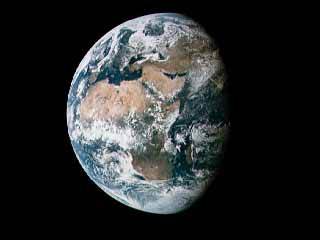
"The heavens are declairing the Glory of God"
II. Argument From the Anthropic Principle.
The conventional design argument says that :A. Universe contains Order, Complexity, functinality and Fitness1) The universe is based upon order, complexity, functionality, and fitness.
2) These qualities imply intelligent design, since only a mind can plan for such qualities
3) Design implies a Designer.
This argument is usually dismissed because we do not have an undesigned universe to compare our universe to; thus we are begging the question, what we call "order and complexity" is merely the way things turned out, and what we think is intelligent designed is merely infurence drawn from brute facts. Moeover, when pressed with the exactitude of percision in the universe the sekptic will say "but that is just assuming teleological ends where there are none, given infinite chances this will result." But new evidence has been so overwhealming even fmaous skeptics like Paul Davies author of God and The New Physics, have become believers based on of all things the new design argument. Davies new book is called The Mind of God. He states:
Max Planck (1858-1947), Nobel Prize winner and founder of modern physics. 5"According to everything taught by the exact sciences about the immense realm of nature, a certain order prevails--one independent of the human mind . . . this order can be formulated in terms of purposeful activity. There is evidence of an intelligent order of the universe to which both man and nature are subservient."
"The equations of physics have in them incredible simplicity, elegance, and beauty. That in itself is sufficient to prove to me that there must be a God who is responsible for these laws and responsible for the universe, " said astrophysicist Paul Davies in his book Superforce (1984). The famous Russian physicist, Alexander Polyakov put it this way in Fortune magazine (October, 1986),
Sir Fred Hoyle, the famous British astronomer and agnostic, in The Intelligent Universe ..commented on the cosmological coincidences discussed by Mackie, "Such properties seem to run through the fabric of the natural world like a thread of happy coincidences. But there are so many odd coincidences essential to life that some explanation seems required to account for them."
Paul Davies, Author of God and The New Physics, and The Mind of God, skeptic turned believer due to the new evidence on design. From First Things, Tempelton Award address:
"All the richness and diversity of matter and energy we observe today has emerged since the beginning in a long and complicated sequence of self- organizing physical processes. The laws of physics not only permit a universe to originate spontaneously, but they encourage it to organize and complexify itself to the point where conscious beings emerge who can look back on the great cosmic drama and reflect on what it all means."
"Now you may think I have written God entirely out of the picture. Who needs a God when the laws of physics can do such a splendid job? But we are bound to return to that burning question: Where do the laws of physics come from? And why those laws rather than some other set? Most especially: Why a set of laws that drives the searing, featureless gases coughed out of the big bang toward life and consciousness and intelligence and cultural activities such as religion, art, mathematics, and science?"
DeYoung states:
Old arguments have an uncanny way of returning at a later time with increased strength. Thus after two centuries, Paley's reasoning still applies and is even stronger than before. The chief reason is the discovery of a new "watch" in nature. In fact, not just one watch has been found, but a whole showcase full, all beautifully constructed and running smoothly. This reference is not to literal watches, but instead, to hundreds of carefully balanced equations, constants, and properties of matter! It is further realized that if any of these quantities were changed in the slightest way, the result would be catastrophic. Scientists, in describing today's universal balance, often refer to "astonishing precision," "cosmic coincidences," or a "contrived appearance." This perspective has been summarized in the Anthropic Principle which states that the universe appears to be carefully designed for the well-being of mankind.1, 2
B. Elegance of Universe
The universe is elegant, based upon just a few simple equasions, the equasions which describe the basic laws that allow everything else, the tremendous complexity to fit together in such a way to produce a vast diversity of delicate life. This indicates that the universe is exactly what it needs to be to procude life, in a one shoft chance it "just happened to be" exactly what it needed to be to mold us.
Walter Bradley Prof. Science Texas A & MAs a young physics student in high school, I was surprised and pleased to learn that the many diverse observations in nature find their description in such a small number of simple mathematical relationships such as Newton's laws of gravity and motion or Maxwell's equations of electricity and magnetism. It would probably surprise many of our earliest scientists to discover that today the universe is adequately described by such a small number of fundamental physical laws, represented by simple but elegant mathematical relationships, that they can be easily written on one side of one sheet of paper.1) Coincidence of the Universal ConstantsBradley again:
"One of the remarkable discoveries of the past 30 years has been the recognition that small changes in any of the universal constants produce surprisingly dramatic changes in the universe, rendering it unsuitable for life, not just as we know it, but for life of any conceivable type. In excess of 100 examples have been documented in the technical literature and summarized in such books as the Anthropic Cosmological Principle (1986)".
"Slight variations in physical laws such as gravity or electromagnetism would make life impossible . . . the necessity to produce life lies at the center of the universe's whole machinery and design," stated John Wheeler, Princeton University professor of physics (Reader's Digest, Sept., 1986).
University of Virginia astronomers R.T. Rood and J.S. Trefil conclude their book Are We Alone? ..by estimating the probability of life existing anywhere in the universe to be one in a billion, and thus conclude the existence of life on planet earth, far from being inevitable, is the result of a remarkable set of coincidences.
"If I were a religious man," Trefil wrote in the concluding chapter, "I would say that everything we have learned about life in the past twenty years shows that we are unique, and therefore, special in God's sight." Instead he concludes that life on planet earth is a remarkable accident, unlikely to have been replicated anywhere else in the universe, which his book powerfully argues.
2) Initial Conditions
Bradley:
"Initial condition problems are found in many places in our scenario of the origin of the universe, its development into a suitable home for us, and the origin of life. These initial condition problems have, in fact, grown much worse with the recognition that many critical processes in the origins scenario are nonlinear, and therefore, require particularly precise initial conditions. Trefil and Rood's book cited above mentions some of these problems in detail. I will also discuss, briefly, initial conditions problems having to do with the origin of the universe and the origin of life.
In summarizing this section, it is clear that there does appear to be something unique and special about our home in the universe and our existence in it."
George Messuer,Scientific American."A second trouble spot is the flatness of space. General relativity suggests that space may be very curved, with a typical radius on the order of the Planck length, or 10^-33 centimeter. We see however, that our universe is just about flat on a scale of 10^28 centimeters, the radius of the observable part of the universe. This result of our observation differs from theoretical expectations by more than 60 orders of magnitude. A similar discrepancy between theory and observations concerns the size of the universe. Cosmological examinations show that our part of the universe contains at least IO^88 elementary particles. But why is the universe so big? If one takes a universe of a typical initial size given by the Planck length and a typical initial density equal to the Planck density, then, using the standard big bang theory, one can calculate how many elementary particles such a universe might encompass. The answer is rather unexpected: the entire universe should only be large enough to accommodate just one elementary particle or at most 10 of them. it would be unable to house even a single reader of Scientiftc American, who consists of about 10^29 elementary particles. Obviously something is wrong with this theory. The fourth problem deals with the timing of the expansion. In its standard form, the big bang theory assumes that all parts of the universe began expanding simultaneously. But how could all the different parts of the universe synchromize the beginning of their expansion? Who gave the command?"[explaining problems with the BB for which the new inflationary model is propossed. The first problem listed above--that the universe pops into exitence out of nothing]
"Fifth, there is the question about the distribution of matter in the universe. on the very large scale, matter has spread out with remarkable uniformity. Across more than 10 billion light-years, its distribution departs from perfect homogeneity by less than one part in 10,000..... One of the cornerstones of the standard cosmology was the 'cosmological principle," which asserts that the universe must be homogeneous. This assumption. however, does not help much, because the universe incorporates important deviations from homogeneity, namely. stars, galaxies and other agglomerations of matter. Tence, we must explain why the universe is so uniform on large scales and at the same time suggest some mechanism that produces galaxies. Finally, there is what I call the uniqueness problem. AIbert Einstein captured its essence when he said: "What really interests ine is whether God had any choice in the creation of the world." Indeed, slight changes in the physical constants of nature could have made the universe unfold in a completeIy, different manner. ..... In some theories, compactilication can occur in billions of different ways. A few years ago it would have seemed rather meaningless to ask why space-time has four dimensions, why the gravitational constant is so small or why the proton is almost 2,000 times heavier than the electron. New developments in elementary particle physics make answering these questions crucial to understanding the construction of our world."
Now Messuer is confident that the new inflationary theires will explain all of this, and indeed states that their purpose is to revolve the ambiguity with which cosmologists are forced to cope. The Scalar field is suppossed to explain all of this; but these inflationary models are still on the drawing board. Moreover, he never says where scalar fields come from, what makes them, and indeed never illustrates how they solve the initial problem of where it all came form in the first palce.
REFERENCES on De Young:3) Fire in the EquasionsC. Unified Field Indicates Designed Universe.The laws of physics are proposed by some, as brought out by Furgesson, as constituting a "final cause" in place of God. This view is actually suggestive of an inversion and can be turned around into an argument for the exist of God. Barr states "The more serious problem with this idea of laws of physics as necessary first casue is that it is based on an elementary confussion. At most the laws of physics could be said to be the 'formal cause' of the physical universe, whereas by first casue is meant efficient cause, the cause of its very existancde. Hawking himself asked percisely the right queitson when he wrote 'even if there is only one possible unified theory is it just a set of rules and equasions? What is it that breaths fire into the equassions and makes a universe for them to descirbe? The usual approach of science constutcing a methematical model cannot answer the question of why there should be a universe for the model to describe.' That is decisive--crushing...." (in First Things).4) DESIGN EXAMPLES
a) Proton MassDeYoung again:"First, consider the mass of the proton. Such a property of an elementary particle might at first seem of trivial significance. However, closer inspection reveals that the proton's mass has been exactly chosen to provide both its own stability and that of the entire universe. In contrast, a free neutron (n), a slightly heavier particle, decays to a proton, an electron, and an antineutrino with a half-life of just twelve minutes. Free neutrons simply cannot persist in nature.""However, if the mass of a proton were somehow increased by just 0.2%, then the proton would become the unstable particle. It would quickly decay to a neutron, positron, and neutrino: This second reaction does not occur, but it would if the proton were just slightly heavier. The implications are truly universal. Of chief significance, the hydrogen nucleus is just a single proton. Thus the hypothesized rapid decay of protons would destroy all hydrogen atoms. Furthermore, hydrogen is a major component of our bodies, as well as water molecules, the sun, and all other stars. Hydrogen is, after all, the dominant element of the universe. It is obvious that the proton's mass has been wisely planned to be slightly smaller than that of a neutron, to prevent the collapse of the universe. Also, protons are not subject to the influence of mutation or natural selection. Their physical properties were chosen from the beginning and have not changed."
b) Gravitational Force.De Young:
"A second example of design involves the basic forces of nature. One of these is the law of universal gravitation. According to this law, all masses are found to attract each other with a force F which is inversely proportional to the square of a separation distance, r, between the masses. Discovered by Isaac Newton 300 years ago, this fundamental force holds the universe together. Gravity maintains the moon's orbit around the earth, the earth's orbit around the sun, and also the rotation of the entire Milky Way galaxy.""Scientists have always wondered about the factor 2 in this equation. As Science News put it, this relation "has always seemed a little too neat. Is the exponent some fraction near two, which would be messy but might seem more empirical?"3 In an evolved universe, one would not expect such a simple relationship. Why is the factor so exact; why not 1.99 or 2.001? The gravity force has been repeatedly tested with sensitive torsion balances, showing that the factor is indeed precisely 2, at least to five decimal places, 2.00000. As with the proton's mass, any value other than 2 would lead to an eventual catastrophic decay of orbits and of the entire universe. The gravity force clearly displays elegant and essential design."
c) Strength of Electrical ChargesAttraction and repulsion of electrical charges.
"This Coulomb force also is found to vary as the inverse square of the distance between the charges. Since the electric force is much stronger than gravity, the factor 2 can be measured to a much greater precision than that of gravity. Thus far the electric force distance dependence has been measured as exactly 2, to 16 decimal places: 2.000000000000000! 4 In other words, the factor in the force equation once again remains exactly 2, to the best limits of scientific testing. These "natural" laws such as gravity and electricity might better be called God's laws. They surely reflect His purposeful planning."
D. Objections answered.1) Unified Field = Blue Print of Universe.But, since the unified field was not the product of the explosion of the big bang, or the singluarity, but must have existed prior to the big bang, this speaks of order and complexity at a totally different level; written into the very fabric of the universe. The structures we see around us in nature could be the products of random chance, but they only exist and are possible at all because they follow a higher blue print to the universe that existed prior to the "accident" that caused everything else. How is it that the uniserve was already "formatted" with a blue print of order and coplexity just waiting for the "accident" to happen? What accounts for the blue print? A bigger accident? An infinite regress of accidents?Prof. Walter Bradley, Texas A.&M University:
"For example, if the strong force which binds together the nucleus of atoms were just five percent weaker, only hydrogen would be stable and we would have a universe with a periodic chart of one element, which is a universe incapable of providing the necessary molecular complexity to provide minimal life functions of processing energy, storing information, and replicating. On the other hand, if the strong force were just two percent stronger, very massive nuclei would form, which are unsuitable for the chemistry of living systems. Furthermore, there would be no stable hydrogen, no long-lived stars, and no hydrogen containing compounds.2) From Blue Print to Personal AwarenessAs a second example, if the relationship between the strong force and the electromagnetic force were to vary only slightly, we would not have the quantum energy levels which allow the remarkable conversion of beryllium to carbon (nearly 100% efficient) and the partial conversion of carbon to oxygen. With slight changes in either of these constants, we would have had a universe either rich in beryllium and little, if any, carbon or alternatively, a universe rich in oxygen with no carbon.
Since carbon is unique in its ability to chemically bond with almost all other elements in bonds that are stable but not too difficult to break (playing the critical role of the round pieces in a tinker toy set), it is remarkable that these forces are so precisely tuned to provide carbon in abundance, along with oxygen which is critical in its own right."
The blue print is a structure which allows for the fromulation of structures that allow for great complexity and order. The sturcture begins at a very simple level of the unity of the basic forces that make up the stuff of the unvierse (light, magnatism, gravity, stong and weak force) and moves toward allowing for the formation of atomic structure which mirros the macro structure of the universe within a single atom, and in all atoms, and fomulates molecular structures. IT works at the smallest level (sub-atomic) and at the greatest (the universe itself). This structure also produces personal awareness.Cognative scientists want to argue that our personal awreness is just the result of chemicals and electro magnetic impulses.They are really very far from being able to prove that consciouness is merely epiphenomenal, nevertheless, the order and complexity invovled in producing consciousness gives one pause to think.
Because the blue print (unified field) contains a structure which allows for the development of personally aware beings who can wonder about their own existance, think up ways to sutdy it, and reason about the origins which allow them to posit the notion of God, we can assume that the blue print is the product of a thinking mind which is capable of planning the universe.
1) No undesigned Universe to compare it to.E. Cosmoligical componants to the arguments.The argument is that we are attaching teleological significance to chance events when we infur design, and any arugment about design merely begs the question becasue without an undesigned unvierse to compare this one to, we have no actual proof that it is designed.Paul Davies:Answer: We don't really need one:
"You might be tempted to suppose that any old rag-bag of laws would produce a complex universe of some sort, with attendant inhabitants convinced of their own specialness. Not so. It turns out that randomly selected laws lead almost inevitably either to unrelieved chaos or boring and uneventful simplicity. Our own universe is poised exquisitely between these unpalatable alternatives, offering a potent mix of freedom and discipline, a sort of restrained creativity. The laws do not tie down physical systems so rigidly that they can accomplish little, but neither are they a recipe for cosmic anarchy. Instead, they encourage matter and energy to develop along pathways of evolution that lead to novel variety-what Freeman Dyson has called the principle of maximum diversity: that in some sense we live in the most interesting possible universe."2) Given infinte chances anything can happen"The origin of life and consciousness were not interventionist miracles, but nor were they stupendously improbable accidents. They were, I believe, part of the natural outworking of the laws of nature, and as such our existence as conscious enquiring beings springs ultimately from the bedrock of physical existence-those ingenious, felicitous laws. That is the sense in which I wrote in The Mind of God: "We are truly meant to be here." I mean "we" in the sense of conscious beings, not Homo sapiens specifically. Thus although we are not at the center of the universe, human existence does have a powerful wider significance. Whatever the universe as a whole may be about, the scientific evidence suggests that we, in some limited yet ultimately still profound way, are an integral part of its purpose.""The laws that characterize our actual universe, as opposed to an infinite number of alternative possible universes, seem almost contrived-fine-tuned, some commentators have claimed-so that life and consciousness may emerge. To quote Dyson again: it is almost as if "the universe knew we were coming." I cannot prove to you that this is design, but whatever it is it is certainly very clever."[ First Things: Physics and the Mind of God: The Templeton Prize Address]
The argument is that none of these forces and examples really prove design because given ifinite chances there will eventually be a universe that gets it right, we just happen to be it. Now scientists theorize that there are billions or even an infinite set of alternate universes arising all the time. That gives us the infinite chances.Bradley observes:Answer a): IF the odds are great enough it's obvious the game is fixed.
"Many additional examples could be cited. If I rolled a dice and got a "6," you would not be surprised. If I rolled a dice five times and got a "6," you would begin to be a little suspicious. However, if you rolled the dice 1,000 times and got a "6" each time, you would be certain that there is something funny about the dice. So it is with our quirky universe in which everything has to be just so and is indeed found to be. Hume and others have argued incorrectly that it is not surprising that everything is just so, else we would not be here to observe it. The well known atheist J.L. Mackie (Miracle of Theism, p.141) saw the flaw in Hume's criticism: There is only one actual universe, with a unique set of basic materials and physical constants, and it is therefore surprising that the elements of this unique set-up are just right for life when they might easily have been wrong. This is not made less surprising by the fact that if it had not been so, no one would have been here to be surprised. We can properly envision and consider alternative possibilities which do not include our being there to experience them."Answer b): it is also not clear that this infinite chances argument applies to the unified field argument at all. Without the unified field, or without it set up just right, no universe could ever support anything. Is it produced by the BB or prior to it? Is it the same unified field for all paralell univeres? We don't know, thus we have no way to judge the soundess of the infinite chances argument, but what we can say is it is an obvious blue print and a dead give away on design.
(above objections don't even count against this part of the argument because logical contingency would apply to all universes).1) Universe is logically contingent
Pal Davies: First Things: Mind of God.
"Some scientists have tried to argue that if only we knew enough about the laws of physics, if we were to discover a final theory that united all the fundamental forces and particles of nature into a single mathematical scheme, then we would find that this superlaw, or theory of everything, would describe the only logically consistent world. In other words, the nature of the physical world would be entirely a consequence of logical and mathematical necessity. There would be no choice about it. I think this is demonstrably wrong. There is not a shred of evidence that the universe is logically necessary. Indeed, as a theoretical physicist I find it rather easy to imagine alternative universes that are logically consistent, and therefore equal contenders for reality."2) Contingency of Universe implies Necessary first causeLike the Big Bang, the unified filed seems to come from out of nowhere, a set of universal laws requiring a law giver.
Given this realization, we must also ask in connection with the unified field, why should there be this organization, these "laws" or tendencies already opporative, already forming a universal sysetm, waithing for the stuff of the explosion to fill it, esepcially when they would have to pre-existant and external to the singularity? The natural response would be that the conditions just "happen to exist" but given what Barr says about a pre-existing univeral system that seems to be beging the question, and launching off on the same infinite regress that fails to answer the previous arugments. The continency of the universe implies a necessary cause which is beyond the realm of contingent facts; a first cause which would require no causal explaination, and that we call "God."
1 Carr, B.J. and M.J. Rees, "The Anthropic Principle and the Structure of the Physical World," Nature 276 (April 12, 1979) pp. 605-612.2 Gale, G., "The Anthropic Principle," Scientific American 245 (December 1981) pp. 154-171.
3 "Gravity Very Precisely,"Science News 118 (July 5, 1980) p. 13.
4 Halliday, D. and R. Resnick, 1978. Physics, Part 2. John Wiley and Sons, Inc., p. 609.
5 Barth, A., The Creation In the Light of Modern Science, (1966) Jerusalem Post Press, Jerusalem, p. 144.
6 Thomsen, D.E., "The Quantum Universe: A Zero-Point Fluctuation?" Science News 128 (August 3, 1985) pp. 72-74.
* Dr. DeYoung received his Ph.D. degree in Astrogeophysics from Iowa State University in 1972. He is professor of physics at Grace College in Winona Lake, Indiana, and is also visiting professor of Geophysics in the ICR Graduate School.