APPENDIX 1
The coefficients Ai and Bi in (1) have the form
A1N=-(f0
N+f2N+f4N+f6N+(5/2)f3
N-(7/8)f5N+(57/16)f7N),
A2N=p-2(f1
N-(3/2)f3N+(15/8)f5N-(35/16)f7N),
A3N=-p-2((3/2)f2N+(15/4)f3N+5f4N+(105/16)f5N+(21/2)f6N+(33411/224)f7N),
A4N=-p-4((3/8)f2N+(15/8)f3N+(35/8)f4N+(105/8)f5N+(210/8)f6N+(378/8)f7N),
B1N=g1N+3g2N+6g3N+10g4N+15g5N+21g6N+28g7N,
B2N=-(3/2)p-2(g2N+5g3N+15g4N+35g5N+70g6N+126g7N),
B3N=-(3/8)p-4(5g3N+35g4N+140g5N+420g6N+1050g7N),
where fiN and giN
can be expressed in terms of the partial xN amplitudes.
In the meson - nucleus potential, they
are related to the amplitudes fTlj for the states
of the xN system with total angular momentum j, orbital angular
momentum l, and isospin T by the equations
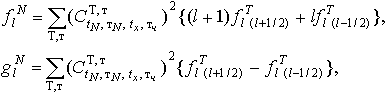 and the relation between the amplitudes fTlj and
the phases b Tlj has the
form fTlj=(exp(2ib Tlj)-1)/2i.
and the relation between the amplitudes fTlj and
the phases b Tlj has the
form fTlj=(exp(2ib Tlj)-1)/2i.
In the NA potential, the quantities
fiN and giN are
related to the amplitudes 2s+1lTj for the
states of the xN system with total angular momentum j, orbital angular
momentum l, spin s, and isospin T by the equations
 where for T = 0 and odd l, or for T = 1 and even l,
flT =(1/2)(2l+1) 1lTl
, glT=0,
and for T = 1 and odd l, or for T = 0 and even l,
flT =(1/2){(2l+3)
3lT l+1+(2l+1) 3lTl+(2l-1)
3lT l-1},
glT=(1/2){[(2l+3)/(l+1)]
3lT l+1-[(2l+1)/l(l+1)]
3lTl-[(2l-1)/l] 3lT
l-1}, g00=0.
The quantities C in the expressions for fiN
and giN are Clebsch- Gordan coefficients,
т is the projection of the isospin
T, and ti and тi;
and the isospin and its projection for particle i. The normalization of
the amplitudes 2s+1lTj is analogous to that
of fTlj.