Pseudoresonance
structures in K+-nucleon
scattering
Ya. A. Berdnikov and A. M.
Makhov
Leningrad Polytechnic Institute
(Submitted 20 June 1988)
Yad. Fiz. 49,1443-1445 (May
1989)
On the basis of recent phase-shift analyses of elastic K+-nucleon
(K+N)
scattering, evidence is obtained for a pseudoresonance character of
the structures in the K+N interaction cross section above
0.8 GeV/c in the states with isospin 0 and 1.
The experimentally observed nonmonotonic dependence in the total cross
section for K
+N scattering is sometimes interpreted as a
manifestation of exotic resonances.' Analyses of the Argand diagrams for the
partial-wave amplitudes usually give P01, D03 , and P13
resonances; however, the contribution of the resonance parts of the
amplitudes to the measured quantities is small, and this leads to uncertainty
in the parameters of these resonances1-4 and to doubts about their
existence.
An alternative interpretation of the peak in the K +N interaction cross
section in the system with isospin I=0 was proposed in Ref. 5. The authors of
Ref. 5 showed that a resonance-like behavior of the scattering amplitudes
occurs if allowance is made for the box diagram with a resonance and a particle
in the intermediate state. They proposed a criterion for distinguishing between
such pseudoresonance features and true resonances by comparing the radii of curvature
of the contours described in the counterclockwise sense on the Argand diagrams
by the scattering amplitude in the forward and backward directions (Rf and Rb, respectively).5
If Rf
>>Rb,
there is a pseudoresonance in the K+N
system; if Rf
and Rb
are similar, there is a true resonance. The analysis of the K +N system in Ref. 5 made use
of the BGRT energy-dependent phase-shift analysis,2,6 which was based
on the poor experimental material of the early 1970s. Subsequently, several
authors3,4,7,8 have reported phase-shift analyses based on more
impressive experimental data. In our work, we have used the 1975 phase-shift
analysis of Martin for the K+N
system with isospin I=
0,1 and the 1985 analysis of Arndt and Roper8 for K +p scattering. The 1984
phase-shift analysis of Ref. 4 is not considered here, since the error in the
determination of the amplitudes in Ref. 4 is large. The 1982 phase-shift
analysis of Ref. 3 also could not be used in the present work, since the
authors of Ref. 3 gave only the Argand diagrams for certain partial-wave
amplitudes without indicating the numerical values of the coefficients of the parametrization.
In Figs.
1 and 2 we show the dependences of the forward and backward scattering
amplitudes which we calculated by using the solutions A, C, and D of
the BGRT parametrization2 and the Martin parametrization7
for the K
+N system with I = 0 (Fig. 1), and also the BGRT solutions (i)
and (iii) of Ref. 6 and the parametrizations of Martin and of Arndt and Roper
(Refs. 7 and 8, respectively) for I = 1 (see Fig. 2). It can be seen that in
the system with I
=1, and not only the system with I = 0, as was noted in Ref. 5, there is a motion
of the amplitudes in the counterclockwise sense with Rf>>Rb. Moreover,
the A and D solutions of the BGRT analvcic for
I
= 0 reveal a rather complex loop structure in the
backward scattering amplitude above 0.9 GeV/c and in the forward scattering
amplitude in the region of 1.3 GeV/c. In the more recent and accurate analysis
of Ref. 7, these details are not confirmed (see Fig. 1).
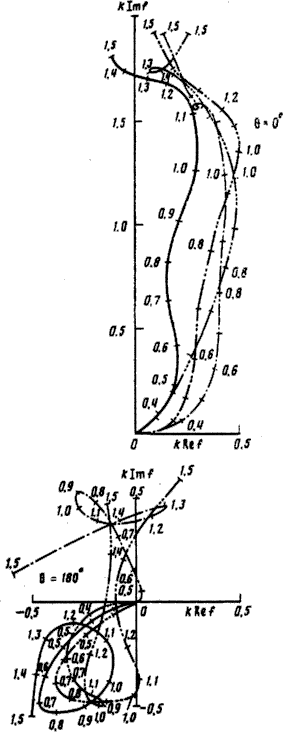
FIG. 1. Argand diagram for the K +N system with I=0. Here θ is the scattering angle. The numbers near the curves give the kaon momentum in the laboratory system in GeV/c. The curves were calculated by means of the following parametrizations: A (chain curves), C (chain curves with two dots), and D (chain curves with three dots) are for the BGRT solutions,2 and the continuous curves are for the Martin solutions.7

FIG. 2.
Argand diagram for the K+N system with I=1. Curves: the chain
curves and the chain curves with two dots are for solutions (i) and (iii), respectively,
of the BGRT analysis,6 and the broken curves are for the solutions
of Arndt and Roper.8 For the remaining notation, see Fig. 1.
Estimates of the ratio Rf /Rb were made
for the K +N system
with I = 0 in the case of the Martin
amplitudes. It was found that Rf /Rb ≈2.2 in the interval
0.9<pL<1.1
GeV/c, in agreement with the result of Ref. 5. For the system with I=1, a
pseudoresonance behavior in the forward and backward scattering amplitudes is
particularly noticeable in the
solution of Arndt and Roper, which was obtained by using the largest amount of
experimental information and which agrees with the energy-independent
phase-shift analysis of these same authors.8 According to our
estimates, the ratio Rf/Rb for
these amplitudes in the region 0.8<pL<l
GeV/c is not less than 4.2. We note that there is no counterclockwise motion
of the forward scattering amplitudes in either of the BGRT solutions for pL >0.8 GeV/c. To all
appearances, this is due to the inadequacy of the experimental data on K +p scattering
which were known when that analysis was performed (1970).
Thus, using the criterion for a pseudoresonance character
of the amplitudes5 and more accurate data of phase-shift analyses of
elastic K
+N scattering, we have found in the present work that
there is evidence for a pseudoresonance character of the structures in the K+N
interaction cross section above 0.8 GeV/c, both in the system with I =0 and in the
system with I
=1.
'C. B. Dover, Meson Nucleon Physics: Proc. of the
Second International Topical Conference at Houston, Texas, 1979 (New
York, 1979), p. 634.
2G. Giacomelli et a/., Nucl. Phys. B71, 138 (1974).
3K. Nakajima etal., Phys. Lett. 112B, 80 (1982).
4K. Hashimoto, Phys. Rev. C 29, 1377 (1984).
5I. M. NarodetskiTand Yu. A. Simonov, Yad.
Fiz. 28,1356 (1978) [Sov. J. Nucl.
Phys. 28, 698(1978)].
6G. Giacomelli et al., Nucl. Phys. B20, 301 (1970).
7B. R. Martin, Nucl. Phys. B94, 413 (1975).
8R. A. Arndt and L. D. Roper, Phys. Rev. D 31, 2230 (1985).