Analysis of the (K+,K+p)
reaction on light nuclei in the intermediate energy region
Ya.A. Berdnikov, A. M. Makhov, and V. I. Ostroumov
Leningrad Polytechnic Institute, USSR Academy of Sciences
(Submitted 4 September 1989)
Yad. Fiz. 52, 76 - 85 (July 1990)
©HTML version from A.M.Makhov.
1997.
On the basis of the distorted-wave
method the integrated cross sections and the diff'erential characteristics
of the (K+,K+p) reaction at the energies 130, 268,
and 480 MeV are calculated. The results are compared with experimental
data. Satisfactory agreement of the theory with experiment is obtained.
1. INTRODUCTION
Analysis of knockout reactions induced by protons
and pions is often performed using various modifications of the distorted-wave
method. The most important among such modifications are the DWIA (distorted-wave
impulse approximation, which has been studied recently in Refs. 1-4)
and the DWTA (the t-matrix approximation, which was suggested in Refs.
5 and 6 and is being actively developed by Vdovin et al. [7,8]).
Other methods [9-13] are also used for
description of knockout reactions, but they are outside the scope of the
present paper.
In the current literature, among the papers which
analyze knockout reactions with protons and pions by the distorted-wave
method, a large place is devoted to various models of the three main quantities
entering into the expression for the matrix element of quasifree knockout:
the distorted-wave functions (DWFs), the t matrix of the
elementary interaction of the incident particle and an intranuclear nucleon,
and the bound-state wave function (the overlap integral F
). The main approximations for the DWFs are either the wave functions of
the phenomenological optical model, calculated numerically using, as a
rule, the Woods- Saxon potential for the nucleons [1]
and a Kisslinger potential for the pions [3,4], of analytic
wave functions for the nucleons [6]. For high-energy nucleons
one sometimes uses eikonal wave functions [14]. In a
number of papers, in order to simplify the computations, the DWFs are obtained
using the strong-absorption model [15,16].
The approximation of factorization of the cross
section [17,18], which appeared in the first versions
of the DWIA, is still used for knockout reactions [16],
but in most papers the t matrix is taken in a separable form,
which does not lead to such factorization. Here one analyses the off-mass-shell
effects [6,15] and the effects of nonlocality
of the elementary interaction [5,6,19];'
there are also different interpretations of the influence of the nuclear
medium on the t matrix [6,20-24].
The models used for the calculation of the overlap
integral F depend strongly on the concrete nucleus.
For light nuclei one uses either the shell model with the Woods - Saxon
potential and spin-orbit coupling [1] or the translationally
invariant shell model [7]. For nuclei lighter than 7Li
it is more suitable to use models that take into account clustering of
the nucleus [7], whereas for heavier nuclei it is apparently
necessary to include the nuclear deformation [25].
There have recently appeared experimental data on
nucleon-knockout reactions induced by a new probe-the positive kaon [26-29].
This makes it necessary to extend the distorted-wave method to reactions
with K+ mesons, which is what we do in the present paper.
Note that in this case in generating the DWFs one must use microscopic
optical potentials, since the experimental information on K+A
elastic scattering is extremely scarce and does not allow one to apply
the phenomenological optical model and the DWTA.
In order to test the applicability of the DWIA to
reactions with K+ mesons we compare the calculated results
with the experimental data on the (K+,K+p)
reaction on light nuclei at the K+-meson energies 480
MeV (Ref. 28), 130 MeV (Ref. 29), and
268 MeV.
2. METHOD OF CALCULATION
The cross section for the reaction
A+x®B+y+z
(1)
in the lab has the following form:
dsfi=|
Tfi|2MxMyMzMBd4(PA+Px-Pz-Py-PB)dpylabdpzlabdpBlab/(pxlab(2p)5EylabEzlabEBlab).
(2)
Here Mi, Eilab, pilab,
and Pi are the mass, total lab energy, lab momentum,
and 4-momentum of particle i; Tfi is the
total matrix element of the transition, which can be represented as a sum
of the matrix elements of direct knockout of a particle y from the
nucleus A and of a two-step process of inelastic scattering of x
by A with excitation into the region of giant resonances and subsequent
decay of A* into B and y. Thus, the squared
modulus of the matrix element from (2) can be written in the following
form:
 where Ty and TA* are the respective
matrix elements of the knockout of y and of the two-step process.
where Ty and TA* are the respective
matrix elements of the knockout of y and of the two-step process.
In deriving the concrete expressions for Ty
in the DWIA we have used the assumptions of Refs.1-4.
As a result, Ty takes the form
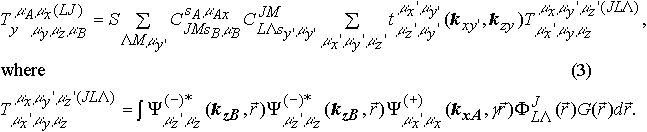 In (3) the quantities si and m
i- are the spin of particle i and its projection,-
S is a spectroscopic factor [30] for separating
a particle y' from the nucleus; C is a Clebsch - Gordan
coefficient; kij is the momentum in the c. m.
s. of particles i and j; the upper indices of the spin projections
pertain to the state prior to the interaction; the lower indices pertain
to the state after the interaction; J, L, M, and L
are the total spin, orbital angular momentum, and their projections for
y'; t is the two- particle xy transition matrix
off the mass shell [31]; Y
+,- (kij) is the wave function of particle
i in the c. m. s. of ij; F is
the overlap integral; and G(r) is a factor which gives the transformation
of Y from the c.m.s. to the lab frame on account
of the time difference of the events in the two frames and which takes
into account the motion of the centers of mass of xA, yB, and zB
in the lab frame in the plane-wave limit. The spin structure of Ty
is illustrated in Fig.1. The wave function has the
following form:
In (3) the quantities si and m
i- are the spin of particle i and its projection,-
S is a spectroscopic factor [30] for separating
a particle y' from the nucleus; C is a Clebsch - Gordan
coefficient; kij is the momentum in the c. m.
s. of particles i and j; the upper indices of the spin projections
pertain to the state prior to the interaction; the lower indices pertain
to the state after the interaction; J, L, M, and L
are the total spin, orbital angular momentum, and their projections for
y'; t is the two- particle xy transition matrix
off the mass shell [31]; Y
+,- (kij) is the wave function of particle
i in the c. m. s. of ij; F is
the overlap integral; and G(r) is a factor which gives the transformation
of Y from the c.m.s. to the lab frame on account
of the time difference of the events in the two frames and which takes
into account the motion of the centers of mass of xA, yB, and zB
in the lab frame in the plane-wave limit. The spin structure of Ty
is illustrated in Fig.1. The wave function has the
following form:

where r' is the result of the Lorentz transformation
of r from the lab frame to the c.m.s. of i and j;  is the direction of the vector n, and Y is a spherical function.
The distorted wave functions Ylj
were calculated using relativistic kinematics and a Kisslinger potential
(see Refs. 32-35). The neutron and
proton densities r n and r
p were taken in the form of a modified Gaussian distribution
[35]. For the nuclei 11B, 13C,
14N, 15N, and 160 which appear in our
calculations, we have set r n=r
p. The parameter of the nucleon distribution was determined
on the basis of the rms charge radius of the nucleus, taking into account
the finite size of the nucleon [25]. The parameter values
for 12C were taken from Ref.35. Since for
light nuclei the shell model reproduces well the density of the ground
state, by calculating the wave function in the present approach we can
avoid the difficulty [1] in removal of the xy'
interaction from the xA potential. To this end it suffices to eliminate
the component corresponding to the knocked-out particle from the density
of the nucleus. In order to reduce the computational load, in the calculation
of the wave functions of the systems xA, yB, and zB
the quantization axes have been chosen along the respective directions
of pxlab, pylab,
and pzlab. The transformation of the
two-particle t matrix to these axes and the inverse transformation
Ty to the experimentally observed projections on the
pxlab axis were performed by the standard
formulas using the Wigner D functions [36].
is the direction of the vector n, and Y is a spherical function.
The distorted wave functions Ylj
were calculated using relativistic kinematics and a Kisslinger potential
(see Refs. 32-35). The neutron and
proton densities r n and r
p were taken in the form of a modified Gaussian distribution
[35]. For the nuclei 11B, 13C,
14N, 15N, and 160 which appear in our
calculations, we have set r n=r
p. The parameter of the nucleon distribution was determined
on the basis of the rms charge radius of the nucleus, taking into account
the finite size of the nucleon [25]. The parameter values
for 12C were taken from Ref.35. Since for
light nuclei the shell model reproduces well the density of the ground
state, by calculating the wave function in the present approach we can
avoid the difficulty [1] in removal of the xy'
interaction from the xA potential. To this end it suffices to eliminate
the component corresponding to the knocked-out particle from the density
of the nucleus. In order to reduce the computational load, in the calculation
of the wave functions of the systems xA, yB, and zB
the quantization axes have been chosen along the respective directions
of pxlab, pylab,
and pzlab. The transformation of the
two-particle t matrix to these axes and the inverse transformation
Ty to the experimentally observed projections on the
pxlab axis were performed by the standard
formulas using the Wigner D functions [36].
The overlap integrals F
were calculated for the Woods- Saxon potential with spin-orbit coupling.
The depth U and the radius c at half-maximum of the potential
were chosen so as to reproduce correctly the nucleon separation energies
from C, N, and 0 as well as the rms radii of the nuclei as
determined by electron scattering. The diffuseness a and the spin-orbit
coupling constant  were kept fixed. The parameter values used and derived are presented in
Table I.
were kept fixed. The parameter values used and derived are presented in
Table I.
The two-step mechanism is regarded as a process
of inelastic scattering of x by A with formation of an excited
nucleus A* of mass M * and its decay
through the level e0 in the model
of complex energy. Here we take into account the spin structure of the
intermediate states (see Fig.2). As a result, the following
expressions are obtained:
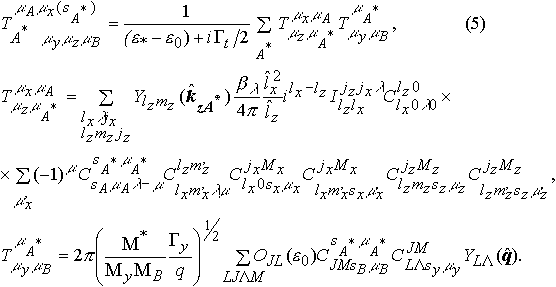
Here q= (2m yBe
*)1/2,  =(2J+1)1/2,
e* =M*-MA,
mij- is the reduced mass of
particles i and j, bl
is a deformation parameter, l is the orbital
angular-momentum transfer, q is the relative momentum of y
and B in their c.m.s., and Gt
and Gy are, respectively,
the total width of the level e 0
and the width of its decay with emission of y. The normalization
condition for the coefficients OJL is
=(2J+1)1/2,
e* =M*-MA,
mij- is the reduced mass of
particles i and j, bl
is a deformation parameter, l is the orbital
angular-momentum transfer, q is the relative momentum of y
and B in their c.m.s., and Gt
and Gy are, respectively,
the total width of the level e 0
and the width of its decay with emission of y. The normalization
condition for the coefficients OJL is
S |OJL|2=1.
JL
The quantities OJL can affect considerably the calculated
results in the case in which the final polarization states are fixed. For
the results obtained in the complete geometry and summed over the spin
states the influence of OJL is insignificant. Our estimates
support this observation. Therefore, in the calculation we have included
only one decay mode and have set OJL=l. Our analysis
shows also that the phase of OJL has little effect on
the results. The quantities I in (5) have the following form:
 where the expressions for
I1-6 can be easily obtained from the expressions (7)
of Ref.37 by making the index replacements l®lx,jx,
l’®lz,jz and
making the replacement l®lx
in the arithmetic expressions; the expression for I6
has the form
where the expressions for
I1-6 can be easily obtained from the expressions (7)
of Ref.37 by making the index replacements l®lx,jx,
l’®lz,jz and
making the replacement l®lx
in the arithmetic expressions; the expression for I6
has the form
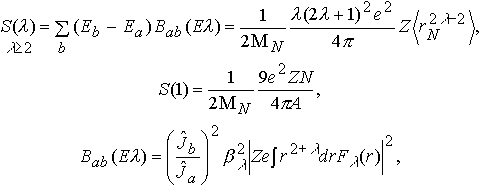
where Fl is the
nuclear transition form factor [37], the quantities Ai
and Bi are the coefficients in the expression for the
xA scattering potential (see Refs. 32 - 34),
 r (r) is the nucleon distribution in the nucleus,
and Uc is the Coulomb potential. The normalization of
Y lj(+,-) in (3),
(4), and (6) corresponds to taking the total wave function
of xA scattering in the form exp(ikijrij)
when Uij=0.
r (r) is the nucleon distribution in the nucleus,
and Uc is the Coulomb potential. The normalization of
Y lj(+,-) in (3),
(4), and (6) corresponds to taking the total wave function
of xA scattering in the form exp(ikijrij)
when Uij=0.
For concrete calculations of the matrix element
of the two-step process we have used a model in which the giant resonance
of a given multipolarity is described by one broad level, since the use
of a set of experimentally observed levels would lead to a large number
of unknown parameters (the relative phases of the matrix elements) and,
hence, to growth of the inaccuracy of the calculation of TA*
and to underestimation of the contribution of TA* to
the total matrix element. The reason for this is that, as estimates show,
for most of the experimentally known levels of the nuclei under consideration
[38] the contribution to the energy- weighted sum rules
(EWSR) is very small. The only exception is the giant dipole resonance
(GDR) in 160, where the contribution of the known levels considerably
exceeds the EWSR.
Analysis of the existing data [38]
shows that in decay of states characterized by large excitation cross sections
(the excitation cross sections are gauged by their electromagnetic widths)
[39,40] an appreciable nucleon yield
can be expected only in 12C and 160, wheras for 14N
the experimental information is considerably poorer and the nucleon yield
is small. For this reason, and also making use of the fact that the concentration
of nitrogen nuclei in the emulsion is small (it amounts to 12% if the total
concentration of 0, N, and C is taken as 100%), one can expect that elimination
of the two- step process on 14N from consideration would not
affect the results appreciably. Thus, in the present calculation of the
matrix elements of the two-step process we take into account the transitions
to the states 1-, 2+, and 3- in the nuclei
12C and 16O. The values of the mean energies e0
and widths Gt for the 2+
and 3- levels of 160 are taken from Ref.
41, and those for the 1- and 2+ levels of 12C
from Ref. 42. For the octupole resonance in 12C
we take the parameters e0 and Gt
of the concrete level observed in (p, p') scattering [38].
We assume that the given states exhaust 100% of the EWSR. This allows us
to obtain the deformation parameters bl
for calculating the transition form factor Fl(r)
from the following expressions [39, 43-47].

where Fl(r)=-r¶r/¶r
for the modified Gaussian distribution in the collective model [37]
and Bab(El
) is the reduced probability of the transition of multipolarity l
from the state a with energy Ea to the state b
with energy Eb. For the proton widths of the given levels
we take the quantities Gp
characteristic of the states of the given multipolarity from the spectra
of 12C and 160 from the tables in Ref.
38. For the GDR in 160 the parameters e0,
Gp, and <Gg
> were obtained by averaging over seven actual states with the largest
values of GpiGg
i /Gti
using the formulas
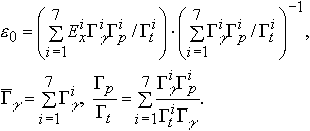 The parameters of the actual averaged levels are given in Table
II. The quantity Gt is
obtained by means of a Breit- Wigner approximation for the sum of the cross
sections of the seven levels. It should be noted that the value of e0
obtained in this way coincides with the position of the GDR found experimentally
in (p, p') scattering [42], but the level used
by us turns out to be somewhat broader. The deformation parameter bl
of a given state is obtained using the expressions [39,44,46,47]
The parameters of the actual averaged levels are given in Table
II. The quantity Gt is
obtained by means of a Breit- Wigner approximation for the sum of the cross
sections of the seven levels. It should be noted that the value of e0
obtained in this way coincides with the position of the GDR found experimentally
in (p, p') scattering [42], but the level used
by us turns out to be somewhat broader. The deformation parameter bl
of a given state is obtained using the expressions [39,44,46,47]
 whence, taking into account the form factor, we obtain
b12=3p<Gg
>/16Z2e2e
03<|rN|>2.
The parameters determined in this way are presented in Table
III.
It should be noted that use of the form factor of
the collective model can lead to underestimation of the contribution of
dipole resonances. Monopole transitions and transitions of multipolarities
higher than 3- are not included for the following reasons:
(a) for monopole transitions there is no reliable
experimental information [38], and the results of Refs.
48 and 49 show that the cross sections
for excitation of the known 0+ levels of 12C are
considerably smaller than the cross section for inelastic scattering with
excitation of the 2+ and 3- levels.
(b) transitions of multipolarity higher than 3-
give, apparently, a small contribution to the matrix element of the two-step
process, since the giant octupole resonance already accounts for less than
20% of the total matrix element of the two-step mechanism.
However, neglect of these transitions can also lead
to a certain underestimation of the contribution TA*
to the total matrix element. All this must be borne in mind in comparing
the calculations with the experimental data.
TABLE I. Parameters of the potential
of the bound state of the p proton used in the calculation.
|
Nucleus
|
U, MeV
|
c,F
|
a,F
|
, F2
|
rms, F
|
|
C
|
50.84
|
3.38
|
0.63
|
0.28
|
2,306
|
|
N
|
40,25
|
3,47
|
0.63
|
0,28
|
2,40
|
|
0
|
41.16
|
3,85
|
0.63
|
0.28
|
2.,589
|
TABLE II. The levels [34]
used in obtaining the GDR parameters for 16O.
|
i
|
Exi, MeV
|
Gg , eV
|
Gp, MeV
|
Gt, MeV
|
i
|
Exi, MeV
|
Gg , eV
|
Gp, MeV
|
Gt, MeV
|
|
1
|
18.773
|
41
|
0,16
|
0,215
|
5
|
22,89
|
120
|
0,485
|
0,3
|
|
2
|
19.48
|
59
|
0.125
|
0.25
|
6
|
24.07
|
384000
|
0.0002
|
0.55
|
|
3
|
20,945
|
170
|
0.04
|
0.3
|
7
|
25.12
|
600000
|
0.003
|
3.0
|
|
4
|
22,15
|
1000
|
0.36
|
0,73
|
|
|
|
|
|
TABLE III. Parameters of the giant
resonances in 12C and 160 in TA*
(e0 and Gt,
are in MeV).
|
l
|
e0
|
Gt
|
Gp/Gt,%
|
bl
|
e0
|
Gt
|
Gp/Gt,%
|
bl
|
| |
|
12C
|
|
|
|
16O
|
|
|
|
1
|
25.28
|
3.5
|
29
|
0.0698
|
23.44
|
3.5
|
0.15
|
0.796
|
| |
|
|
|
-0.0776
|
|
|
|
|
|
2
|
33,0
|
5.0
|
50
|
0.315
|
25.0
|
2.8
|
30
|
0.279
|
|
3
|
21.65
|
1.2
|
50
|
0.270
|
36.0
|
4.0
|
50
|
0.460
|
Note. For the GDR in 12C we give the deformation parameters
of the proton component (the upper number) and of the neutron component,
since the neutron and proton densities in Ref.32 are
not identical.
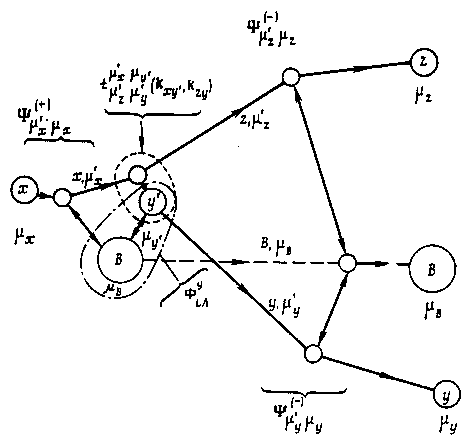 FIG.1.
Spin structure of Ty. Indicated are the interactions
(by two-way arrows between the circles) and the corresponding integrands
in (3).
FIG.1.
Spin structure of Ty. Indicated are the interactions
(by two-way arrows between the circles) and the corresponding integrands
in (3).
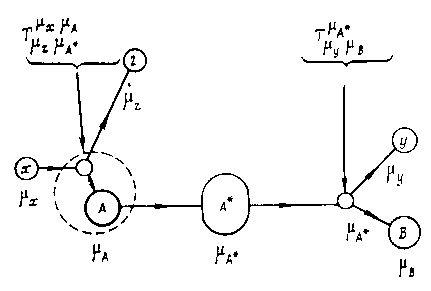 FIG.
2. Spin structure of TA*. The notation is the same as
in Fig. 1. The matrix elements are from (5).
FIG.
2. Spin structure of TA*. The notation is the same as
in Fig. 1. The matrix elements are from (5).
3. METHODS AND RESULTS OF THE EXPERIMENT
The experimental data used in the comparison with
the calculations at the initial kaon energy 268 MeV were obtained by the
method of nuclear emissions. The experimental method was described in Ref.
27. We have identified 630 events belonging to the (K+,K+p)
reaction on C, N, and O. The integrated cross section for
the reaction, averaged over the nuclei, is 12.9±
1.8 mb. We have obtained the following differential characteristics (Fig.3):
the momentum spectrum of the recoil nuclei (a), the energy spectrum of
the protons (b), the distribution with respect to the Treiman- Yang angle
YTY (c), the differential cross section
for kaon scattering (d), the angular distribution of the protons (e), and
the angular distribution of the recoil nuclei (f). We note that, in contrast
to Ref. 27, the differential characteristics are constructed
in the whole region of the momenta transferred to the residual nucleus.
The experimental data at the energies 130 and 480 MeV are taken from Refs.
29 and 28, respectively.
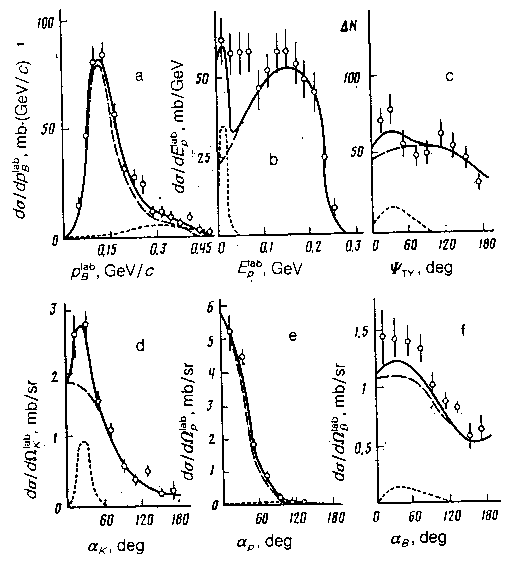 FIG.
3. Differential characteristics of the (K+,K+p)
reaction on light nuclei at the energy 268 MeV. The experiment and the
calculation are from the present paper. The short-dashed curves are for
the two-step mechanism, the long-dashed curves are for direct knockout,
and the solid curves show the full calculation.
FIG.
3. Differential characteristics of the (K+,K+p)
reaction on light nuclei at the energy 268 MeV. The experiment and the
calculation are from the present paper. The short-dashed curves are for
the two-step mechanism, the long-dashed curves are for direct knockout,
and the solid curves show the full calculation.
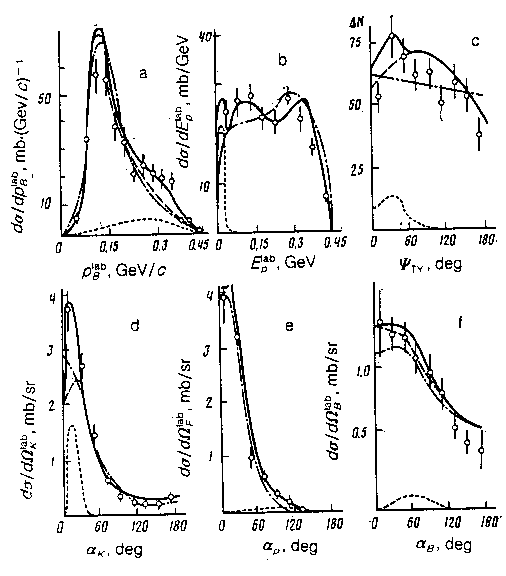 FIG.
4. The same as in Fig. 3, but for the energy 480 MeV.
The circles are from the experiment of Ref. 28, and the
dot - dash curves are the calculation of Ref. 28.
FIG.
4. The same as in Fig. 3, but for the energy 480 MeV.
The circles are from the experiment of Ref. 28, and the
dot - dash curves are the calculation of Ref. 28.
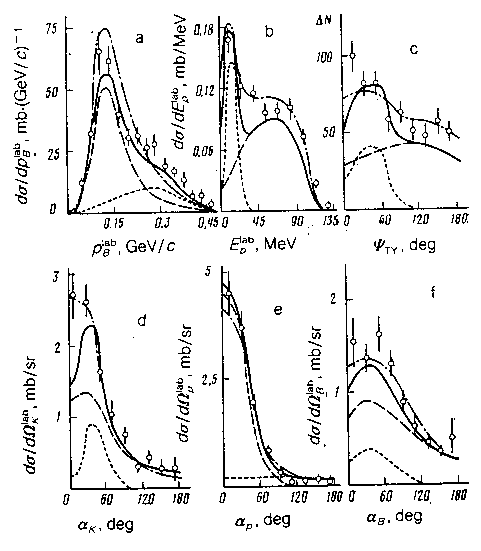 FIG.
5. The same as in Fig. 3, but for the energy 130 MeV.
The circles are from the experiment of Ref. 29, and the
dot-dash curves are the calculation of Ref. 29.
FIG.
5. The same as in Fig. 3, but for the energy 130 MeV.
The circles are from the experiment of Ref. 29, and the
dot-dash curves are the calculation of Ref. 29.
4. RESULTS OF THE CALCULATIONS
Since the experiments of Refs. 26-29
studied the knock- out of 1p protons, in the present paper we have
calculated the knockout of p protons from the nuclei 12C, 14N,
and 160 at the energies 130, 268, and 480 MeV. The results were
averaged over the C, N, and 0 nuclei, taking into account their concentration
in the nuclear emulsion, and are presented in Figs. 3-5.
The calculated contributions of the two-step mechanism and of direct nucleon
knockout, as well as the total calculated and experimental cross sections,
are given in Table IV.
We find that in the full phase space for the measured
quantities there is practically no interference between the two reaction
mechanisms. There is also no interference between multipolarities in the
two-step process with our choice of the parameters of the resonance states.
Note that inclusion of the two-step mechanism leads to improvement in the
agreement between the theory and experiment, especially at 130 MeV. We
also emphasize that the calculations using the present algorithm are compatible
with the experimental data in the studied energy region in the sense of
the c2 criterion with a 5% level
of significance.
Figures 4 and 5
show that at the energies 130 and 480 MeV the results calculated by the
present method and using the diagrammatic technique [28,29]
are similar, though there are some differences in the details.
To conclude, the authors thank A. P. Shishlo and
B. A. Likhachev for help in performing the calculations and in processing
the experimental data.
TABLE IV. Integrated cross sections
for the (K+,K+p) reaction on light nuclei
(in mb).
|
TK+, MeV
|
s theor(y)
|
s theor(A*)
|
s theor
|
s exp
|
|
130
|
6.91
|
2,24
|
9,2
|
12.3± 1.9
|
|
268
|
10.2
|
0.86
|
11.1
|
12,9± 1,8
|
|
480
|
11.0
|
0.77
|
11.8
|
10.1± 1.6
|
-
N. S. Chant and P. G. Roos, Phys. Rev. C 1S, 57 (1977).
-
N. S. Chant and P. G. Roos, Phys. Rev. C 27, 1060 (1983).
-
N. S. Chant, L. Rees, and P. G. Roos, Phys. Rev. Lett. 48, 1784 (1982).
-
L. Rees, N. S. Chant, and P. G. Roos, Phys. Rev. C 26, 1580 (1982).
-
H. G. Pugh et al., Phys. Rev. 115, 1054 (1967).
-
P. C. Wright, R. G. Storer, and I. E. McCarthy, Phys. Rev. C 17, 437 (1978).
-
A.I. Vdovin, A. V. Golovin, and I. I. Loshchakov, Fiz. Elem. Chastits At.
Yadra 18, 1343 (1987) [Sov. J. Part. Nucl. 18, 573 (1987) ].
-
A.I. Vdovin, A. V. Golovin, and I. I. Loshchakov, Yad. Fiz. 45, 1595 (1986)
[Sov. J. Nucl. Phys. 45, 989 (1986) ].
-
V. S. Barashenkov and V. D. Toneev, Interaction of High-Energy Particles
and Nuclei with Nuclei [in Russian] (Atomizdat, Moscow, 1972).
-
Yu. D. Bayukov et al., Phys. Lett. 33B, 416 (1970).
-
V. M. Kolybasov and V. G. Ksenzov, Yad. Fiz. 22, 720 (1975) [Sov. J. Nucl.
Phys. 22, 372 (1975) ].
-
M. M. Sternheim and R. R. Silbar, Phys. Rev. C 24, 574 (1981).
-
R. J. Ellis et al., Phys. Rev. C 26, 1544 (1982).
-
S. L. BelostotskiT et al., in Nucleon-Nucleon and Hadron-Nucleus Interactions
at Intermediate Energies [in Russian], Proc. of the Second Symposium, April
23-25, 1984 (Leningrad Institute of Nuclear Physics, Leningrad, 1984),
p. 445.
-
B.K. Jain and S. C. Phatak, Nucl. Phys. A302, 401 (1978).
-
M. A. Zhusupov et al., Izv. Akad. Nauk SSSR, Ser. Fiz. 50, 178 (1986) [Bull.
Acad. Sci. USSR, Phys. Ser.].
-
N.S. Chant, in Momentum Wave Functions (Second Meeting at Adelaide, Feb.
18-24, 1982), p. 19.
-
D.F. Jackson and T. Berggren, Nucl. Phys. 62, 353 (1965).
-
D.F. Jackson, Phys. Scr. 25, 514 (1982).
-
B.K. Jain and S. C. Phatak, Phys. Lett. 94B, 15 (1980).
-
T. I. Kvaratskhelia and J. V. Mebonia, Phys. Lett. 138B, 257 (1984).
-
J. Cohen and J. V. Noble, Phys. Rev. C 32, 961 (1985).
-
F. Myhrer, Nucl. Phys. A241, 524 (1975).
-
H. J. Ziock et al., Phys. Rev. C 30, 650 (1984).
-
R. C. Barrett and D. F. Jackson, Nuclear Sizes and Structure
(Clarendon Press, Oxford, 1977) [Russ. transl., Naukova Dumka, Kiev, 1981].
-
Ya. A. Berdnikov et al., Yad. Fiz. 42, 564 (1985) [Sov. J. Nucl. Phys.
42, 357 (1985)].
-
Ya. A. Berdnikov et al., Yad. Fiz. 44, 872 (1986) [Sov. J. Nucl. Phys.
44, 562 (1986)].
-
Ya. A. Berdnikov, V. I. Ostroumov, and A. P. Shishlo, Yad. Fiz. 50, 671
(1987) [Sov. J. Nucl. Phys. 50, 416 (1989)].
-
Ya. A. Berdnikov et al., Izv. Akad. Nauk Kaz. SSR, Ser. Fiz.-Mat. No. 4,
73 (1989).
-
A.N. Boyarkina, Structure of the 1p-Shell Nuclei [in Russian]
(Moscow State University, 1973).
-
Ya. A. Berdnikov and A. P. Shishlo, Yad. Fiz. 49, 528 (1989) [Sov. J. Nucl.
Phys. 49, 330 (1989)].
-
Ya. A. Berdnikov and A. M. Makhov, Deposition to VINITI (All- Union Institute
of Scientific and Technical Information) 10.08.88, No. 6463-B88, Leningrad
(1988).
-
Ya. A. Berdnikov et al., in Nuclear Spectroscopy and Nuclear Structure
[in Russian], Abstracts of papers submitted to the 38th Conference (Nauka,
Leningrad, 1988), p. 441.
-
Ya. A. Berdnikov and A. M. Makhov, in Euclear Spectroscopy and Nuclear
Structure [in Russian], Abstracts of papers submitted to the 39th Conference
(Nauka, Leningrad, 1989), p. 429.
-
Ya. A. Berdnikov et al., Yad. Fiz. 49, 995 (1989) [Sov.
J. Nucl. Phys. 49, 618 (1989) ].
-
D.A. Varshalovich, A. N. Moskalev, and V. K. Khersonskii, Quantum Theory
of Angular Momentum (World Scientific, Singapore, 1986) [Russ. original,
Nauka, Leningrad, 1975].
-
Ya. A. Berdnikov et al., Deposition to VINITI, 18.11.86, No. 7831-B86,
Leningrad (1986).
-
F. Ajzenberg-Selove and C. L. Busch, Nucl. Phys. A336, 1 (1980); F. Ajzenberg-Selove,
Nucl. Phys. A360, 1 (1981); A375, 1 (1982).
-
W. B. Cottingame et al., Phys. Rev. C 36, 230 (1987).
-
K. W. Jones et al., Phys. Rev. C 33, 17 (1986).
-
H.V. Geramb and D. Eppel, Z. Phys. 261, 177 (1973).
-
H.V. Geramb et al., Phys. Rev. C 12, 1697 (1975).
-
G. R. Satchler, Phys. Rep. 14, 97 (1974).
-
K. Warburton and J. Weneser, in Isospin in Nuclear Physics, edited by D.
H. Wilkins (North-Holland, Amsterdam, 1969), p. 173.
-
M. Spicer, Adv. Nucl. Phys. 2, 1 (1961).
-
P. Davidson, Pure Appl. Phys. 29, 112 (1968).
-
H. Goldhaber and E. Teller, Phys. Rev. 74, 1046 (1948).
-
R. De Leo et al., Phys. Rev. C 28, 1443 (1983).
-
K. Honoso et al., Phys. Rev. C 30, 746 (1984).
© Translated by Gregory Toker