Miniature University Workshop: Spring Gardens
Lesson #2
Instructor: Melissa Darnell
Email Melissa with questions: [email protected]
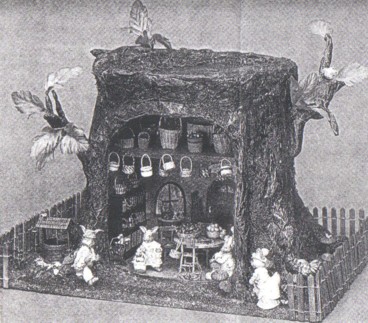
Tree Trunk House
Based on a project by Joann Swanson featured in a Nutshell News Magazine
Materials/Tools Needed:
empty gallon sized ice cream container (for 1/12th scale house; use one quart sized ice cream container for 1/2 and 1/4th scale houses, or a bathroom sized Dixie paper cup for 144th scale house)
1 sheet of foam core board
hot glue gun and low temperature glue sticks
black and white newspaper (no color printed pages)
flour
water
extra gallon sized ice cream container to mix in
cinnamon oil (to prevent mold)
gesso or clear acrylic seal
acrylic paints in shades of gray, black, and brown
real sized silk leaves
grass paper (available at hobby/train model shops)
rubber gloves for your hands
1. Using one of the empty ice cream containers as a guide, decide how large you'd like the base for your house to be. You can make it round and only slightly larger than the open end of the container, or a large rectangle that will give you extra room to one side of the house for a garden. Cut your foam core board to your desired size and shape for the base using a sharp craft knife.
2. Turn the container upside down and use a pen to mark off an opening in the side. This opening is how you'll see into your house, so do make it large enough for at least one of your hands to fit through (for decorating purposes later on), but not so big that you don't have any walls left to decorate! Cut this opening out. (Hint: if you'd like to have a large door instead of just an opening, only cut along one side and the top of your opening, then fold the door open along the remaining uncut side.
3. Put your rubber gloves on, then mix up a small batch of paper mache with flour and water until you have a thick creamy consistency. Try to make sure all lumps are smoothed out. You can also add a few drops of cinnamon oil to the mix to prevent mold.
4. Tear the newspaper into short strips (do not cut the strips so that your strips will have nice ragged uneven edges). Coat the entire outer and inner surfaces of the ice cream container with the paper mache mix, then dip a strip of newspaper into the mix and cover the container with it. Repeat many times with more strips of newspaper, making sure to apply the strips in a disorganized fashion (to prevent any visible patterns from forming), until the entire container has been covered with one layer. If your house has the hinged door instead of a plain opening, be sure to avoid covering the folded hinge of the door, or your door will NOT open and shut later on! You'll also need to cover the door; don't worry if the strips slightly overhang the edges of the door. As long as these strips don't stick to the main part of the house, you can cut and sand the edges of the door and door opening smooth later on. Also be sure to stop every 30 minutes or so to dry the surface of the covered container using a hair blow dryer. Then apply another coating of the paper mache mix over the first layer of strips, then apply a second layer of strips over the container's surfaces.
5. To create a realistic looking "tree trunk" surface for the outside of your container, take about a third of a sheet of newspaper and crumple it into a long snake shape (do not roll the paper to achieve this shape). Soak the roll briefly in the paper mache mix, then paste it onto the side of the container vertically. Shape this root so that it spreads out gradually at ground level, continues out onto the base, and the end tapers and blends into the base. Repeat this step so that your house has roots every 2-3" inches apart (for 1/12th scale houses, smaller scales should make smaller roots using less paper and should space the roots closer together over the smaller container you are using). Be sure to add another "root" to curve over the opening of the house as well for a more natural look.
6. Add more strips of newspaper dipped in the paper mache mix to cover over and blend the edges of the roots into the tree as needed.
7. To create limbs for your house, use smaller crumpled root shapes of newspaper soaked in the paper mache mix to form short main branches, and use even smaller soaked crumbled newspaper pieces for short limbs to attach to the main branches. Use short soaked newspaper strips to attach the smaller limbs onto the main branches (use pictures of a real tree for ideas on how to position limbs), then attach the main limbs to the sides of the house using wads of soaked paper for support and short soaked strips of newspaper wrapped around the end of the branch where it attaches to the house.
8. Help your house finish drying by baking it in an oven at 200 degrees Fahrenheit for an hour or so.
9. Once your house has been dried and cooled off, paint the entire house with branches a medium brown color on the outside and a soft gray or tan color on the inside (if your house features the hinged door, you'll need to cut and sand smooth the edges of both the door and the door opening first, then paint the house and be sure to paint the edges of the door and opening as well). Let dry.
10. Use a slightly darker gray or tan color of paint to stipple over the inside of the house ("stipple" means to bounce the end of the paintbrush over a surface for a spotted, mottled effect). Coat the outside of the house with black or dark brown paint, then wipe this coat off the sides and limbs in a vertical motion to create vertical streaks on the surface. Wipe off the black/dark brown paint on the top of the house using a swirling motion to give the look of "tree rings" like a real tree would have that has been cut in half.
11. To add leaves to the small limbs on your house, use silk leaves (smaller scaled houses will need leaves in an appropriate size to match). Hold the limb with one hand, then gently poke the leaf stem into the limb with your other hand to create a small hole. Remove the limb, add a dab of glue to the end of its stem, then replace it back into the hole you just created.
12. Coat the foam core base with a heavy coat of white/school glue, then cover it with the grass paper, smoothing out any bubbles as you go. Weigh the paper down using a large heavy book for a few minutes while the glue sets.
13. Hot glue your house to the foam core base, then add any sidewalks that you choose. You can create quick and easy paths using glue coated with sand, dirt, tiny gravel or fish tank pebbles, or you could create a brick or stone walkway using Dori Hatfield's Egg Carton Stone Flooring project in our archives (click here to see this project). Another really whimsical idea for stepping stones is to use actual thin slices cut from a real tree limb (look for a small limb about 1" in diameter for a 1/12th scale house, a 1/2" diameter limb for a half scale house, or a 1/4" diameter limb for a one-fourth scale house). These can be easily cut very thinly using a small hacksaw, then sanded smooth and hot glued in place on the base.
14. If you've left enough room, you can now add a small flower or vegetable garden to the side of the house, a small wishing well, or even have a small swing hanging from one of the branches on the house! Ponds or "flowing" streams would make a nice feature, as well as a gazebo or gardening shed. Benches are always nice too. Look for projects such as cattails, toadstools, and other plants and flowers to be featured later this week that you can add to the outside of your new house as well!
Extra Tips:
Want to create a larger home for your mini characters? Try making your house into a 2-story tree house by stacking a second empty ice cream container on top of the first one. You can use paper tape to help support the second floor above the first (if your containers have larger openings and slope to a narrow bottom) and keep the second floor from falling down to cover the first floor, then treat the two stacked containers as one tall structure while you cover them with the paper mache siding. Rik Pierce has a truly inspiring one shown at his website (click here to see it).
Consider making the top of the house into a sun deck where your mini people can enjoy the sun while eating at a patio table.
Want to add windows in your tree house? No problem! You can either measure and cut the window openings before adding the paper mache siding (avoiding covering these openings with strips, of course) and add the windows last, OR you could do the siding first and then cut out the openings for the windows last.
Steps going up to a loft, second floor, and/or sundeck can be either simple ladders made from popsicle sticks, cardboard staircases inside the house, or for a really dramatic look...try making a curved staircase that is carved out of the outside of the house itself! Banister railings and handrails can be made from real tiny twigs or leaf stems too.
This is a really fun project that even kids can help create (part of the fun is the mess you'll make!). It's a perfect home or shop for miniature mice, fairies, or even wee folk, and just like any miniature building, its possibilities are endless. I hope you have lots of fun in making YOUR tree trunk house, and I hope you'll share photos of your finished project with the rest of us!
Many mini hugs,
Melissa Darnell