
From Fischer and Kasparov
To Leko and Radjabov
CHESS IN THE NEW MILLENNIUM
The new millennium really marked a milestone in the chess world when 16 of the world's top players
squared-off for the first ever Grand Master tournament played in cyberspace.
The tournament was unusual, as the players, who were at different parts
of the globe, played on-line over the Internet. Millions of the usual
online viewers were also treated when the commentaries did not come from
just one place but came shooting from all over the world. The most
sought after commentator that the online viewers clicked on was the 12-year
old Azerbaijani who was in his home in Baku. Some puzzled online
viewers who probably weren't pretty up to date on what's going on in the
chess world inquired on what this kid was doing in the commentary box.
Mig of KasparovChess Online replied, "If you think it's strange having a 12-year-old
commenting on the games of world-class GMs, you've never met Teimour or
seen the games of this under-18 European champion!"
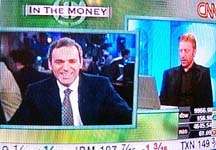 |
Kasparov and tennis legend Boris Becker's
online chess game was televised live in CNN's "In the Money." (AP)
When Boris Becker challenged
Garry Kasparov to an online chess game, young Teimour was the lone commentator.
That duel wasn't just broadcasted live over the internet but in CNN, as well. And just for that event alone, the rest of the world
was finally introduced to the fresh new Prince of the Royal Game.
Becker, the youngest player
ever to win Wimbledon, said he is very amazed by the contrast between young
Teimour's age and his chess skills. There couldn't be a better time
for Radjabov's entry as the sporting world just saw the world's top youth player Peter Leko bid goodbye to youth tournaments when he pulverized the reigning
World Champion Alexander Khalifman no less, in the first major match of
the year 2000. It's sad the world championship is no longer contested
the way it had been for more than a hundred years. Otherwise, Leko
would've broken Kasparov's record of being the youngest champion ever. Nevertheless,
this victory signaled that Leko is definitely more than ready to play at
the highest levels of chess full time.
 |
Peter Leko, the world's no.1 youth,
humiliated World Champion Alexander Khalifman, 4.5-1.5 in their "Millennium
Match" duel. (AP)
If you haven't heard, immediately
after Leko's rousing victory, KasparovChess invited the top 8 of the best
junior players in the world today to play for the coveted title of the
world’s strongest player. This also happened to be the first ever
chess tournament played in cyberspace. The world’s youngest grandmaster,
14-year old Bu Xiangzhi and Teimour Radjabov of course, were among the
participants of the event and the top seeds. It's amusing to note
how comfortably these kids faced a computer that represented their opponent,
notwithstanding certain technical faults, compared to the adults who participated
in the said GM tournament 2 weeks after.
Vladimir Belov, the Russian
prodigy and 3rd seed of that event, also happened to be a correspondent
for KasparovChess. Let's take a look on how he reported the result
of the tournament from these excerpts:
"The KO system of the competition
made it even more acute. In the first round I had to play a Spanish
chess player Jimenez. This match appeared to be rather easy for me. The
result of the battle was predetermined in the very first game, where I
managed to win with Black. In the second round I was to face a serious
adversary: the rating favorite, the talented 12-year-old Azerbaijani international
master Teimour Radjabov. Frankly speaking, he was even stronger than I
had expected. In the first game I had to surrender on the 45th move. Alas,
my hopes for revenge in the second game were not fated to come true. Radjabov
forced a draw with a perpetual check. Just as I had expected, he easily
defeated the Chinese chess player – Bu – in the final round."
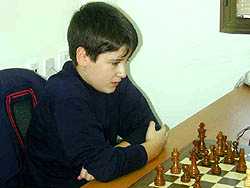 |
Teimour Radjabov had already won 7
World and European Youth Championahips including the tough European Youth
under-18 Championship before turning 13 years old. (AP)
Young as he is, Teimour Radjabov
is already a 7-time World and European Youth Champion. After
winning the World Youth under-10 and under-12 Championships, he felt
or he knew he could take on the older and best youths of the world today
and competed in the very tough European Youth under-18 Championship.
At the playing hall in Litohoro,
Greece (famous for the Greek castles and Mt. Olympus), Teimour looked liked
an elf battling the 69 other players. Everyone was shocked on how he dispatched
one opponent after the other. Even more stunning was how easy and
effortlessly it seemed for him. Here the chess world realized they
are looking at no ordinary prodigy. This is a boy who will, almost
certainly, someday be ranked amongst the likes of Botvinnik, Fischer, Karpov
and Kasparov.
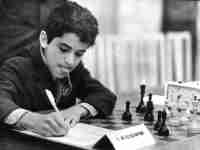 |
Garry Kasparov won the 1976 USSR Youth
under-18 Championship at 12 years of age. (AP)
To those old enough, their
memories flew back to 1976 in Tbilisi when Garry Kasparov won the USSR
Youth under-18 Championship. He was also only 12 then. Oleg
Privorodsky, Garry's first coach, recalled that event as "the most memorable
moment in my chess life. I was very happy and I will always remember that
great moment."
Like Kasparov, Teimour also
hails from Baku, Azerbaijan. When asked what characteristics do Kasparov
and Teimour Radjabov share, Privorodsky said, "Talent from birth. Garry
was a very unusual child. His talent was inclusive of his strong desire
to study chess. He constantly studied chess. It was impossible to speak
with him on any topic not connected with chess. I was amazed at his memory
and strong desire to study chess. Maybe it was intuition, I don’t know."
"I also knew Teimour and
Teimour’s dad very well. I was the coach of Boris Sheinen – dad of Radjabov.
At that time Boris didn’t show significant results. When I left the country,
Teimour was very small but he had already showed himself as a young chess
star," Privorodsky recalled.
And what does he think are
are the most important factors in teaching chess to young kids such as
Garry Kasparov and Teimour Radjabov? "The creation of good conditions is
necessary for the nurturing of young talent," he said. "For example,
Garry was in the Botvinnik correspondence chess school and several times
a year he visited this school to receive lessons there. We also gave Garry
an opportunity to take part in international tournaments. For example,
we sent him to France and as I remember, he took third place. Garry also
took part in many Soviet tournaments. The sports association, “Spartak,”
arranged a scholarship for Garry," he elaborated.
He said also added that Garry’s
mother also had great influence on Garry and helped him very much. She
provided for his participation in all possible chess tournaments. She tried
to open all the doors for Garry. She contributed a great deal to Garry’s
maturity in chess. Thanks to her, he said "I taught Garry individually
at his home for a year and the House of Young Pioneers paid me for it."
"Of course, Garry was a very
talented boy, but I don’t know what would have happened to him without
such strong support," was the point he emphasized on.
When Kasparov was in
Teimour's age, Mikhail Botvinnik, the only 3 time World Champion in history, predicted
Kasparov's great future. "In the hands of this young man, lies the future
of chess," he declared. Garry then grew up attending Botvinnik's chess
school. Perhaps when KasparovChess invited Radjabov to fly over to
their headquarters in Israel to play some matches and participate in the chess clinic
Kasparov himself organized, it was Garry's way of saying he wants Radjabov
to follow his footsteps.
Bobby Fischer, the "Chess Player of the Millennium,"
finds refuge in Budapest, Hungary. (AP)
 |
Several years ago, the world
saw shades of Bobby Fischer in Peter Leko when Peter became the youngest
ever grandmaster in history surpassing Fischer's feat. Today,
of course, the world sees not little but so much of Bobby Fischer in Peter
Leko after it was reported Leko regularly visits Fischer who now resides
in Budapest, Leko's hometown. Kasparov couldn't hide being irritatated
by this news when in an interview, while in the middle of explaining the
complexities of his game with Leko, he suddenly blurted out, "As far as
I know, he keeps in touch with Fischer!"
Garry is still obviously
bothered that Fischer, and not him was declared the "Chess Player of the
Millennium." Well, Kasparov has indeed surpassed everything that
Fischer achieved. Yes it's true, there's nothing more to accomplish
to prove his superiority over Fischer. Nothing -- except to challenge
Fischer himself in a real game. Only then will he convince everyone.
Not all people believe that one's superiority over the other can
really be measured by the number of tournaments won or by ratings alone.
And if he indeed, plans to challenge Fischer afterall, he should not
wait until Bobby grows really old or everyone will simply think he
really intended to wait for Bobby's mind to wane.
Chess fans really feel they've
been robbed of what was meant to be the greatest chess match in history.
But perhaps, their duel was really never meant to be. At this moment
in time, their match isn't just the one the chess world was deprived of.
Nobody realizes it yet but it could have been a pleasure to see Peter and
Teimour play each other while they were still considered both as--
kids.
Who knows, maybe in the future,
their rivalry will unfold and its fate's way of paying us of the Fischer-Kasparov match we were all deprived of. The way everything's been
going, we're indeed headed in that direction!
Peter and Teimour have so
much in common besides being child prodigies whose geniuses are out of
this world. The way they exploit their chances are extraordinary.
Leko, who at 13 could already hold Karpov with a draw, looked back
at his childhood and teen years. He said, "I always played in very strong
tournaments compared with my actual level. I was tough enough to stand
the hard tests. I was away from my family. Many boys would have cracked."
Today, well established among the highest rated players in the world, it's
impossible to play in a tournament stronger than his actual level.
Radjabov, on the other hand, had already won what is probably the ultimate
goal of a youth player-- even before his name is allowed to be listed in
the youth rankings. At 12, his name was listed in the boy's rankings.
 |
Peter Leko has been the most dominant
youth player ever in the history of chess. (AP)
One thing that separates Leko
and Radjabov from other players is that they really hate to loose-- to
anybody. Leko's first coach, Tibor Karolyi remembers how Peter cried
one time when he lost a blitz game against him. Leko is now regarded
as the toughest player to beat. Kasparov himself says, "One literally
has to be at one's best to defeat Leko, unless you can surprise him with
some super-novelty."
We had our first chance to
see how Teimour would react in the face of defeat although it was
only a series of 2 friendly rapid games per day against Bu in an ubsurd
one hour to finish time control. Teimour was definitely winning
most if not all of their games, until he realizes that he won't be able
to force the checkmate before his time expires. Suddenly he
panics and makes those careless daredevil moves. After Bu got away
with a draw in the first 2 games, Teimour was like a boy possessed at the
post-mortem looking at what he should have done. The following day,
probably due to an influence of a coach who was assigned for these
games, Radjabov played both games using openings he hasn't tried out yet
and lost both. When they were just playing the opening moves of their
second game that day, Teimour wrote "Stupid Trompowsky" as the name of
his opening on his scoresheet. This really affected Teimour in the
next games. His spirit was broken. Always in the verge of victory
but due more to the state of shock than the time control, Teimour blew
the won games away.
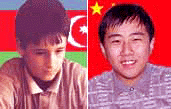 |
Radjabov was in the state of shock
after he lost a series of unrated rapid games to China's Bu. (AP)
Even if this was the same
time control used at the Cadet Grand Prix where he defeated Bu in the finals,
Teimour had already expressed his strong objection against it from the
start. Indeed, for you don't even try to win here-- for material
nor positional advantage usually becomes immaterial-- one must just avoid being
checkmated within an hour. There is no second time control here.
Bu played not to win but to prolong being checkmated for as long as he
can and hope that Radjabov runs out of time first. His ploy worked
indeed. Teimour wasn't able to recover in that series of games for
instead of playing for a win like he naturally does he played not to lose
till the last game. Clearly, Radjabov was in an unfamilliar territory
here. He didn't know how to respond to a lose right away for this
was something new to him. Lucky for him though, this was just experience
learning rapid games.
All players, no matter how
great, sooner or later, experiences defeat. The difference
is that, the great ones become tougher. Leko who lost all 9 of his games
in his very first international tournament says that if that didn't happen,
he might never would've had the motivation to continiously improve and
he won't be as strong as he is today. "My father taught me when I
played football that if they kick me, the best answer is to score goals,"
Leko shared. We'll have to wait how Radjabov responds. Looking
closer at his match with Bu however, one can not help but think that the result would've
been the opposite had they played with the regular time control or even blitz,
as long as it had a second set of time control. "If you haven't noticed,
in the Las Vegas World Championship, all the seeded players went
out in the rapid tiebreaks," Leko observed.
Bu, 2 years older than Teimour,
did not have the impact nor the rousing applause Fischer and Leko had before
when they became the youngest ever Grand Masters in history simply
for 2 reasons. First, the rules on becoming a grandmaster were a
lot more strict then. Today, one's score and rankings at the final
standings of the tournament are no longer the basis of gaining a GM norm.
As few as four rounds will do, even if you loose all the other rounds.
And second, Bu got his last and final norm in his homeland in China playing
his fellow Chinese in a tournament obviously tailor made for him.
Bu lost the first 2 rounds to foreigners then effortlessly won the rest of the rounds against his fellow Chinese.
There's no concrete proof but who wouldn't think those Chinese players simply
threw their game against him so they can make history? GM Ian Rogers of Australia wrote in his weekly column: "Organisers of the tournament no doubt were satisfied at having brought glory to China, yet now may notice people react with a nudge and a wink when he is described as the youngest GM of all time."
Rogers had also featured and discussed "how convincing and smooth Teimour's games are" in his columns.
Going back to the Leko and
Radjabov comparison, though both had an awesome impact on their rise, their
rise in ratings are quite different. Leko is stooping to reach the
top while Radjabov is soaring. Reffered to as the rock of Gibraltar,
Leko slowly but surely forced his way to the top. He already had
a 2530 rating when he became a GM at 14 and then it always kept on increasing
everytime the new ratings are released. Now only 20, his rating is
at an awesome 2735. No other player in history has reached that high
at such a young age-- not Fischer, not even Kasparov. If you haven't
noticed, his rating is only 40 points away from Fischer's
rating which for a long time was believed to be insurmountable until Kasparov
broke it. Radjabov's rating on the other hand, is rising so fast,
that everyone is wondering, specially after losing that unrated series
of games to Bu, how will he take it if, in one instance it dips a little.
Should he trip, let's hope he doesn't fall as high as he soars.
An obvious difference between
Leko and Radjabov is their style of play. Peter is basically a defensive
player, waiting for his opponent make the small mistake before going in for the kill. Just like Karpov
or Fischer. Radjabov is different, he attacks his opponent no
end until his opponents cracks. Like Kasparov, he forces his way to victory.
Interestingly, with the white pieces, Leko usually plays the openings as
Fischer usually does but plays as Kasparov does with Black.
Radjabov's style is the other way around.
 |
Leko and Kasparov, mobbed by the media,
agreed to do their post-game analysis at the press room during the Wijk
Aan Zee tournament in the Netherlands. (AP)
Another difference is their
preference to draws. Leko, can live playing an entire 13-round tournamemt
without a single decisive result. Some players take a chance offering
him a draw when they barely played 20 moves and he'll take it depending on his mood
to play. Once Karpov, playing white made his first move, then offered
him a draw before he could even make his first move. Leko accepted.
At Wijk Aan Zee and Linares, he had quite a number of opportunities he
didn't take to the dissapointment of his fans. Surprisingly it was
Kasparov himself who spoke in Leko's defense, "Anand had a bad position
against Leko; Leko had a won position against Kramnik. I think that
the only explanation of all these draws is in the chess players' mood,
he was not in the mood to give all his got. He was not ready to break
the resistance of their equals." Kasparov couldn't have said it any
better.
Teimour on the contrary hates
draws. Look at how he behaved when Bu got away with draws in their
first 2 rapid games. The KasparovChess correspondents described him
"like a boy possesed." He couldn't put the thought behind him and
it cost him the entire match. Radjabov's aim in a tournament is to
win all his games-- to play the entire tournament perfectly. One
draw ruins everything for him.
So what's going to happen
next? What does the future hold for Leko and Radjabov? Whatever will be will be. The future of chess looks
brighter than ever, though. There is so much to look forward to.
One thing for sure is that destiny is not a matter of chance but a matter
of choice.

 PETER
LEKO Chamber PETER
LEKO Chamber
TEIMOUR
RADJABOV Chamber
The
Realm of The Citadel : SPORTS FEATURES
 THE REALM OF THE CITADEL : MAIN HALL
|