Peter, you were my very first pupil in 1989 when I started to give
chess lessons. Now I start a new job, and once again you are the one I interview
first. Do you think it is coincidence or is it fate? Do you believe in
fate?
P.L.: First of all, I would like
to wish you good luck with your new job.
I hope you still manage to find time to work
with me. I think nothing is accidental;
whatever happens to us has a reason. Though things are more complicated than this. Everybody believes something, even if they don’t want to.
Before talking about your successful match against the FIDE World
Champion, I would like to ask about your career. You have virtually been a
professional chess player since you were 10 years old. Now you are in the
top ten, meaning that you have succeeded with chess. Looking back,
do you see it was necessary to make it? Were there moments when things could have gone wrong?
P.L.: There were several critical moments. I don’t want
to go into details 10 years is such a long period. When you are a
kid, you depend on other people
like your family and trainer. It is very important to get into
good hands. In general, I was lucky, though many things were far from perfect.
I feel young
and I like to think of the future and looking back to the past too
much is
a waste of time.
Let me stay for a short while at your childhood, and tell our readers
about your early years as I remember them. You had excellent conditions for
learning chess. You could always come to train a lot, you could participate
strong tournaments, you got a computer early, and so on. You had a manager-friend
Gaspar Mathe, you had Juergen Daniel, who helped you a lot in Germany.
On the other hand, it took an enormous effort from your mom and from your
family to provide the necessary conditions. Your mom stopped her own career and never finished medical school. I know she still regrets
it, though she said to me not long ago, that it was worth it.
I was happy to
hear it.
P.L.: Yes, I appreciate it, and I am very grateful to
my family for the sacrifice they made. And not only my mother but even
Tamas had to go early to bed
because of me, and I can recall many other examples. Nowadays, I try
give back
something to my family here in Hungary. Of course, I was very lucky
to have
you as trainer. Those days I found it senseless to learn so many openings
and endgames, but now I see it was obligatory. The people you mentioned
did a lot for me indeed.
I have to admit I was cruel sometimes. One thing that underlines
your
qualities; you were able to cope with the main Rauzer and
the main Ruy
Lopez openings at the age of ten. Not all ten-year-olds can learn
the
Gruenfeld with black so young. Also, you lost so many blitz
games against
me-- sometime you even cried. On the other hand, the way you
exploited your chances is extraordinary.
P.L.: Please note that I have never
been broken. I always played very strong
tournaments compared with my actual level. I
was tough enough to stand the
hard tests. I was away from my real family. Many
boys would have cracked.
You always gave what you had to chess and worked very hard.
Recently, I noticed that you are much more interested in and devoted to
chess. Apart from the training time, you did not take care of chess too
much. Now you talk about chess a lot, even in your spare time. Do you agree with me,
and if yes, what made you love chess?
P.L.: That is a very good point.
I can understand that for a ten-year-old,
learning openings and endgames systematically
for six hours every day was not
a joy all the time. In those early stages, you
don’t understand how important
that would be. Now, I train as much as
I want and I enjoy it. When I was
young, I knew that my family in Hungary depended
on my chess. It was bad
and hard that from so early age I had to play
for the living of my family.
I think the opposite. The great responsibility forced you to put
everything into
chess. To be so successful and be in the spotlight a great part
of your life must have affected your personality. How much do you feel its effect
on you?
P.L.: Being in the spotlight is a very pleasant feeling,
at first. People listen to
you even if you say something not very wise. Now I understand that
it goes
with my profession, and I have learned to live with it. I don’t try
to change
the world with my interview, just answer the questions.
You used to try to convince everybody to become a vegetarian;
you don’t
want to influence people that way anymore. My other GM pupil Zoltan
Gyimesi, who also followed the same lifestyle, told me that the
diet is useful
but he had overestimated its effect on chess. What is your comment
on this?
P.L.: When I was together a lot with my former patron
Gaspar Mathe, I was really convinced that changing everything would improve
my chess a lot. Now there is no connection between my diet and my results.
I am still a vegetarian. Now that is the way I live, and I don’t want to
prove anything with it.
You have been very motivated and ambitious as long as I have known
you.
You are still looking very hungry for success, though you could
sit back and enjoy what you have achieved. Do you do something special
to keep up your motivation, or it comes to you naturally?
P.L.: From my childhood, I wanted
to become world champion. I have not
achieved it yet. That keeps me motivated. I am
not looking for short-term
accomplishment. I am ready to work for my goals
step by step.
Is there a difference between how the public and press judge you,
and
how you judge yourself?
P.L.: The press is mainly taking
into consideration results only. The level of
the games should be more important.
Sometimes, the evaluation of my
results can be different. Let me come up with an example. It
was written at
your website that I made modest results at super tournaments.
My answer is
to that to improve my ELO from 2665 to 2735 against the very
best players
of the world requires decent play.
I agree with you. I would like point out that throughout your
career you did very well when you were treated unfairly and with no proper respect.
Unlike most chess players, who could not get rid of the sour memory,
you always kept your concentration on chess and you were able
to drive your energy in the right direction.
P.L.: It comes from my very young
age
when I did not even play chess.
"My father taught me
when I played football that
if they kick me,
the best answer is to score
goals. "
For an ordinary chess player, 2600 players are very strong indeed.
Where do the differences lie between them and a top ten player?
P.L.: The difference exists. All 2700 players were once
2600 players,
but they were good enough to improve.
Can a 2600 player play one game as well as anybody?
P.L.: Yes, Las Vegas was the proof. They were able to
hold the two regular games. On the other hand, I would like to point out
that the best players were eliminated nearly every time in the rapid games.
Well established at the top you must know what it takes to be a top
ten
player. There must be several qualities together: Special
talent is obviously required, good chess education, strong will power and
good fighting spirit
are also needed. Do you agree?
P.L.: All top ten have the qualities you mentioned,
but the proportions in each player are different.
As you get higher and higher in the world rankings, do you feel that
you understand chess better and better or do your opponents seem to make
more mistakes?
P.L.: Hard to tell. Something is
changing, because I started to win more games.
Throughout my career, the more I got used to
a level the stronger I got.
I played extremely strong tournaments very early.
It had good and bad sides as well.
I was not working with when you were around 15. I think it would
have been better to mix those heavy tournaments with some average ones.
P.L.: Definitely, but I managed to stand that big pressure.
When you were young, you said many times that money is not
important. What does it mean to you now?
P.L.: It is important, but I control
it. I don’t let money drive my life.
I need it as well. Now I have a team working
for me. It costs money.
Amador Rodriguez is the main trainer, Arthur
Yusupov has a key role as well. From my countrymen I work with you and
IM Gyula Feher. This is exactly the team I want, and I am pleased. Of course,
my sponsor is the Westfalische
Ferngas I am grateful to them. I have a German
manager, Carsten Hensel.
Things became very professional since we started
to work together.
Let me say, your chess work was always professional.
P.L.: Yes you are right; I mean that by arranging my contracts
and so on,
he is doing a fine work, which I did not have earlier on that level.
Now you are your own trainer, as you make decisions about what to
train on, and what and where to play. When did you become independent?
P.L.: Since we stopped working together in Autumn, 1993 I have
decided
everything myself. Of course, I always consult with my trainers and
listen to their advice.
I find you very disciplined; you have talent for
many things
like table tennis, football, and tennis, but you always knew
when to stop
and kept focusing on chess.
This cleverness is not a usual feature of a youngster.
How do you do it?
P.L.: Well, in the beginning it
was hard. I understood what it takes to be a
professional chess player. The wrestling with
Tamas I missed most
when I was away for long. He understood it as
well. We stopped wrestling when
I was around 13. Those were great fights.
I witnessed some of the bouts. They started friendly but ended up
with your
mom’s intervention. The way she stopped them was sometimes a few
slaps.
P.L.: I compensated with craftiness and I was wiser.
When you were young, you spent so much time with my family that
we considered you a member of our family. In those days, you had
a much
more open personality. Now you are a closed person.
What caused this change?
Is this closeness intentional, or does it come naturally?
P.L.: Yes, I am like that now. I
just had and wanted to try it for a while,
and I realized that this was what I had to do
and is what I like.
I noticed that you take special care to have enough energy for
a tournament. I know you have great inborn fighting spirit. I can recall only
one point in your career that your energy to fight expired and let you down. What makes you worry about it?
P.L.: When I started to play other
big royal guys, I played relatively a lot.
They really pushed me to my limits.
Grandmaster Ribli told me about your game;
something is special in your chess.
Most players play a position according to their own style, while
you are playing according to the position. You attack when it
is required
and you defend when that has to be done.
Do you see it the same way?
P.L.: Yes, I just try to grab the
best chance. I can abandon an opening if I think
that there is no point in continuing to play
it. I pick up a new one if it is needed.
I am open-minded.
The other most influential people for my chess
were you and Adorjan.
I know you always had a very high opinion of Khalifman.
What did you expect from the match?
P.L.: In no way could I think
of a final result like this. I thought that against
such a good theoretician I would face hard times
with Black. I was lucky to get away with my game as Black. This gave me
further energy and I played well
with White and managed to win. The third game,
I was under pressure and just escaped. The whole match reminded me of the
Karpov-Anand 98 match.
The first part was very exiting.
Of course, I am very happy about
my play and with my result.
My philosophy is to take care of
myself in chess and concentrate on it and improve it as much as possible.
Thank you for the interview, I enjoyed it very much.
Good luck in your future tournaments.
As you could tell from the interview, he is a disciplined sportsman.
But even he can’t resist temptation sometimes.
He did not want to play chess on this particular day
in order to rest before a tournament.
He has natural talent out of this world.
But, he is human as well,
and we ended up playing blitz.
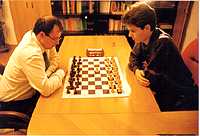
By the way it is quite an experience to play blitz with him
and analyze as well.
I guess the result will not come as a great surprise to the readers.
The KasparovChess correspondent was beaten.
-- Tibor Karolyi