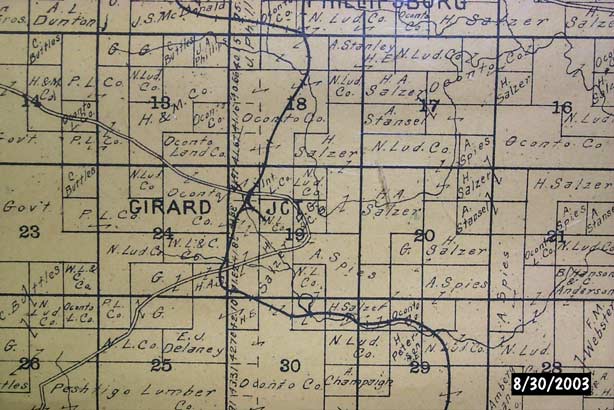
(Information Courtesy of Tim Sasse)
Construction began in late 1888 on a 4 mile line running north from Dunbar to reach the timber of the Girard Lbr Co. The line opened in April of 1889 along with the company’s mill.
By late 1889 the Girard Lbr Co was already kicking around the idea of constructing a line south to Wausaukee to form a connection with the Milwaukee Road. Girard Lbr was dissatisfied with the service that they were getting from the SOO Line and were looking for a second rail outlet for their mill. Nothing came of this, however for the next few years.
For the time being, Girard Lbr operated quietly as a simple logging railroad, operating 10 miles of track by 1892. In that year continued dissatisfaction with SOO Line service to its mill, caused the Girard Lbr Co to incorporate the Dunbar & Wausaukee RR. The D&W would construct a line running south 12.8 miles from Dunbar to a connection with the Milwaukee Road at Girard Jct. giving Girard Lbr a second rail connection to its mill.
Construction of the line did not begin until 1894. One of the biggest obstacles to be overcome was that the SOO would not let the new shortline cross its tracks; a situation eventually resolved by a tunnel under the SOO main about a mile east of town.
Connection with the Milwaukee’s Athelstane Branch at Girard Jct. (about 10 miles northwest of Wausaukee) was accomplished in late 1894 with the cost of construction being $50,000. The line south from Dunbar to Girard Jct. was common carrier trackage, complete with mixed train service.
Relations with the SOO were patched up within a few years and a grade crossing was built at Dunbar eliminating the need for the tunnel under the SOO’s tracks.
Several logging spurs were constructed off of the common carrier Dunbar-Girard Jct. line in addition to those running north out of Dunbar. In 1897, a connection was established with the Holmes & Son RR near Walton in 24 37N 19E. Holmes & Son had trackage rights over the length of the D&W from Walton west and south to Girard Jct. to reach various blocks of timber. This connection was in use until 1900.
All of the spurs along the Dunbar-Girard Jct. main and north of Dunbar seem to have been abandoned by late 1901.
With pine timber nearly exhausted, Girard converted to hardwood cutting in the fall of 1901. To reach company owned stands of hardwood, in 1901 and 1902, the D&W constructed a 10 mile branch running north and west to Popple, located in 6 37N 18E. A new connection was established, on this branch, with the Holmes & Son RR in 24 37N 18E. In 1902, and 1903, Holmes used the D&W’s trackage north and west of that point to reach various stands of timber that it owned in the area. At this time the company is listed as having 23.5 miles of track and 4 locomotives. A 4.25 mile extension was added to the line at Popple in 1903, ending at Camp 3 in 34 38N 17E. Another 5.25 mile westward extension was added in 1905, ending at Fence (Camp 6) in 31 38N 17E. In 1908 a 5.4 mile branch was constructed northward from this line at 28 38N 17E to Camp 7 in 33 39N 17E. This branch was extended 4.1 miles north again in 1910, ending at Fern (Camp 9) in central Florence County. (30 39N 17E) The main was eventually pushed another 5.4 miles west to Camp 13 (6 37N 16E) along the Florence-Forest County line, in 1910. This marked the last expansion of the Dunbar & Wausaukee.
In 1903 the connection with the Holmes & Son Railroad was broken. That company’s line was sold to the Wisconsin & Michigan Railway in 1904. In 1905 the W&M reconstructed a portion of the former Holmes & Son line to Constine, (34 38N 18E) reestablishing a connection with the D&W.
How much of the branches north of Dunbar were common carrier trackage is subject to much debate. The line north of Dunbar to the W&M connection at Constine definitely was. The State Railroad Commission heard cases concerning rates that the D&W charged for hauling freight from Fence, but the Commission stated it had no jurisdiction as this was not common carrier trackage. It seems that despite many lines not having common carrier status, the D&W was willing to carry commodities for others.
Around 1910, the company had 14 miles of common carrier 56# track, 4 locomotives, and 150 cars.
J.W. Wells, president of the Bird & Wells Lbr Co, was also president of the D&W, so there was always close relations between the neighboring logging railroads. Beginning in 1903, B&W’s Wisconsin & Northwestern RR ran west from the D&W main at Phillipsburg, with the W&NW having secured trackage rights between Phillipsburg and Girard Jct.
One time during a rate war Wells was having with the Milwaukee, he was shipping logs from his Wausaukee mill to his Menominee Mich. Mill via the W&NW to Phillipsburg, the D&W to Constine, and then over the Wisconsin & Michigan RR the remainder of the way.
The Dunbar & Wausaukee remained in operation until 1918. The portion of the main that the Wisconsin & Northwestern had trackage rights over became a part of their operations at the time.
In 1891, the Girard Lbr Co pioneered the idea of having a ‘camp on wheels’ in the woods. They had a diner car, sleeper, kitchen, rooming cars, grain, store, and refrigerator cars strung together. This allowed for easy moving of the logging camps from place to place as the location of logging operations shifted.
In 1904 the Girard Lbr Co constructed a shingle mill at Girard Jct. It is unknown how long it remained in operation.