Ancient India's Contribution to Production Technology and Mechanical Engineering |
||
| "Many of the advances in the sciences� that we consider
today to have been made in Europe were in fact made in India centuries ago." - Grant Duff (British Historian of India) � We have been told through Indian as well as foreign literary sources that in ancient times, commodities like sugar, palm oil, coconut oil, cotton cloth, clarified butter, cast iron, tin sheets, copper vessels, dyes and pigments like cinnabar (ochre), indigo and lac, perfumes like sandalwood oil, musk tamarind, costus, macir, camphor, and even crude glass crockery were being exported from India.(The Periplus of the Erythrean Sea - Travelsand Trade in the Indian Ocean by a Merchant in the First Century, Translated from the Greek and Annoted by Wilfred H. Schoff, Longmans Green and Co. New York, 1912) These items are not gifts of nature, their
manufacture involves processing to effect chemical changes in their properties notably in
the case of sugar, glass, metals and perfumes. Thus some kind of chemical engineering must
have existed in India in those times i.e. about 2000 to 2500 years ago. Alongwith this
chemical processing, some physical apparatus would have been used. This presumes the
existence of at least a rudimentary knowledge that in today's terminology would be called
'mechanical engineering'.
The earliest recorded use of copperware in India has been around 3000 B.C. the findings at Mohen-jo-daro and Harappa, bear this out The earliest documented observation� of smelting of metals in India is by Greek Historians in the 4th Century B.C.
No doubt, the chemical and mechanical engineering would have been very rudimentary by today's standards but nevertheless it would have been chemical and mechanical engineering of some standard as is evident from the following references about the quality of Indian products in foreign literature of those times. When referring to India, the author of the Greek text Periplus, which is dated around the 1st century A.D. has said, "There is a river near it called the Ganges" .... "On its bank is a market town which has the same name as the river, Ganges. Through this place are brought malabathrum and Gangetic spikenard and pearls and muslins of the finest sorts, which are called Gangetic. It is said that there are gold mines near these places, and there is a gold coin which is called caltis. And just opposite this river there is an island in the ocean, the last part of the inhabited world towards the east, under the rising sun itself, it is called Chryse; and it has the best tortoise-shell of all the places on the Erythrean Sea"2 The Periplus further states that "Nelcynda is distant from Muziris by river and sea about five hundred stadia, and is of another kingdom, the Pandian. This place also is situated on a river, about one hundred and twenty stadia from the sea." ... "They send large ships to these market towns on account of the great quantity and bulk of pepper and malabathrum. There are imported here, in the first place, a great quantity of coin; topaz, thin clothing," "fine linen, antimony, coral, crude glass, copper,tin, lead; wine, not much, but as much as at Barygaza; realgar and orpiment; and wheat enough for sailors," "There is exported pepper which is produced in quantity only in one region near these markets, a district called Cottonara. Besides this there are exported great
quantities of fine pearls, ivory, silk cloth, spikenard from the Ganges, malabathrum from
the places in the interior,transparent stones of all kinds, diamonds and sapphires"3
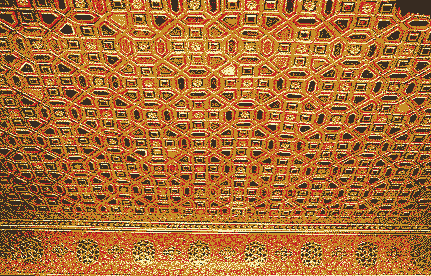
This mirrorwork dates back to to the12th Century A.D. But smelting of metals and derivation of alloys was done since 3000 B.C. in ancient India About other commodities the Periplus says, "The voyage to all these far-side market towns is made from Egypt about the month of July, that is Epiphi. And ships are also customarily fitted out from the places across the sea, from Ariaca and Barygaza, bringing to these far-side market-towns the products" "wheat, rice, clarified butter, sesame oil, cotton cloth (the monache and the sagmatogene), and gridles, and honey from the reed called Sacchari." 4 Thus we see that in a rambling manner, the Periplus refers to the "muslins of the finest sorts," "fine pearls, ivory, silk cloth" "crude glass", "coins", etc'., apart from many other commodities that were exported from India. Other western historians, and traveller-adventurers like Megasthanes, Strabo, Ptolemy, Fa Hien, Huen Tsang, Pliny, Marco Polo, Al Beruni, Ibn Batuta, etc., have also enumerated the various commodities that were produced and exported by India. The following is a list of various commodities that were exported from India in ancient times. The present day English names of most of these commodities have originated from Sanskrit. This list has been compiled from references to India made by Western, Chinese and Arab historians in ancient and medieval ages. (LIst to be included shortly) We shall now have a detailed look at some of these products which were imported from ancient India. We will begin with Perfumes. THE DISTILLATION OF PERFUMES The distillation of scents, perfumes and fragrant liquids and ointments was one area where the knowledge of chemistry was applied in India since ancient times. In fact the very word 'scent' which is of unexplained origin according to the Oxford Dictionary, is possibly derived from the Sanskrit term Sugandha which literally means 'good or aromatic paste'. This word could have been transmitted to European languages through the Greek langua which has borrowed (and lent) many wor from Sanskrit. Other instances of such transmission are the English words li 'cotton' which is derived from the Sanskrit Karpasa or the word 'sugar' derived frc the Sanskrit Sharkara, etc. Many present day perfumes had existed India since ancient times and perhaps had originated here. In ancient times perfumes and fragrant ointments were of two typ viz., Teertha (liquids) and Gandha (slurries or ointments). During the coronation Kings or durlng any auspicious occasion person was sprinkled with aromatic oils. Fragrant ointments based on sandalwood were applied during ceremonial bathing. Even today during some festivals like Diwali aromatic slurries and pastes are prepared out of a powder called Sugandhi. Utne and are used during the ceremonial bath which is taken during that festival. Even in other religious rites, Sandalwood, Ochre and Camphor are traditionally used by Hindus. SANDALWOOD: Since very early times Sandalwood and Sandalwood oil were items of export. The Greek text of the 1st century A.D., Periplus mentions sandalwood as one of the items being imported from India. The word Sandal (wood) is derived from the Latin terms Santalum Album or Santalacae. These terms used by the Romans to describe sandalwood were, according to the Oxford Dictionary, derived from the Sanskrit term Chandana, for sandalwood. The Sandalwood tree is native to India and is found mainly in South-western India in t he state of Karnataka. Sandalwood has been a known item of export from India since ancient times. Authors of Sanskrit texts on botany which in Sanskrit is called Vanaspati-Shastra had classified Sandalwood into three types viz. white sandalwood Shrikanda (which perhaps is an abbreviation of the term Shewta-Chandana ), the second is yellow sandalwood or Pitta-Chandana and the last is red sandalwood or RaktaChandana The reference to Sandalwood in the Periplus is perhaps the earliest available western reference to Sandalwood. It has been mentioned in later times by Comas Indiwpleustes in the 6th century A.D. as Tzandana and thereafter it is frequently referred to by Arab traders. Oil was also extracted from Sandalwood. This oil which was a thick but refined liquid was extracted in specially constructed oil mills called Teyl-Peshani and Teylena-Lip. The oil extracted from these mills was a thick, dark yellow liquid. Alongwith Sandalwood, the Sandalwood oil was also an item of export from India during ancient times. Sandalwood oil was mainly bought by the Romans between the 1st and 3rd centuries A.D. MUSK: Musk is also a fragrant substance which is secreted in the gland by a male musk-deer. Musk is redish-brown in colour and is used as a base for perfumes and also as an ingredient for soaps to give it a musky smell. In Sanskrit, Musk is known as Muska which means the scortum i.e. the pouch of skin containing the testicles of the deer. The English term Musk originates from the Sanskrit term Muska according to the Oxford Dictionary. The Sanskrit word Muska is perhaps derived from the words Maunsa or Masa which means 'flesh'. In Sanskrit, other words used for musk are Kasturi, Kastutrika and Mruga-Nabhi. The last term literally means 'a deer's navel'. TAMARIND: Tamarind is a fruit whose acid pulp is used in the making of cooling or medicinal drinks. The English word Tamarind is derived from the Latin term 'Tamarindus Indica' which is derived from the Arabic term Tamr-Hindi which means 'Dates from India'. The Arabs were familiar with only one form of fruit i.e. Dates, which grow in the desert. Thus when they came across another fruit which they could use in the making of cool refreshing drinks they named it 'Dates from India' Tamr-Hindi; after the country from where they had obtained the fruit. In Sanskrit, Tamarind is called Chincha and Amlica. The latter term is derived from the word Amlica which means acidic. This name is given to Tamarind due to the acidic odour and juice that it has. This fruit was an item of export from India since ancient times. The fact that it originated in India is evident from the name Tamr-Hindi which the Arabs gave it. CAMPHOR: Camphor is a whitish translucent crystalline volatile substance with aromatic smell and bitter taste. It is also used in pharmacy as a medicinal drug. The word camphor is derived from the Latin word 'Camphora' which comes from the Arabic term Kafur, which ultimately originated from the Sanskrit term Karpuram, according to the Oxford Dictionary. The Sanskrit words for Camphor, apart from Karpuram are Hima-Valuka which literally means 'Snow-sand' and Chandraka which means 'like a moon' perhaps because it is whitish and translucent. Camphor was also an item exported from India since ancient times. The Camphor that was exported was not in its natural form but it was refined and cut into strips and square pieces before being loaded for export. That it was mainly obtained from India is established by the fact that the name chosen for this commodity was the corrupted version of the original Sanskrit term. Even today Camphor is used by devout Hindus as an incense during prayer. SPIKENARD: Spikenard was a costly aromatic ointment extracted since ancient times from an Indian plant known in Sanskrit as Nardostachys Jatamansi which perhaps means 'the braid of hair (Jataa) of (Narada). The English word Spikenard is derived from the Greek term Nardostakhus and the Latin term Spica Nardi; both the terms are derived from the Sanskrit term Nardostachys Jatamansi. This plant has purplish-yellow flower heads and is very rarely found. Its smell is quite pleasing and hence it had been in great demand since ancient times. In Sanskrit, other terms used to refer to this plant are, Jatila which means 'difficult', Tapasvini which literally means 'concentration and devotion'. These words used to describe Spikenard indicate that it was very difficult to obtain and cultivate this plant. In India this herb was available only in the Himalayas. Spikenard, which is aromatic and bitter, yields on distillation a pleasant smelling oil. In India, it had been used since ancient times as an aromatic adjunct in the preparation of medicinal oils and was popularly believed to increase th growth and blackness of hair. The Roman historian Pliny observes the Spikenard was considered very precious i Rome and it was stored in alabaster boxes by persons of eminence. Another aromatic herb exported from ar cient India was the Nard. It is a root of th ginger-grass found in western Punjab an Baluchistan. The Nard is found in semi-aril areas and it seems to have been found by Alexander in Gedrosia (Baluchistan) when hi army unknowingly trampled the plant whil on march and this resulted in a sweet pel fume which we are told "was diffused fa and wide over the land by the trampling". The Nard is known in Latin as Cymbopogon Jwarancusa the word Cusa is perhaps de rived from the Sanskrit word Kusha fo grass. The use of the word grass to refer tz Nard is perhaps because of its being confused by the Romans with other aromatic grasses like lemon grass, gingergrass, citronella, etc., which also yield aromatic oils. COSTUS: Costus is the root of the plans Saussurea Lappa, a tall perennial plant growing on the open slopes of the vale or Kashmir and other high valleys of that region. The plant is found at elevations ol 8000 to 13000 feet. It was used by the Romans as a culinary spice as also as a perfume. This root was dug up and cut into small pieces and shipped to Rome and China. The root is generally of the size of a finger wit' a yellowish woody part and a whitish barl It is said that Seleucus Callinicus had ot tained Costus from India and sent it as gift to the Milesians.6 The Romans also re ferred to costus as radix, the root as distirguished from Nard which was called folio the leaf. The price of Costus in Rome is stated by Pliny to have been 5 denarii per pound. India still exports Costus and today the collection of Costus is a state monopoly. In Kashmir the product is used by shawl merchants to protect their fabrics from moths. The Indian origin of Costus is evident from the fact that the word is derived from the Sanskrit term Kustha which means 'that which stands in the earth'. This word was perhaps used as Costus was a root. MACIR: Macir is mentioned by Dioscorides as an aromatic bark. Pliny says that it was brought from India. He describes it as a red bark growing upon a large root, which bears the name Macir from the tree that produced it. He prescribed a mixture of this bark with honey as a cure for dysentery. The word Macir is today neither found in the English nor the Sanskrit Dictionaries but it has been mentioned in the Periplus on pages 80 and 81. -The word Macir has been said to have been derived from the Sanskrit word Makara which in India was said to have been used in ancient times as a traditional Ayurvedic remedy for dysentery. Macir seems to have been the root-bark of the tree Holarrhena Antidysentrica which according to the notes appended to the Periplus was found throughout India and Burma in the lower Himalayas upto 3500 feet. Both the bark and seed of this tree were among the most
important medicines in the Ayurvedic system of medicine. According to the notes to the
Periplus. "This tree found by the Portuguese was called 'Herba malabarica owing to
its great merit in the treatment of dysentery they having found it on the Malabar coast.
The preparation, generally in the form of a solid or liquid extract, or of a decoction, is
astringent, anti-dysenteric an anthelmintic. The seeds yield a fixed oil, and the wood ash
is used in dyeing.'' Thus this commodity which was exported from India in early times had
multiple uses. THE MAKING OF DYES AND PIGMENTS �Many dyes and pigments were extracted in ancient India from vegetable and mineral bases. The Greek historian Ktesias who lived in the 4th century B.C. at the Persian Court has observed that "Among the Indians are found certain insects about the size of beetles and of a colour so red that at first sight one might mistake them for cinnabar. Their legs are of extraordinary length and soft to the touch. They grow upon trees which produce amber, and subsist upon their fruit. The Indians collect them for the sake of the purple dye, which they yield when crushed. This dye is used for tinting with purple not only their outer and under-garments, but also any other substance where a purple hue is required. Robes tinted with this purple are sent to the Persian King, for Indian purple is thought by the Persians be marvellously beautiful and far superior to their own." Ktesias also says that the Indian dye is deeper and more brilliant than the renowned Lydian Purple. �We will discuss some of these dyes which were extracted in ancient India, e.g. indigo, lac, ochre, copal, anline, in the following pages. LAC: Lac is a resinous substance secreted on trees by an insect called the Lac insect. This is used as a protective covering and as varnish on wooden furniture. According to the Oxford Dictionary the English word lac is derived from the Sanskrit term Laksha which itself is derived from the word Raksha which in Sanskrit means protection. This was perhaps as lac was used as a protective covering. Lac was also used as a dye. In ancient times it was used by women for dyeing nails and palms. It was also used to dye cloth. The process of dyeing cloth with lac was termed Vastra-ranga-kruta which literally means 'to give colour to cloth' . In doing this screens were used to hold cloth in place while the dye was being applied. In ancient times, lac was used both as a dye and a resin but with the introduction of aniline, the demand for lac as a dye became less. It is today used mainly as a resin called 'shellac', which is melted into thin flakes and used to make varnish. OCHRE: Ochre is a pigment varying from light yellow to orange and brown. It is a mineral of clay and hydrated ferric oxide. The old name of ochre is cinnabar which was perhaps derived from the Sanskrit term Sindhura. According to the Century Dictionary, the word cinnabar originated from the Persian word zinjafr, which is a corruption of the Sanskrit Sindhura. Ochre (or cinnabar) was used as a dye for cloth and also as a paint for walls in Roman times. In India it was, and still is used to paint images of Gods and as a caste mark applied on the forehead called tilaka. �COPAL: Copal is a resin extracted from a tree which in Latin is named Vateria Indica. This tree is to be found in the Western Ghats (Hills) of India. The word copal is not to be found today in the Oxford Dictionary, but according to the Periplus, " it is derived from the Sanskrit term "Kankamon". ANILINE: This is a blue coloured dye obtained from coal tar. This was being extracted in ancient India and was Transmitted to the west by the Arabs. It was called Neel or Neelam in Sanskrit. The Arabs named it AI Nil or An Nil from which we have the English word Aniline. This is corroborated by the Oxford Dictionary. INDIGO: Indigo is also a blue coloured dye obtained from a plant named Indigofera. In ancient times, indigo was used both as a dye and as a medicine. The word indigo is derived from the Greek word Indikon which means 'from India'. In Sanskrit it is referred to as Neelam. THE SMELTING OF METALS According to information culled out from various Roman and Greek texts, metals like iron, tin, copper and brass were imported from India. These texts say that the metals were not being imported as an ore but as sheets. This presumes that the ore must have been smelted and cast into sheets in India before it was exported. References in Sanskrit literature also support this. According to a Greek writer named Ktesias who lived in Persia in the 4th century B.C., the smelting of metals was undertaken in India in those days. He has written that, "Every year a spring filled itself with fluid gold which was drawn from it in one hundred earthen pitchers. It was necessary that they should be of clay, because the gold afterwards congealed, and the pitchers had to be broken in order to get it out." "Each pitcher contained one talent of gold". On this remark of Ktesias, McCrindle, who has translated Ktesias' writings, has noted that "The sense of this passage can only be that auriferous ores were melted, and that the gold obtained from them was drawn out in a fluid state. That there was a spring, must be a misapprehension, and we must imagine instead that there was a cistern prepared to receive gold."... "If this supposition is right, it follows that the Indians knew how to extract gold from the ore by melting''. �We shall now look into some of the metals that were being exported from India. IRON: �Marco Polo has mentioned that iron and Ondanique was sold in the markets of Kerman in Iran. The word Ondanique has been interpreted as a corruption of the Persian word Hundwaniy which meant 'Indian Steel'. Even earlier, during the reigns of the Roman Emperors Marcus Aurelius and Commodus, Ferrum Indium appears in the list of dutiable articles. There also exists an ancient Greek chemical treatise entitled "On the Tempering of Indian Steel". Edrisi has noted that "The Hindus excel in the manufacture of iron. They have also workshops wherein are forged the most famous sabres in the world. It is impossible to find anything to surpass the edge that you get from Indian Steel". This passage which has been quoted in the notes to the Periplus on page 71 proves beyond doubt, in the words of a foreign historian, that the art of smelting and casting iron was well developed in ancient India. In ancient times, in India, Loha-churna meant iron ore; Kupya- shala and Sandhaani meant an iron foundry'. A furnace was called Chuli or Agnikund. Wrought iron was called Lohabandhan, iron bars were called Loha-pindaha. Smelting of iron was called Loha-drava-Karan (literally, liquefaction of Iron). Loha-chinha meant an iron mould and Lohakaraka meant a smith or ironmonger. TIN: In ancient tunes tin was known as Kassiteros in the Greek language. This word was derived from the early Sanskrit word Kasthira for tin. Even today in some Indian languages tin and aluminium are called Kathila which is derived from the Sanskrit word Kasthira. In ancient India the value of tin for hardening copper was recognised and the art of tempering tin with other metals was developed. The fact is corroborated by the comments of the Greek historians (quoted below in the section on Copper) regarding the excellent tempering of various metals that had been practised in India. �COPPER: Copper has been mentioned in the Periplus as an article of export from India. In those days copper ore was extracted in a big way and it was smelted locally in South India and Rajputana, according to the Periplus. Philostratus of Lemnos, in about 230 A.D. has mentioned a shrine in Taxila in India, in which were hung pictures on copper tablets representing the feats of Alexander and Porus. In the words of Philostratus "The various figures were portrayed in a mosaic of orichalcum, silver, gold, and oxidised copper, but the weapons in iron. The metals were so ingeniously worked into one another that the pictures which they formed were comparable to the productions of the most famous Greek artists''. �In ancient India copper was also known as Tamara, copper plate was called Tamara-Patra. Tamrakar meant a copper smith and Tamara-pana meant a copper coin. BRASS: Brass is not an original metal obtained from natural ore, it is a composite metal found as an alloy of copper and zinc. From the above quotation of Philostratus it is evident that in ancient India the art of welding metals together was known. We cannot conclusively say that Brass (called Pitalam in Sanskrit) was manufactured in ancient India but the fact that their were Sanskrit equivalents for copper (Tamara, Kasthira), zinc (Dasta) an alloy which was called Mishradhatu (mixed metal) Nyunata (novelty) and Dushitaha (impurity) supports the fact that Brass, or a Brass-like metal, was smelted in ancient India. Thus it was recognised that an alloy would be a mixture of metals, that it would be novelty; and that due to the mixing of metals, the resultant alloy would be impure in the sense that it would not be a metal derived from a natural mineral ore. It is possible that brass was used for decorative purposes due to its likeness to gold. Thus we have the terms like Pitalam-Pushpakam, Pitalam Kusuman janam and Pitalam-Pushpaketu which mean efflorescence created from brass. The ornamental use of brass in ancient India is also evident from the quotation of Philosotratus given above in the section on copper. CORUNDUM: This unfamiliar word connotes crystallised aluminium oxide of various colours having great hardness and used as gems and also as an abrasive. We have been told that certain gems were used to cut metals in ancient India, corundum, or Kuruvinda in Sanskrit, was one such gem. Corundum was also exported from India to foreign countries since ancient times. The fact that India was the main source of this item is evident from the name Corundum given to it which according to the Oxford Dictionary is derived from the Sanskrit word Kuruvinda. NOWSHADDER: �This is another unfamiliar term which means chloride of ammonium. This was also being obtained from ancient India. The word Nowshadder is also derived from a Sanskrit root word 'Narasara'. BERYL: �This is a mineral species of a transparent precious stone varying from pale green to yellow in colour. This was one of the items of export from India during early times. The word Beryl is said to have been derived from the Sanskrit term Vaidurya. COPAL: This is an amorphous quartz like form of hydrated silica, some types of opal are semi-translucent and appear like glass. This item is recorded to have been exported in ancient times from India. The English word Opal has been derived from the Sanskrit term Upala a fact which is corroborated by the Oxford Dictionary. THE PROCESSING OF AGRO-BASED PRODUCTS Indians in ancient times had invented methods of extracting oil from agro-products like, coconut, palm, sesame, etc., for doing this, oil presses and oil mills were used. The oil was refined through the use of special sieves. Sugar was also being manufactured. The making of sugar presumed the existence of a process of vaporisation, condensation and crystallisation of sugar alongwith the apparatus like a mill, a sugarcane press, a furnace, etc., Various agro-based products were made in India and exported abroad since the last 2000 to 2500 years. To support this claim we have the observations of foreign historians and also references in Sanskrit literature. A Greek historians named Ktesias whom we referred to earlier and who was a contemporary of Hippokrates, has written that, "There is bred in the Indian river a worm, like in appearance to that which is found in the fig, but seven cubits more or less in length, while its thickness is such that only a boy ten years old could hardly clasp it within the circuit of his arms.'' In this passage Ktesias is obviously referring to the Indian python, he further says that, "For catching this worm a large hook is employed, to which a kid or a lamb is fastened by chains of iron. The worm being landed, the captors hang up its carcass, and placing vessels underneath it leave it thus for thirty days. All this time oil drops from it, as much being got as would fill ten Attic Kotylai. At the end of thirty days they throw away the worm, and preserving the oil they take it to the king of the Indians, and to him alone, for no subject is allowed to get a drop of it. This oil (like fire) sets everything ablaze over which it is poured and it consumes not alone wood but even animals. The flames can be quenched only by throwing over them a great quantity of clay, and that of a thick consistency". (Quoted from Ancient India as described by Ktesias the Knidian, Translated from Greek by J.W. McCrindle, Trubner and Co., London 1882, P. 28.) �The above passage describes one method of extracting the body oil from a python which we are told had an inflammable quality and which, we are told through our epics, was used in warfare, in ancient India in Agniban or Agniastra. This word dhanikru seems to have been derived from creek commentator has also described other methods of extracting oils from trees which were used as lubricants and perfumes. �He has said that " there are certain trees in India as tall as the cedar or the cypress, having leaves like those of the date palm, only some what Broader, but having no shoots sprouting from the stems . They produce a flower like the male laurel, out no fruit. In the Indian language they are called Karpion, " "These trees are scarce. There oozes from them an oil in drops, which are wiped off from the stem with wool, from which they are afterwards wrung out and received into alabaster boxes of stone. The oil is in colour of a faint red, of a somewhat thick consistency. Its smell is sweetest in all the world, and is said to diffuse itself to a distance of five stadia around. The privilege of possessing this perfume belongs only c the king and the members of the royal family We shall see below the various agro based products that were manufactured and exported by ancient Indians. SUGAR: "Honey from the reed called saccharin This is the first mention of the word sugar in western literature according to the notes appended to the Periplus. It was known to Pliny as a medicine. The word sugar is derived from the word quoted above Sacchari which means sugar in Prakrit. In the Sanskrit original it is called Sharkara, from which we have the Arabic Sukkar and the Latin Saccharum. Most modern languages reflect the Arabic form, e.g. we have the Portuguese: Assucar, Spanish Azucar, French: Sucre, German: Zuker and English: Sugar. �In Latin the Sugarcane plant is termed Saccharum Officinarum, in Sanskrit it is called Sharkara Ikshu. According to the Periplus, sugarcane was first cultivated and crushed in India. Apart from sugar, jaggery (Guda) was also exported. In ancient times in India the process of crystallisation of sugar was known as Sphatika-rupena-dhanikru, in which Sphatika means 'crystal', rupena means 'to form' and Kru in the verb Kru which means 'to do'. The Sieves that were used to refine the sugarcane slurry before crystallisation were known as Titauha or Chalani in Sanskrit. COCONUT OIL �PALM OIL: Palm oil was also an item of export from India alongwith coconut oil. But from Greek texts we find that the commentators confused Coconut oil and Palm oil. Palm fruit in India was Talaha in Sanskrit. From this word we today refer to this tree as Tada in many Indian languages. SESAME OIL: Sesame is a herbaceous plant called Sesamum Indium in Latin and Tilaha or Teelaha in Sanskrit. It is known as Til or Teel in many Indian languages. The sesame seeds are rich in oil and sesame oil is used as a cooking medium. In western India during a festival called Makara Sankranti which falls in January, Sweetmeats are prepared from Teel and jaggery. The fact that sesame oil was first extracted in India is evident from the latin name Sesamum Indium given to it. The word sesame is of oriental origin according to the Oxford Dictionary. The sesame plant was regularly being cultivated in India since ancient times according to the Periplus. The author of the Periplus has said, Beyond the Gulf of Baraca is that of Barygaza modern Broach) and the coast of the country of Ariaca, which is the beginning of the Kingdom of Tambanus and of all India".... "It is a fertile country, yielding wheat and rice and sesame oil and clarified butter, cotton and the Indian cloths. �Thus according to the author of the Periplus, not sesame seed but the oil extracted from these seeds was exported. As mentioned in the section on Sandalwood in ancient India, oil mills were known variously as Teyl-Peshani, Teylena-lip and Teylena-Auja. Oil cake was called Teyl-Kuthha or Teela-Kalkam. In this term Teela is- evidently derived from Teelaha, and Kalkaha in Sanskrit which means dirt. There were terms for oil extractor who was called Teylikaha; the bottle in which oil was stored was known as Teyla-Kutu. To refine the oil, sieves were used as in the manufacture of sugar. CLARIFIED BUTTER: �This commodity was referred to as Butyram in Latin and as Bouturon in Greek. In Sanskrit it is referred to as Ghrutam. Clarified butter as we know, is animal (fat) oil derived from the heating and melting of ordinary utter during which the moisture is evaporated and residual refined oil is deposited. In this Process the butter loses about 25 percent of its bulk. It is made both from cows, and buffaloes' milk, though the latter is richer in fat content. In ancient Hindu texts, Ghrutam or Ghee is an essential ingredient in most religious rituals. As clarified butter can last longer than ordinary butter it was more suitable as an item of export. according to the notes to the Periplus, clarified utter was exported from India after being enclosed in leather skins or earthen pots, while still hot. This way it could be preserved for many months without the aid of salt or other preservatives. A European traveller by the name Fryer Las mentioned in the year 1672 that in the deccan he was shown tanks of Ghee which were at that time 400 years old. They had great medicinal value and were highly priced. Clarified butter according to the Periplus was exported mainly from Barygaza in India. Barygaza is the Greek corruption of the Sanskrit name Bhrigu-Kaccha, the original name of the city of Broach in Gujarat. Even today the state of Gujarat produces large quantities of Ghee and other milk products at Anand and Khaira. Since ancient times Gujarat has been famous for pastoral activities and has been associated with our pastoral cowherd god Srikrishna who we are told spent a large part of his life at Dwarka in Gujarat. Even the English word 'Butter' is said to have been derived from a Sanskrit root word. According to the notes to the Periplus "Lassen, Oppert and others, following a mention of boutyros by Theophrastus, identify it with asafoetida, byway of the Sanskrit Bhutari " which means 'the enemy of evil spirits'. Thus out of a confusion between the products asafoetida and clarified butter, the name butyron in Greek, Butyrum in Latin and Butter in English could have been derived from the Sanskrit term Bhutari. (Quoted from Hobson-Jobson: A Glossary of Anglo-India colloquial Words and Phases, Rout ledge and Kegan Paul. London 1986.) �COIR: �The word 'coir' has been derived from the Malayalam terms Kayaru which means 'to be twisted' and Kayar which means a rope. These Malayalam terms are perhaps derived from the Sanskrit words Kunchanam or Akunchanam which also mean 'to twist'. According to Marco Polo, ropes made from an 'Indian nut' were used to bind planks in ships. The Periplus notes that boats were sewed together with ropes. These boats are referred to as Madarata. This word is derived from the Arabic term muddarra'at which means' fastened with palm fibre'. Jute and hemp were also being exported from India. In fact, the English word jute stems from the Sanskrit word Jataa meaning a braid of hair and one of the words for hemp i.e. Sunna originates from the Sanskrit word Sana according to the Oxford Dictionary.' TALIPOT: �This is an unfamiliar English word but it means a fan made of palm leaves. The Talipot was made by weaving together palm leaves and also used in constructing sunshades and roofs for houses in rural India in ancient times. It was known as Talapatra which means )palm leaf (Tala = palm and patra = leaf). The 'Talipot was exported to the Roman Empire mainly torn Kerala in South India. The English word 'Talipot is derived from the Malayalam term nalipat. In modern Hindi the word used for this commodity is Talpat or Tadpatra which even Today is used as material for roofing in rural areas. BAMBOO: This item as we know is also used as building material and also in making furniture. bamboo products as well as Bamboo poles were exported from India since very early times. The Bamboo, according to the Oxford Dictionary derived from the Malayalam word Mambu. But this word is itself derived from the Sanskrit root word Vambha for bamboo. Incidentally another Sanskrit word Stambha which means pillar, comes etymologically close to the word Bamboo. In modern Indian languages the words Khamba (pillar) find Bamboo are still in usage. LEMON: Lemon fruit and lemon syrup were also manufactured in ancient India and were also exported to Persia and Rome. The exports to Persia were by overland routes but those to Rome went by the Sea. The word lemon itself is derived from the Sanskrit term Nimbuka which is used Modern Hindi as Nimbu or Limbu. The Arabs who many a time were the carriers of Indian products to the Roman Empire pronounced Nimuaka as Lima from which the word was transmitted to various European languages as 'lemon'. This is even attested by the Oxford Dictionary. MALABATHRUM: This is also an unfamiliar word today, but in earlier times in Latin it meant 'dried leaf of cinnamon'. The name of this item which was exported from India was derived from the Sanskrit term Tamala-pattram. Incidentally the English word cinnamon is also derived from the Sanskrit root word Kurunta. 24 The cultivation and export of cinnamon has be observed by the Greek writer, Ktesias who lived in Persia in the 4th century B.C. MUSTARD: Mustard. seeds were also an item of export in ancient times. Mustard is an agricultural item but in India the seeds were threshed and dehusked before being exported. The English word mustard is also said to have been derived from the Sanskrit word Mugda. ORANGES: This fruit is today considered-to be native of the Mediterranean region but in very early times, it was being exported from India. The English word 'orange' is derived from the Sanskrit word Naranga which was transmitted to the west though the Arabs. The Arabs pronounced this word as Naranj as the letter 'g' is absent in Arabic. It is from the Arabic Naranj that the English word Orange is derived, a fact corroborated by the Oxford Dictionary. Even today oranges are widely cultivated in Central India around Nagpur. THE MANUFACTURE OF TEXTILES The man |
 |
|
|
"Sudheer, Lavlesh and the Hindu History team would be happy to receive your valued feedback on this site.We invite you to Sign and Read our Guest book. We also invite you to use our Message Board on Hinduism and Hindu History to start a discussion on any relevant topic" For comments on site mail to [email protected]
� Page Accessed
 times
times