Rebuilding the
The case for RoTo Architecture’s design proposal.
“Un fastidio sottile mi procura il vedere pubblicate
numerose proposte sul "come ed il perché" ricostruire il
From “Speer a
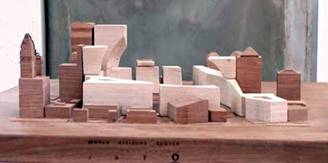
There have been many proposals about the
reutilization/rebuilding of ground zero.Some are official, but also a lot of citizens from around
the world have expressed their wishes, suggestions and even designs.After the tragedies of 9/11 a need for a memorial arises,
something that reminds us of the void, the absence. Something has been taken
away from the city.A space that needs to be regained but also emptiness to
reminds us of the loss. In several of these projects this is accomplished by
leaving an actual void or building "wire frame" or
"placeholder" versions of the towers. Brian Perla in New York, Larry
Purtell in Irving, Texas ,David Brick in New York, Leopoldo Padron in Morris
Plains, New Jersey, and most notably Jason Freeny in New York submitted
designs for CNN's "Your Proposal" special[i],
expressing this need.One can witness how the desire to respect the space where
so many died is constantly struggling with the urge to build over it. Also on CNN it is possible to access the WTC official
rebuilding plans, on 2D and 3D representations[ii]. Although these six official designs also
follow the philosophy of leaving the actual footprint of the towers relatively
untouched and virtually clear of above-the-ground structures, and a couple also
feature "wire frame" hollow structures, they are certainly very
austere and logical, but none of them expresses the needs of the people in NY
and the world for a statement of some kind to be achieved through these
proposed new buildings.The
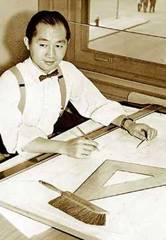
The towers made a statement by themselves, much to the chagrin of their creator, Minoru Yamasaki, who was ambivalent regarding this matter.Should he be alive nowadays, he would be taking a lot of heat.
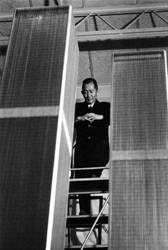 The original
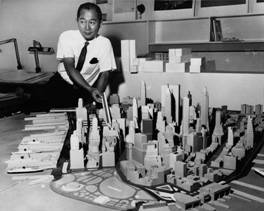 Yamasaki’s take on architecture was full of
contradictions, at first his work was of a minimalist tone, believing that
"The purpose of architecture is to create an atmosphere in which man can
live, work, and enjoy"[v].Yet he undertook the epic adventure of building the
towers, that were instantly criticized for being “urbanistically irresponsible”
and “no longer appropriate to convey world power and wealth (Previously they
had attacked his work as too "dainty")”[vi].He also declared that the "…grandeur, the elements
of mysticism and power, basic to cathedrals and palaces, are also incongruous
today, because the buildings we build for our times are for a totally different
purpose."[vii].
Yamasaki’s take on architecture was full of
contradictions, at first his work was of a minimalist tone, believing that
"The purpose of architecture is to create an atmosphere in which man can
live, work, and enjoy"[v].Yet he undertook the epic adventure of building the
towers, that were instantly criticized for being “urbanistically irresponsible”
and “no longer appropriate to convey world power and wealth (Previously they
had attacked his work as too "dainty")”[vi].He also declared that the "…grandeur, the elements
of mysticism and power, basic to cathedrals and palaces, are also incongruous
today, because the buildings we build for our times are for a totally different
purpose."[vii].
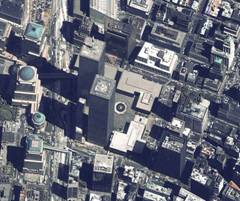 The
towers were indeed a symbol of wealth and certainly represented the city’s
identity. Lourdes Lluy, a tourist, remembers: “The towers where a self
contained universe. With their underground shopping mall, multiple
transportation channels converging on them, they were a city within the
city.” She also recalls not being impressed by the towers as she
stood by their feet.“They weren’t a big deal, looking up from the ground,
actually not such a nice building at all. But from the top it was a whole
different story.”
The
towers were indeed a symbol of wealth and certainly represented the city’s
identity. Lourdes Lluy, a tourist, remembers: “The towers where a self
contained universe. With their underground shopping mall, multiple
transportation channels converging on them, they were a city within the
city.” She also recalls not being impressed by the towers as she
stood by their feet.“They weren’t a big deal, looking up from the ground,
actually not such a nice building at all. But from the top it was a whole
different story.”
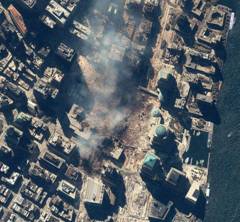 Besides the need to replace such a symbol, there is also the
challenge to reconstruct one of the most dysfunctional neighborhoods in the
world.In this area of town, small businesses can no longer
survive. Many have closed their doors. Restaurants with an average 150 patrons
now have near none.The economic and social implications cannot be ignored,
as many people agree that a project as big as the world trade center could not
be cost-effective or successful on today's economy.
Besides the need to replace such a symbol, there is also the
challenge to reconstruct one of the most dysfunctional neighborhoods in the
world.In this area of town, small businesses can no longer
survive. Many have closed their doors. Restaurants with an average 150 patrons
now have near none.The economic and social implications cannot be ignored,
as many people agree that a project as big as the world trade center could not
be cost-effective or successful on today's economy.
So the question is: Can it be done? That is, should the
towers be rebuilt?Who would want to return in that case?Many firms have already relocated on other parts of
There is for the rest of the world, and I hope for many
Americans too, the necessity of reflecting on why the attack happened, and
certainly on the events that led to it.It was so big that it can’t be blamed on a senseless act
of terrorism.It was retaliation. To deny it, although understandable, is not healthy.The actions of the
The RoTo project, exposed on the Max Protecht gallery on 02/02 alongside many other excellent others, symbolizes for me the perfect thing to build on the site of the WTC. It has provoked dissimilar reactions in those who have seen it, but never indifference:
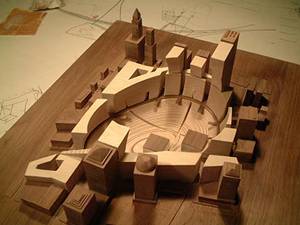
“…the RoTo Architects' submission looks like the mutant child of an M.C. Escher painting and a classical Greek amphitheatre.”[viii]
“Of the architectural proposals included in the recent exhibition at Max Protecht, I felt that the one by RoTo architects had the most to offer as a realistic proposal in scale and tone.”[ix]
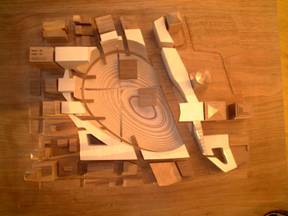
“In a similar effort to immortalize ground zero, the design from RoTo Architects transforms the subterranean disaster pit into an amphitheater.”[x]
“The project presented at the Max Protecht gallery by the firm of RoTo is another example of void and memory in architecture.Does the void and its representative size act as a cue that can stir the memory?”[xi]
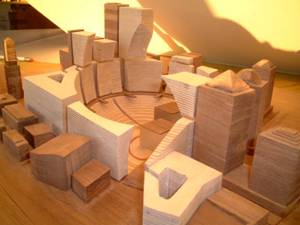
This project has been inspired, according to their creators, among other things, on the shape of an orphic egg, a symbol of rebirth and also of learning from our own mistakes. Its design contours the shape of a “hand” containing ground zero, therefore expressing perfectly the emptiness and the void created by the attack and the absence of the towers and, in my opinion, additionally depicting the innocence lost. The result could be, hopefully, a constant reminder that people should weigh on the outcome of their actions and a meaningful spiritual memorial for those heroes who saved many lives and died courageously on the service. Most importantly, a memorial for the living, the survivors: it would give citizens a space to honor their loved ones.
RoTo also designed the
Finally we are faced again with the concept of scope and size: Yamasaki had a lot of contradictions on this.His initial minimalist style was later replaced by the construction of huge buildings (both in size and meaning) and ferociously criticized. This should be taken on consideration while pondering on possible designs for the area. The risk of going overboard is still there, echoing on the scale of the attack itself.
The final and most sensible advice is, ironically, Yamasaki’s:
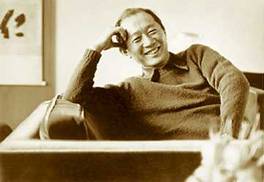
"Buildings should not awe and impress, but rather, serve as a thoughtful background for the activities of contemporary man.”[xii].
Pedro D’Ardis.

[iv] John Winter, in Randall J. Van Vunckt, ed. International Dictionary of Architects and Architecture : Volume 1, Architects, p1006 to p1008
[v] Minoru Yamasaki quoted on the Minoru Yamasaki Associates, Inc. web site.
[vi] From “Minoru Yamasaki, world-class architect” by Vivian M. Baulch, The Detroit News: http://detnews.com/history/yamasaki/yamasaki.htm.
[vii]Minoru
Yamasaki, in Paul Heyer, Architects on Architecture: New Directions in
[viii] From “Up from the ashes” by Matt Continetti: http://www.theamericanenterprise.org/hotflash020510.htm .
[ix] Julian Jackson, artist/gallerist: http://archrecord.construction.com/WTC/theFutureB.asp .
[x] From “Covering Ideas Another Voice at Ground Zero: Designers” by Robert Condit:
http://www.jrn.columbia.edu/studentwork/coveringideas/designers.asp .
[xi]
From “a ao t: architecture and/of terrorism” by Clark
Todd Gollotte, Studio burns,
[xii] From “Minoru Yamasaki, world-class architect” by Vivian M. Baulch, The Detroit News: http://detnews.com/history/yamasaki/yamasaki.htm.