|

Varieties
~
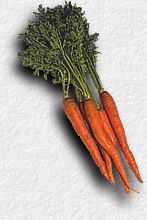
Carrots
are believed to have originted in the Middle East and Asia. The earlier
varieties were mostly purple and black. Apparently the modern-day carrot
was orginally a mutant variety lacking certain purple or black pigments. Carrots
are now cultivated worldwide.
Key
Benefits~
The
carrot is the king of vegetables. Of the commonly consumed vegetables,
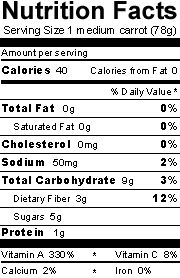
it is the highest source of provitamin A carotenes. In fact, two carrots
provide roughly 4,050 retinol equivalents, or roughly four times the RDA (recommended
daily allowance) for vitamin A. But, unlike vitamin A, beta-carotene
and other carotenes in carrots do not cause toxicity. Carrots are full
of many other nutrients and anutrients, but it is their carotene content that
is most talked about. Judging from extensive human studies, as little
as one carrot a day could conceivably cut the rate of lung cancer in half.*
(Carrots are undoubtedly one of our most valuable and complete foods. The finely grated pulp of raw carrots has been found to be one of the most soothing, efficient and beneficial means to aid the colon in nourishing itself back to a normal condition.)
(Raw carrots contain all the elements and all the vitamins that are required by the human body. Their value is lost when carrots are cooked, canned or otherwise processed.)
 |
Of the vegetable juices, raw carrot juice stands supreme. It is a particularly wonderful cleanser of bile and waste matter coagulated in the liver as a result of years of wrong eating.)
(A lifetime of wrong living (eating the wrong kind of food), creates disintegrating processes in the body which it will take months or years to completely eradicate. It is silly to expect a miraculous regeneration of the body by merely drinking a pint of juice now and again.)
(Carotene is that part of the carrot which, when raw, contains the finest quality of Vitamin A that the body can assimilate. When this Vitamin is subjected to heat or other processes and concentrated, separated from the other elements furnished by Nature in the carrot, then its value is correspondingly reduced if not virtually lost. Occasionally some temporary benefit is derived from such concentrated extracts. For definite practical results, nothing compares to the raw juice, when properly extracted.)
(Children should drink one pint of carrot juice daily. Most troubles afflicting children are recognized as due to a deficiency of Vitamin A. So is night blindness. A pint of carrot juice in the afternoon or evening is most helpful to bring relief to eyes and reduce the fatigue resulting from driving against bright lights.)
(Fresh carrots contain more than 87% water. About 37% of the total mineral content is potassium, with a great amount of sodiam and calcium also present and a good percentage of iron, magnesium and manganese. The cleansing elements, sulphur and chlorine, are also present in ample proportions, while phosphorus, the brain food, is nearly 13%.)
Selection~
Carrots
should be fresh-looking, firm, smooth, and vibrantly colored. Avoid
carrots that have cracks, are bruised, or have mold growing on them.
(Carrots that are too young are immature, the minerals and vitamins are not completely formed and they are therefore not as nourishing as when they have been allowed to grow in the ground for 4-1/2 to 5 months before being pulled.)
References~
*Wald NJ, Thompson SG, Densem JW et al., Serum beta-carotene and subsequent
risk of cancer: Results from the BUPA
study, Br J Cancer 57:428-33, 1988; Harris
RWC, Key TJA, Silcocks PB et al., A case-controle
study of dietary carotene in
men with lung cancer and in men with other epithelial
cancers, Nutr Canc 15:63-
68, 1991; Peto R, Doll R, Buckley JD et al., Can
dietary beta-carotene materially
reduce human cancer rates? Nature 290:201-8,
1981; Rogers AE and Longnecker
MP, Biology of disease: Dietary and nutritional
influences on cancer: A review of
epidemiologic and experimental data, Lab
Invest 59:729-59, 1988.
Ziegler
RG, A review of epidemiologic evidence that carotenoids reduce the risk of
cancer, J Nutr 119:116-22, 1989; Olson JA,
Chapter 11. Vitamin A, in MB Brown,
ed. Present knowledge in nutrition, 6th ed.
(Washington, DC: Nutrition Foundation,
1990), pp 96-107; National Research Council, Diet
and health: Implications for
reducing chronic disease risk (Washington, DC:
National Academy Press, 1989);
Trowell H, Burkitt D, and Heaton K, Dietary fibre,
fibre-depleted foods and disease
(New York: Academic Press, 1985).
Carper J, The food pharmacy (New York: Bantam, 1989).
Thanks
to~
(The
Vegetarian Guide to Diet & Salad)
by Dr. N.W. Walker, D.Sc., pp. 90-92.
The
Complete Book of Juicing: Your Delicious Guide to Youthful Vitality
by
Michael T. Murray, N.D., Jay Kordich, pp. 135-137.
|
Home
| Juicing
| Water
Apples | Grapefruit | Grapes Beets | Carrots | Spinach Recipes | Fruit Recipes | Vegetable Recipes | Dressing Recipes About Lou | FAQ's Questions, Comments or Suggestions? Site Map | Search this site or the web |
[email protected]