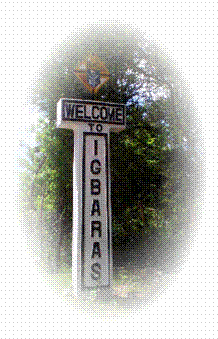
|
As early as 1615, Igbaras was already a “visita” of the
Agustinian Missionaries. It was in “Tinogpahan” in the vicinity of Binanau-an
that the first “Iglesita” or chapel was founded by Rev. Juan de Medina. The
missionaries found out that there were three “datos” that ruled the
settlement in Igbaras. Binanua-an in the Kiput area became the first townsite
because it is strategically located between Tiglabat and Tuminting Hills. It
proved to be impregnable to Muslim raids and attacks because during that period,
the coastal towns of Iloilo were already raided. Later the
townside was moved to Utas, a high-rise outside the Kiput area for the former
site was inundated by the floods. The new site was a flourishing settlement
even before the coming of the Spaniards as evidenced by uncovered antique
wares so abundant in the area with the impression of Ming and Sung Dynasties
of 960 A.D. The site was not productive as the plains of Cabubugan, so the
townsite was transferred to the latter for, Cabubugan was also under a “dato”
and a flourishing settlement in 1223 A.D. when Ogtong was the seat of
Confederation of Madiaas. However, the area proved to be a flooding hazard
and a new townsite was imperative by then. In 1752, it was
Fr. Juan Aguado who founded the townsite that existed to the present Igbaras.
Don Diego de Tamooc was formally selected to head the “pueblo” in 1761.
Prominent edifices were constructed during the incumbency of
“Gobernadorcillo,” Don Pedro Sexto, like “Casa Real” of the 1799 at Calle de
San Augustin, a municipal street completely inundated by the floods. The old
church was constructed in 1784, followed by the convent in 1795 under Fr.
Ignacio Marcos. These structures were also washed away by the big floods but
the remains are still visible today. In 1878, Fr.
Celestino Fernandez constructed a new church with a big convent under the
term of Fr. Jose Laviana as parish priest, but just the same, these two
imposive and beautiful structures were destroyed by the 1948 earthquake named
“Lady Caycay.” During the
American regime, lawlessmen and banditry were rampant. In 1890, Don Joveniano
Ealdama built a “talutog” or bamboo and wooden fortress around the
poblacion.”Montor,” the famous bandit penetrated the “Talugtog” or bamboo and
wooden fortress and killed Don Mariano Benedicto at the same time looting the
Poblacion. It was also during this period that the Spanish-American War
flared up. “Directorcillo” Julian Bucoy, joined the revolutionary forces
against the Spaniards and later against the Americans as “Primer Teniente de
Estado Mayor” under General Martin Delgado with headquarters in Santa
Barbara, Iloilo. It was in 1902
that Igbaras was fused to Guimbal as the later’s arrabal until the time when
Acting Governor General Charles E. Yeater issued an Executive Order No. 64,
dated December 23, 1918, that mandated the separation of Igbaras from Guimbal
on January 1, 1919. Don Flor
Evidente was elected first Municipal President in 1919-1922, followed by
Lucas Gentica, 1922-1925; Julian Bucoy Saavedra, 1925-1931; Justo Estrella,
1931-1938; Dionisio Esquilla 1938, but lost to Gerardo Escaba (1938-41) in an
electoral protest; Toribio Melliza, 1941-45; Perfecto Saavedra, 1945-1955;
Ricardo Ealdama, 1955-61; Toribio Melliza 1961-64; Atty. Daniel Esmeralda,
1964-1977; Vicente E. Perez, 1977-1985; Wilfredo C. Uy (taken
by Our Lord - February 23, 1999), 1986-1992 and Fruto J. Saavedra (1992-2001). The current mayor is Jaime Esmeralda, M.D. Igbaras has the
distinction of having one of the first Congressman elected to the Philippines
Congress in 1925-1928 in the person of Don Eugenio Ealdama, and the delegate
to the 1935 Constitutional Convention, Don Mariano Ezpeleta who later served
as Consul General and Ambassador to several countries. During the
Second World War, the poblacion of Igbaras was burned to ashes (holocaust) by
the resistance against the Japanese Imperial Army. Ramon Esporas was
appointed as municipal head by the Civil Government under General Tomas
Confessor. Lt. Pedro B. Saavedra organized guerilla forces under General
Macario Peralta. Luis Ezpeleta with the consent of the USAFFE Guerilla
movement accepted the position of the puppet mayor to protect the populace.
After the war in 1945, Perfecto B. Saavedra was appointed mayor prior to
local elections in 1947 in which he was elected mayor. Today, Igbaras
is a fifth class municipality with a population of more than 27,000. It has a
land area of 15, 245 hectares, 75% of which cultivated and devoted to
agriculture. It has 46 barangays and approximately 54.32 kilometers of
barangays road network. Under present
dispersion, Igbaras is a recipient of rural electrification, irrigation and
related programs of our government especially road and other infrastructure
programs. Worthy to note is the muti-million road network from Guimbal to
Igbaras. This is through the effort of Congressman Oscar Garin. Many
infrastructure projects are being lined-up by the good Congressman in favor
of the municipality and under his leadership with Divine Providence, Igbaras
will surely march forward to progress. Fruto
J. Saavedra, member of the Iloilo Historical Society |

|
LEGENDS OF
IGBARAS Legend has it that when
the Spaniards came to this place later to be called “Igbaras,” they have been
enchanted by her beauty. Not knowing the name of this beautiful pueblo, they
happen to stumble on a group of men working on a pile of sand, stones and pebbles.
One of the Spaniards asked the name of the place in his native Spanish.
Thinking of having been asked about
their work, the men responded, “AH, BARAS” (oh, gravel)! which would later
led to the naming of “IGBARAS,” a newly founded pueblo. Another familiar folk
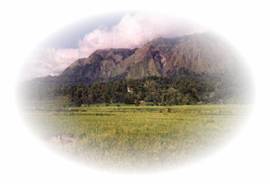
story revolves around Mount Napulak. According to some beliefs, Mt. Napulak
used to stand on a stony but solemn “pueblo” (town) with a number of
beautiful land spots and where an abundance of gravel (“baras”) and stones
basking the site thus gained its distinction as the town of “BARAS.” |