"Lung Cancer: It's a Woman Thing"
Lung cancer used to be a man's disease. When I first started in surgery
training, it was unusual to see a woman patient with lung cancer. Why? Because
during the 1920s and 1930s, "nice" women didn't smoke. It was
socially unacceptable.
I can remember during the 1950s sitting with my grandmother Rose in her
kitchen, sharing a Pall Mall, 1/2 half for each of us. She would never think of
having a cigarette in public.
During the 1930s the tobacco industry targeted women in an agressive
advertising campaign headed by ad exec Albert Lasker. It was enormously
successful, and women began to smoke in increasing numbers. The result was a
steady increase in the number of women dying of lung cancer. In the 1970s and
80s, the tobacco industry had a large proportion of adult women smoking and so
they began to target girls and young women with the Virginia Slims "you've
come a long way baby" campaign and more recently "It's a woman thing".
These predatory ad campaigns have also been very successful in addicting many
young women.
The end result is that lung cancer has gone from a rare disease in women to
become the
Number 1 cause of cancer death in women
exceeding breast, cervical, uterine and ovarian cancers.
Lung Cancer: It's a woman thing!
The proof of these statements can be found at CA Magazine produced by the
American Cancer Society. CA A Cancer
Journal for Clinicians, published by the American Cancer Society and Lippincott
Raven and available on the web at http://www.ca-journal.org.
Follow this link to the January Cancer Statistics Issue and click on the
links for the two graphs listed below.Lung
Cancer in Women
Table 9: Reported Deaths for the Five Leading Cancer Sites for Females by
Age, United States, 1994
and
Figure 3: Age-Adjusted Cancer Death Rates for Females by Site, United
States, 1930-1994
Smoking is doubly harmful when a woman is pregnant! Is smoking during
pregnancy harmful to unborn children? The answer to this question is an
unequivocal YES. The chance of the pregnancy ending in a miscarriage is
increased by 24%.
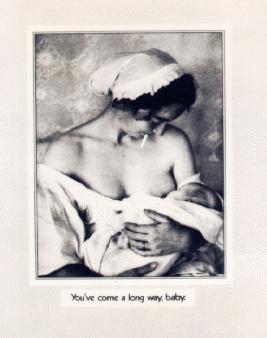 This photograph and other striking counter-images can
be found at Badvertising http://world.std.com/~batteryb/slidesho.html
This photograph and other striking counter-images can
be found at Badvertising http://world.std.com/~batteryb/slidesho.html
The chance of the baby being born in the low birth weight category is increased
by 82%. These babies have higher morbidity and mortality rates. They often
require expensive prolonged hospitalization.
The chance of perinatal mortality (i.e. the infant dies immediately before or
soon after birth) is increased by 26%
The risk of SIDS- Sudden Infant Death Syndrome triples if the mother has smoked
during pregnancy.
"It is estimated that 25 percent of expectant mothers in the U.S. smoke
throughout their pregnancies.According to a report from the Surgeon General, 20
percent of low birth weight births, 8 percent of preterm deliveries and 5
percent of all perinatal deaths could be prevented by eliminating smoking
during pregnancy. Mullen
Here is some new information INFANT LIMB DEFECTS Life Sciences &
Biotechnology Update, VOL. 98; No. 6 [06/01/98] This (University of Washington)
thesis looks at case-control studies that suggest an association between
prenatal smoking and infant limb defects, possibly due to vascular disruption in
the embryo. Examination of specific types of malformation reveals that maternal
smoking is associated with a greater than two-fold increased risk of transverse
reduction limb defects. This finding, related to smoking, is consistent with
previous studies, and emphasizes the continued need for public health
interventions designed to reduce prenatal smoking.