Tintin
Tintin (French, Basque, Catalan, Spanish, Danish, Indonesian, Italian, Malay, Norwegian, Swedish), Kuifje (Dutch), Kuifie (Afrikaans), Tim (German), Tin Tin (Arabic), Tintti (Finnish), Ten-Ten (Greek), Tainetaine (Iranian), Tinni (Icelandic), Tan Tan (Japanese), Tintim (Portugese)
Debut: Tintin in the Land of the Soviets
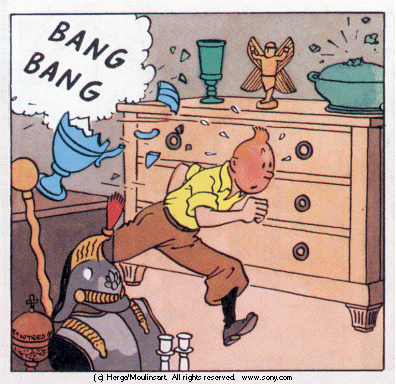
Tintin is without a doubt the strangest character in the history of the strip cartoon. Unlike the majority of cartoon heroes, he has no particularly remarkable characteristics. True, he is intelligent, astute, quick-witted and almost invincible, but when we examine him more closely, it is his unreality which is most startling.
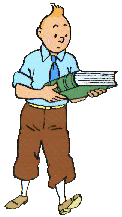
Take his name for a start. In neither French nor English does it mean anything. Is it a first name or a surname? Next look at his round face with only little dots for eyes and mouth and a small button of a nose. The only distinctive feature is the celebrated quiff. Then there is his profession, one which except in the very first book we never see him exercise. Tintin is not a typical reporter. He has no real age; sometimes he seems to be a child, at other times an adolescent, but generally he behaves like an adult. His sexlessness is also noteworthy. At no time does he have a girlfriend, or do marriage plans interfere with his adventures.
Strictly speaking, he is characterless. This could be seen as a weakness, but that would be a basic misunderstanding of the great coherence of Hergé's world. In fact, it is the neutrality of the hero which is a key element in the success of the books. It is his lack of personality which allows him to change from having been a colonialist in 1930 to taking sides with guerillas in 1976 without any feeling of contradiction. As a neutral character he fulfils marvellously the essential role of a hero of a cartoon series, allowing readers scope for identification. This enables anyone, boy or girl, young or old, French or Japanese, the chance to live the extraordinary adventures of Hergé's books.
And around his neutral hero, Hergé could over the years add a whole collection of richly coloured, often type cast, characters. In this way the series of adventures could be enriched, gaining variety and intensity while, thanks to Tintin, retaining that immediacy which makes them so very readable.