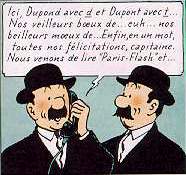
Thomson and Thompson
Thomson, Thompson (Indonesian, Malay), Dupont, Dupond (French, Catalan, Danish, Finnish, Norwegian, Portugese, Swedish), Dupond, Dupont (Italian), Jansen, Janssen (Dutch), Uys, Buys (Afrikaans), Schultze, Schulze (German), Tik-Tak (Arabic), Hernandez, Fernandez (Basque, Spanish), O Ntupon, O Ntupont (Greek), Douponte, Doupon(t)e (Iranian), Skapti, Skafti (Icelandic), Tomson-Tompson (Japanese)
Debut: Cigars of the Pharoah
First appearing in 1934 in the black and white version of Cigars of the Pharoah, (but already given an anonymous walk-on part in the opening frame of the colour version of Tintin in the Congo), the Thomson twins have a curious relationship with the other characters of the series. Although not really belonging to the family, they assiduously follow it. Always ready to arrest Tintin, they yet never hesitate to call him "old boy".
Identical in every way, the two can only be determined by the style of their moustaches. Thomson's is more rounded and Thompson's more pointed. Otherwise, each one is a perfect idiot, as Pol Vandromme demonstrates in his book Le Monde de Tintin.
"They are in mourning for the passing of intelligence. They have the expressions and moustaches of morons, bowler hats which had gone out of fashion years ago, the arched eyebrows of the inquisitor in desperate straits, suits smeared and sticky with black ink, ridiculous noses, dismal faces, boots with nails and soles of lead. Looked at from the front, back or in profile, from any angle they are always prime idiots."
The fact that they are inseperable underlines their ineptitude. For if the imbecile does nothing but repeat himself, then to repeat an imbecility is the ultimate confirmation of idiocy. The doubling up - reflected already in their comic appearance - is emphasised even further by their constant repeating of what the other one says: "To be precise....". Their language is made up of a series of variations on a limited number of clichés which they use at any opportunity, generally the least appropriate. Inverted and confused, the clichés used by the two detectives never succeed in imitating correctly the pompous style of the prize-giving speech which is clearly their idea of eloquence.
The behaviour of the Thomsons is also true to stereotype, and especially their way of dressing. In each of the places to which their work takes them, the two detectives dress in their conception of local costume in order to pass unnoticed. This inflexible idea of what is typical or traditional has exactly the opposite results to those intended. The disguises, which are meant to make them blend in discreetly with the local populace, enable them to be spotted a mile off.
And finally the detectives serve as the useful scapegoats of the Tintin adventures. All nonsense can be attributed to them, to the clear benefit of the other characters.