Cuthbert Calculus
Tryphon Tournesol (French, Danish, Greek, Norwegian), Trifonius Zonnenbloem (Dutch), Tertius Phosfatus (Afrikaans), Balduin Bienlein (German), Bergel (Arabic), Silbestre Tornasol (Basque), Silvestre Tornassol (Catalan), Silvestre Tornasol (Spanish), Teofilus Tuhatkauno (Finnish), (Cuthbert) Calculus (Indonesian, Malay), Vandratur (Icelandic), Trifone Girasol (Italian), Trifolic Girassol (Portugese), Kalkyl (Swedish)
Debut: Red Rackham's Treasure
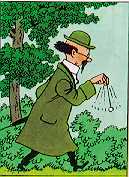
Hergé had long been interested in absent-minded professors. Hector Alembick in King Ottokar's Sceptre is the best example, but already in The Broken Ear there is a passage which anticipates Calculus when another professor apologises to the escaped parrot perched on the lamp-post for mistaking it for a bird. Like many elements in Hergé's books, Cuthbert Calculus was modelled on a real person, as the author himself relates:
"Physically, Calculus and his submarine were above all based on Professor August Piccard and his bathyscaph. But a scaled down Piccard, as he was much too tall. He had an unending neck that emerged from a collar that was too big. I would occasionally bump into him in the street and he struck me as being the incarnation of the typical scientist. I made Calculus a mini-Piccard, as otherwise I would have had to enlarge the frames enclosing the drawings." (Fron Numa Sadoul's Interviews with Hergé)
Even the Professor's christian name in French, Tryphon, was taken from a carpenter Hergé knew. His French surname, Tournesol, means sunflower. The combination of the two names sums up the Professor's character, as does the English rendering, Cuthbert Calculus. Both his appearance and his manner are an anachronism, and there is a subtle contrast between his behaviour, which is that of at least a century earlier, and his highly advanced inventions. For a while, Calculus himself does not change, but his scientific career progresses by leaps and bounds. As Michel Serres has written:
"From being a small-time inventor, he becomes a nuclear physicist. From his garret with his patented fold-up beds and clothes-brushing machines, he moves to the nuclear laboratory."
Calculus is intrigued by everything, from botany to physics, from electronics to dowsing, and Hergé even seems to have given him some of his own interest in the occult and parapsychology. The Professor's latest inventions, however disconcerting they may seem at first, often are the starting point of an adventure, whether Calculus is working on the conquest of space and sets out with Tintin and the others on the Moon expedition, or whether he develops plans for a secret weapon which Tintin and Haddock have to wrest from a military dictatorship.
As well as being the scientist in the adventures, Calculus is also a rather poetic figure. A dreamer and secretly sentimental, the Professor brings an element of freshness and fantasy to the series.