 source: Internet Movie Database |
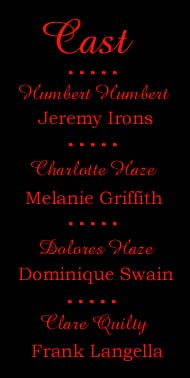
This latest attempt to capture the essence of Lolita is more accurate than the previous version. Many of the scenes follow the book more closely, and the feel of the story more similar. The character of Humbert Humbert is better written and acted out; Jeremy Irons gave an excellent performance. The audience becomes aware of Humbert�s past and part of his impulse for his odious behavior towards Dolores Haze. His desires for Dolores are blatantly played out, and one can sense where the resentment in Charlotte becomes born from. The focus in the first part of the movie centers upon the budding relationship between Dolores and Humbert; in the 1962 version the focus is on Humbert and Charlotte. This follows the novel much more closely, enabling one to see the entrapment Humbert wants the jury to see and in the end feel sorry for him. Dolores Haze is also much better written and portrayed, permitting the aura of duality to shine through. Dominique Swain does a improved job from Sue Lyon, she plays both the temptress and the victim well so that one may see the ruse on the part of Humbert Humbert. Clare Quilty does not appear much in the film until the end for which is more true to the novel. He is a dark menacing presence always at the heels of Humbert Humbert, commenting on his decisions. Frank Langella enacts the part brilliantly, more abstruse to Sellar�s comic. This interpretation of the novel tends to flow better than the previous attempt and captures the story of the novel in a way to see the sick and demented behavior of a marten that defiles a callow, innocent girl. The scenes are more mature and show the relationship between Dolores and Humbert Humbert more clearly. In the end one even finds out the fate of Humbert Humbert and Dolores, they both die, something left out in the 1962 version. |

