* C A R P A T H I A A R R I V E S *
Many passengers, in seeing the last of the Titanic, noticed her "settle back a bit". What they were actually witnessing was the ship breaking in two. The Titanic's structure could not handle the pressures put upon it by the stern raising out of the water. Like a twig snapping, the giant hull's keel could not support the pressure and snapped, bringing the rest of the ship with it. The ship broke from the bottom to the top. As the stern section settled into the water, many passengers actually believed the ship was "righting itself" and would stay afloat. But the bow section pulled the stern vertical, broke off, and sank to sea-bed. The stern stood up at an almost 90 degree angle before filling with water and fallowing the bow. Thus the Titanic sank and left only 705 people in 20 boats to tell her tale.
After the Titanic was gone, the people had to listen as those left on her decks struggled in the cold water. Their cries and screams sounding like swarms of locusts in the night. Many of the people in the boats were too afraid of being swamped to go back and help, but a few were able to pick up some people. Lifeboat number 4 was close enough to the scene to pick up 7 crewmen from the water. 6 of the men lost consciousness, 2 died, and only Steward Andrew Cunningham remained conscious throughout the night. Lifeboat 14, under command of Fifth officer Harold Lowe, also returned to the scene. Lifeboat number 14, tied up with lifeboats 10, 12, 4, and collapsible D, transferred it's occupants to the other boats, untied, and went back. The boat picked up five men from the water. One of them, Mr. W. F. Hoyt, died during the night.
By 3:30 am the rockets of another steamer could be seen bursting on the horizon every once-and-a-while. The Cunard Line's Carpathia had arrived. On her deck, Captain Arthur H. Rostron guided his ship through the water in search of any sign of the Titanic. Soon, a green light could be seen lying low in the water. What was first thought to be the Titanic turned out to be Lifeboat number 2 under command of Fourth officer Boxhall, who was waving a green flair in the air to attract Rostron and his crew.
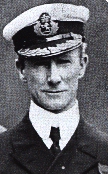
Captain Arthur Henry Rostron
Coming along side of the boat [after avoiding an iceberg near-by] at 4:00 am. Boxhall called out for Rostron to shut down his engines and take them onboard, and First class passenger Mahala Douglass called out that the Titanic had gone down with everyone onboard only to be silenced by Boxhall with the order to shut up.
"When we pulled alongside Mr. Boxhall cried out 'Shut down your engines and take us aboard. I have only one sailor.' At this point I called out, ' The Titanic has gone down with everyone on board,' and Mr. Boxhall told me to 'shut up.' This was not told in criticism; I think he was perfectly right."
The Collapsible lifeboat B was now floating so low in the water that the water was washing over the keel and up to the knees of the almost 30 men standing on top of it. Included on the boat were First class passenger Colonel Archibald Gracie, Second officer Lightoller, Chief Baker Charles J. Joughin, and Second Wireless operator Harold Bride.
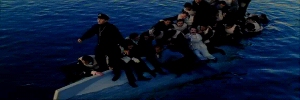
Lifeboat B floats low in the water
All the men watched as the Carpathia began to pick up the survivors of the horrible night one boat at a time. Noticing Lifeboat number 12 floating near-by, Second officer Lightoller hailed the vessel with his whistle. Soon, all the men were transported off of the collapsible lifeboat, and into the overfilled lifeboat number 12. Harold Bride, his feet badly frost bitten, watched eagerly as their boat came closer and closer to the Carpathia's side.
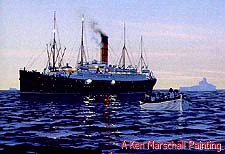
The RMS Carpathia takes on survivors
"At last the Carpathia was alongside and the people were being taken up a rope ladder. Our boat drew near and one by one the men were taken off of it."
Before Lifeboat 12 was completely alongside, a large swell had grown and threatened to sink the boat. One wave after another broke over the boat's bow and for a short time it was thought that the boat would go under and spill everyone into the sea. But soon, it was alongside and the men were transferred up a rope ladder. While walking towards the ladder, Bride remembered seeing one dead man in the bottom of the lifeboat. The man, he said, was his partner in telegraphy, John Phillips.
"One man was dead. I passed him and went to the ladder, although my feet pained terribly. The dead man was Phillips. He had died on the raft from exposure and cold, I guess. He had been all in from work before the wreck came. He stood his ground until the crisis had passed, and then he had collapsed, I guess."
The rescue operations took over 4 hours due to the large vicinity in which the lifeboats had been scattered. Survivors were hauled aboard the 36,000 ton Cunarder by way of winches, rope ladders, and other devices such as canvas bags. As each survivor came aboard, they were asked to give their names to a steward on hand, and many of the Carpathia's passengers had lined the upper decks to get a look at the survivors of the Titanic. Many snapping photos as the rescue attempts continued.
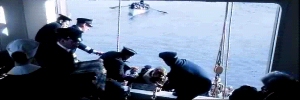
The Rescue Attempts continue
The women who had survived the night lined the rails in the hopes that other boats would carry their husbands and loved ones to safety. Second Class passenger Mrs. Nellie Becker and her daughter Ruth watched the other women lined the rails. They had been lucky. Mr. Becker was not onboard the Titanic with them. He was safe at a missionary in Africa. Second Class passenger Edith Haisman was 15 years old and sailing with her father and mother. Now she and her mother also lined the rails with the other women looking for her father. He did not survive the sinking.
At 8:00 am, Second officer Lightoller was the last man to board the Carpathia. A service was held in the lounge to give thanks to those who were saved and to mourn those who had died in the disaster. During this ceremony, Captain Rostron guided his vessel along the wreck area and only saw one body. The rest had apparently been carried by the current.
At 8:30 am the Leyland Liner Californian came along the side of the Carpathia. Captain Stanley Lord had learned about the sinking of the Titanic when wireless man Evans was awakened at 5:30 am and learned of it himself. Lord had been resting on the chart room settee the whole evening and was awakened more than once by his officers with reports of a ship firing rockets on the horizon. The Californian tried to contact the ship with the morse lamp, but received no reply. And the ship on the horizon seemed to apparently steam away around 2:30 am. She had fired a total of 8 rockets. Lord immediately started up the engines and headed for the position he had been given by Evans. The Carpathia could be seen in that vicinity and Lord turned his ship towards it. Arriving on the scene, he encountered the Carpathia picking up the last of the Titanic's survivors. Lord was asked, through use of flag signals, to stay and scan the area for anymore survivors. None were found and the Californian continued on it's course to Boston and went down in history as "The ship that stood still".
At 8:50 am Captain Rostron decided to turn his ship towards New York when he realized he would not have enough food and provisions for his passengers and the 705 Titanic's survivors. He sailed the ship parallel to the giant ice field to avoid his ship suffering the same fate as the Titanic had. Of those onboard, J. Bruce Ismay was in such a state of shock that he walked around muttering "I'm Ismay". Carpathia's surgeon Dr. McGee gave up his own cabin to the man. Ismay would remain inside the cabin until the ship reached New York.
On the other hand, Mrs. Thayer, Widener, and Astor were taken directly to Captain Rostron's own cabin. Second Wireless operator Harold Bride lost consciousness and was taken to the ship's hospital. When he recovered he learned that Carpathia's wireless man, Harold T. Cottom, was becoming tired from the lack of sleep, and needed someone to take his place. Bride happily assisted Cottom in the transmitting until the ship reached New York.
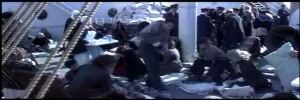
Titanic survivors are aided by passengers and crew of the Carpathia
The rest of the survivors were given provisions in the ship's dining saloons and other areas of the ship. They were helped by both passengers of the Carpathia as well as stewards. Rostron's ship would achieve the name of "The Rescue ship" and "The Ship of widows". The men, women, and children that survived the Titanic would never forget the ordeal they went through. Neither would the era in which they lived ever be the same.