

Due to the skyrocketing popularity of Irish dancing, a short history of these two (actually four; keep count as you read) shows is long overdue, and very necessary to clear the confusion that inevitably occurs when people first become aware of one or both of these dance productions.
In Europe, every spring, millions of viewers (now close to 300 million) watch a live television broadcast called The Eurovision Song Contest. This contest started in 1956 as one of many programs to be presented under the "Eurovision" title. Eurovision was designed as a post-WW2, European-unity measure, with production costs and organization of various programs to be shared by the state-run TV stations of the European nations. The Eurovision Song Contest was designed to find the best new popular song and has been a successful way of showcasing pop-music performers from all the countries ever since. Each country has its own selection process to determine which of its acts will compete. The winners occasionally go on to have impressive careers; ABBA ('74) and Celine Dion ('88) probably being the most famous examples to the average, American, pop-music consumer. As in all competitions, there is a short period of time at the end when the judges tally the scores, and something diverting is presented during this interval.
An Irish contestant won in '93, so by tradition, it was Irish television which had to host the show for '94. It was also up to the Irish to fill the interval. In the summer of '93, TV producer Moya Doherty was asked by RTE, Ireland's national television station, to produce the show. The Eurovision Song Contest is, in essence, a three-hour variety show with no variety - just one song after another, making the job of producing it somewhat uncreative. She decided to accept the offer after attending a week-long, Irish cultural festival called "Mayo 5000" that same summer. This festival was part of Ireland's celebration of the 5,000 year anniversary of the Céide [pronounced "KAY-jah"] Fields, the field pattern systems and megalithic tombs near Ballycastle on the north Mayo coast, which forms the most extensive stone-age monument in the world. During the opening-night festivities, she saw Michael Flatley performing his solo act. She also saw Jean Butler performing in a traditional duet with her friend, Colin Dunne. On the strength of these performances, she thought an Irish dance number during the interval would inject enough interest to make the job worthwhile.
At the time of the Eurovision Song Contest, Michael Flatley from
Chicago, was 35 years old and had been a professional dancer for about
fifteen years, as well as an Irish Dance champion before that when he was
in his mid-teens to early twenties. After he stopped competing, he
performed at a wide range of folk and Irish cultural events. Most
important to his professional career were the ten years (from '81 to '91)
when he toured on and off with The Chieftains. They encouraged him
in his development of a more stylish form of traditional Irish dancing
that had greater audience appeal than straight competition dancing.
New Yorker Jean Butler was 23, and had been Irish dancing since childhood.
She, among others, also toured with the Chieftains performing traditional
dance in the years after Michael stopped performing with them.
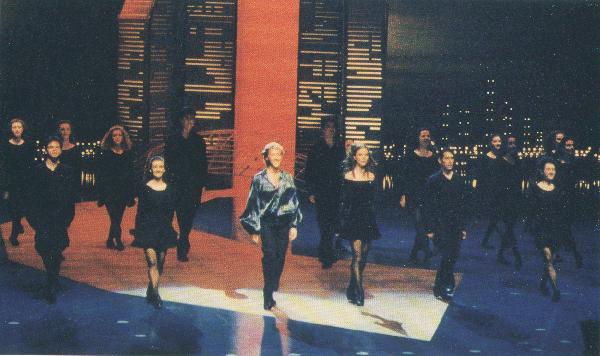
In the summer of '93, Moya asked Bill Whelan, a composer, arranger,
and record producer, to write the music for the interval. Michael
and Jean were asked to perform the leads. (I believe they both were
responsible for most, if not all, of the choreography. Michael did
his own and that of the troupe, Jean did her own, and they worked jointly
on their duet sections.) The seven-minute interval act called "Riverdance"
(which included a vocal introduction by Anuna), debuted during the Eurovision
Song Contest on April 20, 1994 and was a phenomenal success, creating a
huge demand for both live performances and a video. The seven-minute
act, along with the winning Eurovision song, were released in Ireland on
a short video called "Riverdance for Rwanda," the proceeds all going to
the Rwandan Relief Fund. A single of the music also was released
and both sold well.
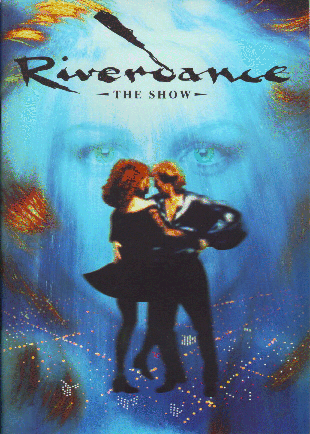
The demand for more Irish dancing was overwhelming and soon after
the debut, it was decided to expand the interval act into a full-fledged
stage show. More music was written by Bill, more dances were choreographed
by Michael and Jean, more money was raised by Moya, and the second incarnation
- "Riverdance - The Show" - had its premiere in Dublin at the Point Theatre on February 5, 1995 with
all of the same principals plus the new, international, performers.
Extended runs of the show were booked in Dublin (5 weeks), London at the
Apollo Hammersmith Theater in May (4 weeks) and back to Dublin in July
(6 weeks). An initial recording was issued in Europe, and a re-vamped
version of the recording which had four additional numbers (plus Michael
Flatley's taps added to two of the numbers) was later released on November
6, 1995. (An even newer version of the CD was released in October,
'97 with his taps removed from one of the numbers.) A video entitled
"Riverdance - The Show," taped at the Point Theatre, Dublin, was
released in April '95. All three sold very well. (Note to U.S.
consumers and Flatley fans: the version we have on NTSC format is not as
complete as the one released in Europe on PAL format. The flute number
Michael did was edited out as well as four other numbers.)
- had its premiere in Dublin at the Point Theatre on February 5, 1995 with
all of the same principals plus the new, international, performers.
Extended runs of the show were booked in Dublin (5 weeks), London at the
Apollo Hammersmith Theater in May (4 weeks) and back to Dublin in July
(6 weeks). An initial recording was issued in Europe, and a re-vamped
version of the recording which had four additional numbers (plus Michael
Flatley's taps added to two of the numbers) was later released on November
6, 1995. (An even newer version of the CD was released in October,
'97 with his taps removed from one of the numbers.) A video entitled
"Riverdance - The Show," taped at the Point Theatre, Dublin, was
released in April '95. All three sold very well. (Note to U.S.
consumers and Flatley fans: the version we have on NTSC format is not as
complete as the one released in Europe on PAL format. The flute number
Michael did was edited out as well as four other numbers.)
As the show progressed, some numbers were eliminated due to audience dislike, and others - all Irish but one - added for the coming return to London. Hollywood to Harlem was removed in favor of Trading Taps. Colin Dunne from Birmingham, England, then 25 and also a former Irish dance champion, had been hired specifically to perform in this number. The two choral gospel numbers were removed in favor of one solo gospel number; American Wake, Oscail An Doras (Open the Door) were added, as well as the narration to bolster the "River of Life" theme.
Sometime during the first London run, contract negotiations between the Riverdance management, i.e. Moya Doherty, and Michael Flatley began and fundamental disagreements about creative control became generally known. Moya refused to pay Michael for the entire first London run and the entire return run in Dublin in an effort to make him sign a contract that -
- 1. Made him surrender his copyright for his choreography.
2. Gave him no artistic control over his work. (This included his solos, Distant Thunder - renamed Thunderstorm, and the numbers performed by him with other members of the Riverdance troupe. The other principals had choreographed their own routines.)
3. Didn't allow him to talk to the press at all without RD management permission. (Apparently, in all Riverdance contracts now.)
Moya portrayed herself to the press as accomodating, citing her repeated
acceptance of what she says were Michael's ever-increasing demands.
The Riverdance management portrayed him to the press as someone who could
not be satisfied despite all of his demands regarding money and billing
being met with the exception of the three listed above. (This was
the time that the combination of RD management statements about egotism,
self-centeredness, etc., coupled with the rabid, British tabloid press,
created the false impression of his personality. According to my
research, Michael was considered charming, generous, and affable up to
that point, and still is, according to the people who meet him now.)
Michael said that issues of money (note well the final paragraph below)
and billing had been easily settled, and that the only issues in question
were the ones regarding artistic control and copyright. (Plus, after
doing over eight months of interviews and promotional work, why should
he have to stop?) The Riverdance management announced that allowing
him to keep artistic control over his work would endanger the production,
and he was fired from the show he had helped create and for which he was
billed as principal choreographer, on the eve of the second London run
at the Apollo Hammersmith which began on October 2, 1995. Colin Dunne
performed in most of Michael Flatley's numbers. (Maria Pages danced
"Firedance" solo for many months. She is now partnered by SIX male
dancers.) Jean Butler had an injury and was replaced by Eileen Martin
for the opening. (Eileen and Arlene Boyle  traded
performing the lead female role until Jean's return. Arlene was Michael's
choice for leading lady and is the first dancer we see on "The Dublin Show"
video. Arlene left RD in May '96 to join LOTD in which she used the
Irish form of her name - Areleen Ni Bhaoill [pronounced "nih WHEEL"].
She now dances the part of Saoirse [pronounced "SEER-sha"] in Troupe 2.
Jean left RD in November '96.)
traded
performing the lead female role until Jean's return. Arlene was Michael's
choice for leading lady and is the first dancer we see on "The Dublin Show"
video. Arlene left RD in May '96 to join LOTD in which she used the
Irish form of her name - Areleen Ni Bhaoill [pronounced "nih WHEEL"].
She now dances the part of Saoirse [pronounced "SEER-sha"] in Troupe 2.
Jean left RD in November '96.)
The Riverdance show now went into its third incarnation, called "Riverdance - The New Show," containing all of the changes. It played the Apollo Hammersmith for 19 weeks, and then went to New York City in March '96 for a successful run at Radio City Music Hall, which was taped and released on a video of the same name (1:24) with Colin Dunne and a recovered Jean Butler. (A new video called "Riverdance - Live From New York City" (1:50) is now available. It is not a retaping of the show, but simply a renaming of "The New Show" with footage transferred directly from film, as opposed to transfer from the PAL - European video format - version.) The tour continued throughout the US and Canada to generally wide acclaim. A second troupe was started which began touring in Australia using the same music and choreography as "The New Show." Both troupes are still performing, and a third troupe is due to debut in just days. To make the show more generic and to avoid the emergence of any "stars," multiple leads are used in all of the troupes, and there are no cast lists in the programs.
 During this
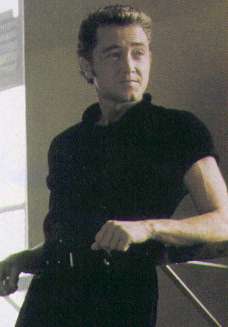
period - October '95, Michael began to produce and
During this
period - October '95, Michael began to produce and  choreograph
his own show, called "Michael Flatley('s) Lord of the Dance." He
and his colleagues had to overcome difficulties created by the Riverdance
management due to negative press, and fear by musicians and technicians
of not getting work in the future with RTE-related projects if they worked
with him. (Note that RTE was one of the original backers of Riverdance,
and as the largest television station in Ireland, they do have some clout
with regard to who gets air time and who does not. RTE received a
license to begin a radio station at this time as well, adding to their
clout.) By early January '96, Michael and co-producer Derek Mackillop
found a composer with the gift of being able to create music for dances
that Michael had already choreographed; namely, Ronan Hardiman. Hardiman
had worked extensively in TV, commercials, and cinema, and has won many
awards for his compositions. Marie Duffy-Messenger, a renowned teacher
of many dance champions, was hired as assistant choreographer.
choreograph
his own show, called "Michael Flatley('s) Lord of the Dance." He
and his colleagues had to overcome difficulties created by the Riverdance
management due to negative press, and fear by musicians and technicians
of not getting work in the future with RTE-related projects if they worked
with him. (Note that RTE was one of the original backers of Riverdance,
and as the largest television station in Ireland, they do have some clout
with regard to who gets air time and who does not. RTE received a
license to begin a radio station at this time as well, adding to their
clout.) By early January '96, Michael and co-producer Derek Mackillop
found a composer with the gift of being able to create music for dances
that Michael had already choreographed; namely, Ronan Hardiman. Hardiman
had worked extensively in TV, commercials, and cinema, and has won many
awards for his compositions. Marie Duffy-Messenger, a renowned teacher
of many dance champions, was hired as assistant choreographer.
The first performance of "Michael Flatley('s) Lord of the Dance"
was on June 28, 1996 at the Point Theatre in Dublin. Although some
critics were hard on it for its "rock concert elements" and 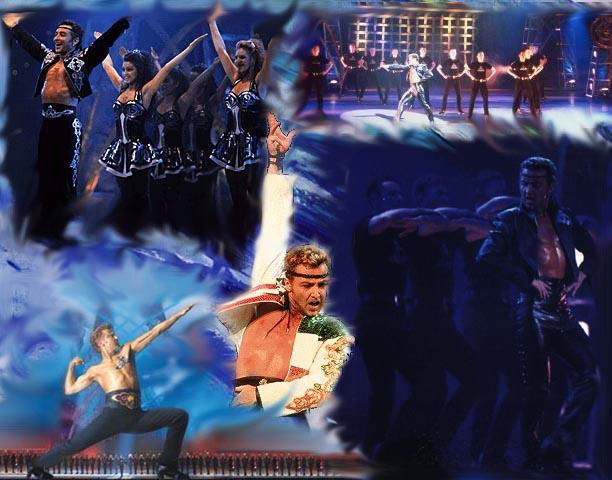 diversions
away from traditional competition-type dances, many critics and most fans
applauded it for its innovations, great music from beginning to end, intricate
choreography patterns, the loveliness of the precision footwork, the enormous
energy, and because it was just plain enjoyable. After the initial
shock wore off, many purists concurred that a lot of the footwork was indeed
more traditional than they had first admitted. There followed successful
runs in Liverpool, Manchester, the London Coliseum, and other UK sites
except Edinburgh. (A barring clause had been taken out by the Riverdance
management when Riverdance performed there, which prohibited any other
Irish dance show from performing at the same venue for six months.
Since there was only one suitable venue in Edinburgh, "Lord of the Dance"
could not perform there.) The video of the show and the recording
were released and both sold extremely well.
diversions
away from traditional competition-type dances, many critics and most fans
applauded it for its innovations, great music from beginning to end, intricate
choreography patterns, the loveliness of the precision footwork, the enormous
energy, and because it was just plain enjoyable. After the initial
shock wore off, many purists concurred that a lot of the footwork was indeed
more traditional than they had first admitted. There followed successful
runs in Liverpool, Manchester, the London Coliseum, and other UK sites
except Edinburgh. (A barring clause had been taken out by the Riverdance
management when Riverdance performed there, which prohibited any other
Irish dance show from performing at the same venue for six months.
Since there was only one suitable venue in Edinburgh, "Lord of the Dance"
could not perform there.) The video of the show and the recording
were released and both sold extremely well.
"Michael Flatley('s) Lord of the Dance" then went Down Under in late '96 to great acclaim, and came to America in March '97. (Note: PBS first ran LOTD in March '97. Their first broadcast of "The Dublin Show" video was in December '96.) The company with Michael we now call Troupe 1 (T1), and it completed its U.S. tour in October '97. In November, Troupe 1 returned to Australia where this leg of the tour was canceled halfway through when Michael became severely ill with bronchial asthma - a condition that had plagued him through the last leg of the American tour. Reports say he was not well from the beginning in Sydney on November 12. In the only show in Adelaide the "flute jam" was omitted as he struggled for air, being plagued with a coughing fit during "Hell's Kitchen". Again, in the first show in Brisbane on November 27 the flute jam number was omitted, and he then collapsed backstage before the final number, "Planet Ireland". He was hospitalized for three days, and advised to get complete rest. By December 28, he was sufficiently recovered to personally accept the National Entertainment Award in Dublin for "Performance of the Year - Lord of the Dance/Michael Flatley". This is the type of award that is voted on by the public. In January '98, Troupe 1 begin an extensive tour throughout England and Europe, with dates being constantly added, probably into early summer. He will not be performing after July of '98, because he begins filming a semi-autobiographical movie at that time, tentatively titled "Dream Dancer." Hollywood movie studios had been bidding for the rights, but in a recent Australian interview, Michael said he will produce the movie himself. He is also working on a TV special and a biography.Troupe 2 of "Lord of the Dance" (T2) debuted November 10, 1997 in Boise, Idaho to public and critical acclaim, with some of the dancers from Troupe 1 taking over the leading roles. Three, if not all, of the four leading roles will be alternated, not only because these roles are very demanding, but probably to give necessary experience for a third troupe, which is being considered for performances in Las Vegas starting next year. Negotiations with various hotels for one, permanent venue, are underway.
(Ticket-buyers note: In 1998, Michael will be performing with Troupe 1 in Europe. Troupe 2 WITHOUT MICHAEL will be performing in American and Canadian venues. That is why TWO PERFORMANCE VENUES appear with ONE DATE on ticket-selling information. Ask when purchasing tickets if you are not sure which troupe is performing.)
Michael Flatley is currently suing the Riverdance management for two percent of the profits relating to his choreography which they are still using. This lawsuit is still pending. Jean Butler is pursuing a movie acting career and no longer dances. She is considering a lawsuit against the Riverdance management for a share of the profits for the work she choreographed.
---------------------------------------
Compiled by Catherine Chamberlain; updated January 7, 1998.