 |
|---|
|
|---|

In the 1750s, when nearly all of the colonists lived along the Atlantic seaboard, the Ohio River lands were a bone of contention between the French in Canada, the British held colonies and the Native American tribes. It was truly a frontier, with widely separated trading posts and settlements of just a few crude cabins. The Indians were very certain that they should not let the British or French encroach any further and after many letters, and meetings between the parties the Indians made it clear that they expected withdrawals by both parties. As a means of learning more about the fortifications being built by the French, Gov. Dinwiddie of Virginia informed, by letter, Gov.James Hamilton of PA. on Nov. 24 1753, � I have sent a Person of Distinction to the Commander of the French forces on the Ohio to know his Reasons for this unjustifiable step...... and demanding their immediate withdrawal.......The Messenger has been gone three weeks,� (Col.Rec. V, 710)
That �Person of Distinction� was a twenty-one year old Major in the Forces of the Virginia Colony who was well fitted to take on an arduous trip into the wilderness to the northwest. And indeed, he became one of the most beloved Americans of all time. We, of course, refer to George Washington.
The trip across the ridges, valleys and streams took from the day he was commissioned 30 October 1753 until he reported to the Governor on 16 January 1754. Washington moved swiftly to collect the needed party and supplies and by the 24th of November. He had met with Indians under the leadership of Half King, who had already insisted that the French leave, and who now agreed to accompany Washington to the French . Venango was reached on Dec.4th and Washington had a chance to learn valuable information while he dined and wined with some French officers stationed there. Another week of travel brought them to Fort LeBouef, which is present day Waterford in Erie Count. The next day the letters from Gov. Dinwiddie were presented to the highest ranking officer. While these were studied and a reply prepared, Washington made sure he learned all that was possible about the fort, even down to the number of canoes available.
By the 16th of Dec.,with snow getting deeper daily, Washington had received the French reply and departed by canoe down French Creek. Ice and low water made it a tiring trip as many portages were necessary. Fingers and toes were suffering and clothing frozen. Venango was reached on Dec. 22nd.1753. From the Journal of Christopher Gist, a woodsman Washington had hired as �pilot�, we quote parts of a passage that show the dangers faced as they continued their return and a party of �French Indians� appeared.
�We asked them to go with us and show us the way to the nearest fork of the Allegheny... we traveled very brisk for eight or ten miles when the Major�s feet grew very sore and he was very weary... The Major desired to encamp, to which the Indian (guide) asked to carry his gun. But he refused that and then the Indian became churlish and pressed us to keep on, telling us there were Ottawa Indians in these woods and they would scalp us if we lay out; but to go to his cabin and we would be safe. The Major soon mistrusted him as much as I....We went two miles further....we came to a clear meadow; it was very light and snow on the ground. The Indian made a stop, turned about; the Major saw him point his gun towards us and fire. Said the Major,�Are you shot?� �No�, I said. Upon which the Indian ran forward to a big standing white oak, and to load his gun; but we were soon with him. I would have killed him; but the Major would not suffer me to kill him. We let him charge his gun; we found he had put in a ball; then we took care of him. ....We made him make a fire for us by a little run, as if we intended to sleep there. I said to the Major: �As you will not have him killed, we must get away, and then we must travel all night. Upon which I said to the Indian,� I suppose you were lost and fired your gun� He said he knew the way to his cabin and �twas but a little way�. �Well,� I said �do you go home and as we are much tired, we will follow your track in the morning, here is a cake of bread for you. You must give us meat in the morning�. He was glad to get away. I followed him and listened until he was fairly out of the way, and then we set out about half a mile, when we made a fire, set our compass and fixed our course and traveled all night. In the morning we were on the head of Pine Creek.�
One of Washington�s Journal notes is that �From the first of December until the fifteenth there was but one day on which it did not snow or rain incessantly; and though out the whole journey we met nothing but one continued series of cold, wet weather.�
Safety was reached on January 6th. After a day of rest Washington continued to Virginia, arriving at Williamsburg on Jan.16, 1754 where he submitted his report and delivered the French reply.
Edward Everett said of this event: �Such was the journey undertaken by Washington, at a season of the year when the soldier goes to quarters, in a state of weather when the huntsman shrinks from the inclemency of the skies, amidst perils from which his escape was almost miraculous; and this too, not by a penniless adventurer fighting his way through desperate risks to promotion and bread, but by a young man already known most advantageously in the community, who by his own honorable industry and the bequests of a deceased brother,was already possessed of a fortune. In this, his first official step, taken at the age of twenty-one , he displayed a courage, resolution, prudence, disinterestedness and fortitude which never afterwards failed to mark his conduct. (Edward Everett, in �Orations and Speeches� I .588)
This record speaks for itself. Today we need to renew this Nation with the recollection of the perils faced and brave actions of our founding fathers. Let us hold strongly to our heritage and require the best of our leaders.
Until our Notebook is opened once again, we leave you with Washington wearing a British uniform.
As we open our Notebook again, we recall that Major George Washington had returned to Virginia after an arduous winter trip on which he had carried a message to the French who were threatening British control of the western frontier. He had performed well, bringing a French reply back to Gov. Dinwiddie, and was praised for his honorable industry. All this at the age of twenty-one.
Soon, April 1754, he left Alexandria to travel west, this time sent with two companies of men. Upon reaching Great Meadows, he received word from the Iroquois Indian chief he had met on the earlier trip, Half-King. The message warned of French soldiers nearby . Washington and Half-King considered them a danger. Early on the morning of May 28th they surprised the French, killing ten, including the French commander, and taking 10 prisoners who were sent back under guard to Virginia. He wrote to his brother John ,�I heard the bullets whistle and, believe me, there is something charming in the sound.� The first shots of the French and Indian War had been ordered by George Washington.
Just over a month later, on July 4, 1754 at Fort Necessity, Washington was forced to surrender. He returned to Virginia defeated, but , when his bravery was reported, having gained the respect of the men who had served under him.
Since his brother Lawrence�s widow now controlled Mount Vernon, Washington leased the property from her and made it his residence. After she remarried, it became his. Now he turned for a time to agrarian life and the pleasures of Virginia gentry. He dined with neighbors , one of whom was the influential Fairfax family, and especially enjoyed the attention of Mrs. Fairfax. She saw to it that her seamstresses provided him with shirts. Washington wrote to her , charmed by this friendship, and after several letters she replied gently rebuking him. He continued to write.
May 1755 brought the beginning of the Braddock Expedition to Duquesne. While in the wilderness a letter from Mary Ball Washington arrived asking her son to send her butter and a Dutch farm hand. His reply was to explain that his immediate area was in short supply of such items. Mrs. Washington was known to be a domineering and eccentric person and over the years Washington did what he could to keep her at a distance, still providing for her needs. In later years (1771) he purchased a house for her in Fredericksburg, VA, 35 miles from Mt. Vernon. The house is now open to the public.
As the Braddock force neared Duquesne the French and Indians attacked. Washington, ill with dysentery, mounted his horse and joined the fight. Bullets whizzed, slitting his clothes. Two horses fell beneath him. Washington fought on. Braddock was killed and Washington felt he had again failed. The end result, however, was that he became the Commander in Chief of Virginia�s forces , having escaped the wounds of both military and political battle.
Returning again to Mt Vernon , he sometimes traveled in his capacity of Colonel for the Virginia militia. This took him in 1756 to New York and Boston. At what is now Yonkers, New York, he stayed overnight at the home of an old friend , Mr. Beverly Robinson. There he met Robinson�s sister -in-law, the beautiful and accomplished Mary Phillipse, who had many admirers and she seemed to enjoy their homage. Washington was added to her conquests. Perhaps there might have been more but shortly Washington learned that she was betrothed to one of his aides, Roger Morris. Shaken, he returned to his duties in Virginia. Roger Morris and Beverly Robinson sided with the British and by 1776 the Morris/Robinson lands were confiscated. The family became so destitute that Mary went to Washington at the Battery Headquarters where he was staying briefly on his way North. She asked for his help . All he could offer was to assure her that he would do all he could to see that her children�s rights to the family properties would not be effected by the confiscation. The family of Mary Phillipse was allowed to reclaim their home of many years along the Hudson River.
Time passed after Washington�s return to Virginia in 1756, he was overseeing the development of the Mount Vernon plantation and keeping up his military career. And after several attempts he had been elected to the Virginia House of Burgesses.
Returning from some distance, he stayed overnight in the spring 1758 at the Custis plantation. This was a normal occurrence as Virginia hospitality was extended to travelers by plantations along their way. His hostess was Martha Dandridge Custis, a widow of 7 months, who had young children. The overnight visit became a whirlwind courtship. He made more forage to the West on military duty, then Martha Custis and George Washington were married January 6, 1759 at her home on the York River. After a visit to Martha�s Six Chimneys House in Williamsburg , they moved on to Mount Vernon with the children. They, no doubt, envisioned a pleasant life in the Virginia countryside.
Until our Notebook is opened again, we leave you as the clouds of dissent and dissolution begin to appear.
The clouds of dissent and dissolution thickened, men of vision saw the need for freedom from the �Great King across the water� ...but, the King refused to heed and sent more troops and his Navy.
In 1774 George Washington was one of the delegates elected by
Virginia to attend the First Continental Congress in Philadelphia. The
Colonies, though torn by regional politics, were certain that they must heal
the breech with the King and sent resolutions and petitions that
were mostly refused. Then came the first battles of rebellion in New
England. Fighting spread and, alarmingly, more battles were being lost
than won.
Although many Colonists, including Washington ,had abhorred the idea of independence from England, they slowly came to realize that the ultimate outcome of a bitter struggle must be the complete freedom from all ties with the British government .
In May 1775 the 2nd Continental Congress understood that they must have one man as the Commanding General of the entire colonial military force. Would it be a New Englander? John Hancock, was then presiding over the Congress, and although Hancock had no real military experience he was hoping to be nominated. This troubled John Adams. He came to a thoughtful decision and brought before the assembly a motion that Congress adopt the forces then assembled at Cambridge as a Continental Army and appoint a Commanding General for it. But, he added, that it was not the proper time to nominate such a man as it would be a difficult choice, even though he was ready to propose the name of a a gentleman from VA.
George Washington, who had been sitting near the door, realized that Adams was hinting about him as nominee. Modestly, Washington quickly rose and left the assembly room.
On May 15th 1775, the decision was reached and the position was offered to the Colonel from Virginia, George Washington. In speaking to the Congress as he accepted their commission ,Washington expressed his uncertainty, saying his ability and military experience might not be adequate to carry out the trust they had conferred on him . But, that he would exert his every power in the cause of the United States and if he failed, they were to remember his words. He refused the monthly salary that had been voted for the position and promised to keep careful expense accounts for which he would take reimbursement . In a letter to Martha he said that he �would enjoy more real happiness and felicity in a month with you ....than if my stay abroad (away) was to be seven times seven years. �
A month later, June 17, 1775, while Washington was still making preparations to join the troops in New England, the Battle of Bunker Hill was fought.. It was a brave fight, the British lost many men and important officers but they carried the day and the Americans, short on powder and lead, had to flee. A British colonel, dying from wounds said, �A few such victories would ruin the Army�, and Nathaniel Greene, an American commander from Rhode Island remarked, � I wish we could sell them another hill at the same price.�
For the next eight years, the British were his enemy in the field and the Continental Congress was in many things like an albatross around his neck. Washington and his troops outmaneuvered the British Army on one hand , while on the other, with wise words and patience , Washington reasoned and remonstrated with Congress.
Some of the major events these years were: 1775 - the siege of Boston. 1776 -Success came as the British left Boston but hope was fading that Canada could be saved. Continental Congress shocked the world as it officially broke with England and the Declaration of Independence was proclaimed. Howe defeated Washington at the Battle of Long Island , and occupied New York City. The victory of the American forces at Trenton ended the year on a more positive note. 1777 - Began with another American victory at Princeton; Howe entered Philadelphia and Congress had to flee. Then came the defeat at Germantown, but the surrender by British General Burgoyne at Saratoga was greeted with much relief. The winter at Valley Forge was harsh but spirits and hopes brighten when France became our ally early in 1778. It was said that Washington�s men had never seen such delight on their Commander�s face. The Marquis de Lafayette was so excited he kissed Washington on both cheeks to demonstrate his joy. The wilderness area,in Pennsylvania known as Wyoming seemed to burst into flame and destruction on July 3, 1778 as British troops and the Indians of the Iroquois League ravaged along the central Susquehanna River. In the South, Savannah, GA was captured by the British. Then, in mid-November, the town of Cherry Valley, NY at the upper reaches of the Susquehanna was destroyed and many residents killed or taken prisoner.
1779- An attempt to retake Savannah failed, and Charleston ,NC fell as the British began a campaign to conquer the Southern colonies. In the North , General Sullivan was sent by Washington to march through the �Lake country� of New York and subdue the Indian population. Cornwallis was cornered at Yorktown and with the arrival of the French fleet was put under siege. On Oct.. 19,1781, Cornwallis surrendered . Britain now realized that they can�t continue fighting America and France at the same time and the war essentially ended. Still, Washington knew he must keep the American forces intact and ready to answer any new outbreaks by the British until the final peace agreement was signed in France.
In 1782, a year after the victory over Cornwallis, many American soldiers had not been paid for several years for their services and there was considerable unrest in the ranks. When some word of a plan to mutiny and march on the Congress at Philadelphia reached the Commander in Chief he arranged to meet the officers in a face to face meeting. When the General completed speaking on the matter, he withdrew a letter from his pocket and began to read the pledge of a Congressman to redeem the debt owed by the nation to the Army. After a paragraph he stopped and in a moment produced a pair of eyeglasses. �Gentlemen, you must pardon me,� he remarked,� I have grown gray in your service and now I find I am growing blind.� Finishing the reading of the letter, he turned and left. The thought of their commander having given so much touched the men�s hearts and they decided to let their demands be carried to Congress by this man they had followed so long.
On April 19, 1783, the 8th anniversary of the Battle of Lexington, the announcement was made of the signing of the Peace Treaty ay Versailles. The War of the American Revolution had ended.
Washington spent several months winding up his responsibilities. Then, in late November, as the British flag no longer flew over New York City, he consented to go there. After seven years of occupation, a triumphant ride down Broadway was in order, but only if the American flag was flying. Today we honor our nation�s heroes in a similar events. It was at the Fraunces Tavern in New York that he met with his officers� in farewell. A somber moment, many wept as they did not expect to see him again. Glasses were raised in a final toast and each man came forward to shake his hand and silently embrace. There were more receptions, grand balls, parades, bells , and cannon salutes in his honor as he traveled through Philadelphia, Wilmington and Baltimore, on his way to Mount Vernon.
Congress gathered in Maryland�s State House at Annapolis on December 23, 1783 to hear from this amazing leader.The man who had once expressed his doubts about his abilities to be Commander -in- Chief, now stood before them victorious. Thomas Mifflin, the presiding officer, greeted Washington and said to him, �...the United States in Congress assembled are prepared to receive your communication. � Twenty members leaned forward to hear his remarks. With trembling hands the paper was opened and all there listened carefully to his written address. As Washington commended his country to the providence of Almighty God, his voice broke. Then he removed from his pocket his commission, penned in 1775, and presented it to Thomas Mifflin saying, �Having now finished the work assigned me, I retire from the great theatre of action, and bid an affectionate farewell to this august body under whose orders I have so long acted. I here offer my commission, and take my leave of all employments of public life.� Little did he know!
With the War of Independence won, Washington returned his military commission to Congress and made haste to leave for Mount Vernon. Horses were waiting at the steps of the Federal Building and he looked forward, as he hastened along with his companions, to a new era in his life.
Just at dusk on Dec. 24, 1783, to the delight of his extended family and servants, Washington arrived to enjoy his first Christmas at home in eight long years.
Now he looked for new ways to fill his days, restoring his beloved farms, furnishing the new wings at Mount Vernon and riding a 24-mile circuit of daily inspections if his properties. But his mind was still centered on what was happening to the country to which he had given so much of himself as Commander in Chief. This was an unsettled time for the new country, still so loosely bound, and Washington could see inherent dangers. He was convinced a convention of the states was needed to deal with the problems that had developed. He wrote and spoke about this to his friends. When the Federal Convention of 1787 was called, Washington headed the Virginia delegation and once there was elected to preside over the proceedings.
His quiet manner lent dignity and prestige to the daily sessions. He voted according to his principles, which included a strong central government; election of the chief executive by the people, not the state governments; and a three-fourths vote to overturn a presidential veto. The delegates came to realize that no other person would satisfy the nation as its very first President but George Washington.
At the close of the Convention four months later he returned to Mount Vernon and was working in the fields on April 14 when the Secretary of Congress, Charles Thompson, arrived with the official announcement that informed him of his unanimous election to the Presidency with an annual salary of $25,000. There had been no Army pension and he was facing financial hardships along with many others of that period. Washington had to borrow funds to pay his expenses for the trip.
Within two days, Washington was on his way to New York City, the temporary capital. Throngs turned out all along the way to cheer their President-elect. But Washington was filled with misgivings about his abilities, just as he had been when called by Congress to head the American Army. He would serve out of a sense of duty tempered by the awesome responsibility.
Dressed in a dark brown suit, made in America at his insistence, Washington arrived at Federal Hall where Congress was assembled and was introduced by the new Vice President, John Adams, who had already been sworn in, thus setting the inaugural precedent. Stepping onto a balcony, standing before the joyous crowd, Washington was administered his oath of office by Robert R. Livingston, Chancellor of New York State. There was an inaugural speech, a church service of thanksgiving and then fireworks, before Washington presided at a private dinner with his aides.
In the first year, both the President and Lady Washington were careful in defining their responsibilities and social activities. They realized that whatever was done might well become the accepted practice in future administrations.
Taking advice from both Hamilton and Adams, �visits of complement� with the President were scheduled twice a week in the afternoon; every Tuesday he would hold a one-hour levee for suitably dressed men only; he chose to be addressed in person as Mr. President.
Mrs. Washington presided over a public tea party for "ladies and gentlemen" every Friday; together they would host a small dinner party every Wednesday at 4 p.m. by invitation only. These arrangements made them accessible to ordinary citizens and was part of their routine for all eight years .
Washington�s ability to choose capable and worthy men to serve in the newly created Presidential Cabinet was a bright light on a rather clouded horizon. He called only five Cabinet meetings in his first term, but he read and countersigned all letters sent by various the Cabinet members.
Over 1,000 personal appointments were made by the new President to fill he offices required to run the new government and its agencies. This went as far as appointing lighthouse keepers and approving the orders for the oil to run the lighthouse lamps.
When Senators complained that they should have some say in the appointments in their own states, the arrangement of �advise and consent� was devised.
And also, the Legislative, Judicial and Executive branches began feeling their respective ways in the halls of government set forth by the Constitution under the thoughtful and discerning guidance of the President and his advisors. Washington did not believe the President should interfere with the Congress.
Although he would have preferred to end his presidency in 1792, he was deeply converened by problems that existed within the government and between the new states, such as the development of a two-party system, and the threat of an English and French war that might easily draw American into it. Both Jefferson and Madison pleaded with him to �make one more sacrifice.� Washington could not bring himself to forsake the call of duty, which had always guided his actions. The Electoral College, in December of 1792, again elected him to serve. They knew he would never refuse the call of his countrymen.
The farmers of Western Pennsylvania became a serious problem in 1794. Their only cash crop was corn, and welling it in the East was very expensive due to its bulk. Solution: convert it to whiskey and ship that. But a new Federal tax on whiskey was levied, and when tax agents tried to collect, riots and civil unrest resulted. Washington knew Federal laws must not be scoffed at. He called up a large number of troops from the militia of Pennsylvania, New Jersey, Virginia and Maryland.
Donning his old uniform he traveled to Bedford as commander and soon all resistance was ended. Twenty �rebels� were sent to Philadelphia for trial; 18 were released for lack of evidence, two were convicted. Washington pardoned them both due to their mental problems. Washingotn�s use of State militia to enforce Federal laws set a precedent still in use today. He is the only sitting President to actually command a military unit during his term in office.
The waters of the Presidency were rough and even tempestuous as he served those final years. It required great wisdom and patience at home and abroad. He counseled prudence and moderation on all sides.
Weary from the demands of the past eight years, he was dismayed by the criticisms of Congress, by the opposition press, which he labeled �discontented characters; a corrosive and disuniting force.�
Washington wrote to Henry Lee, �No man was ever more tired of public life.� This, after 47 years of service to his country from his first military experience in the British militia, through the long eight years of the Revolution, the Constitution debates, and finally another eight years as the president of a new political system.
We must marvel at his integrity, leadership and his resolve to make this new concept of government successful: A government that served the people, a government of new ideals, a government whose strength was in the vision of its people.
Once again we open our Washington Notebook, this time to the final chapter. It was March 16th,1797,twelve days since John Adams had taken the Oath of Office as President, that the Washington family were finally able to begin the several day journey to Mt.Vernon, and be home at last.
For most of the time Washington was busily engaged in the activity he had always cherished, caring for Mt.Vernon and his family. He wrote in May of 1797 to a friend, �to repair houses going fast to ruin, to build one for the security of my papers of a public nature and to amuse myself with Agricultural and rural pursuits will constitute employment for the years I have to remain on this Terrestrial globe...�
Late in 1798 , when war with France seemed possible , and after a visit from James McHenry,Secretary of War who carried a letter from President Adams, Washington agreed to again become Commander of the nation�s military forces, with the agreement that he could do this from his Virginia home.Fortunately,the war never materialized.
A high point in the family was reached when, on Washington�s 67 birthday,his beloved step-granddaughter Nelly Custis was married to his dear nephew Lawrence Lewis . For the occasion , at the bride�s request, he had donned his Continental buff and blue uniform, still a good fit.
That summer he decided that a new will was in order, Nelly and Lawrence were expecting a child and Washington wanted to be sure they were properly settled nearby.
He hand wrote a twenty-eight page will making sure all his wishes for his family, farm people and vast properties were properly set forth. It made good sense as every man of his age, even in good health, should have such a document.
Autumn of 1799 was a fine one, even though Washington�s last brother Charles died. He commented that he had been the first child of his father�s second marriage and now was the last.
In November ,when he escaped injury as he unexpectedly was unseated from his horse,family members recalled the prophecy of an old Indian chief, that he would lead a charmed life. This scare was soon put behind as Nelly gave birth to a daughter names Frances Parke Lewis, Martha�s first great granddaughter.
December 1799.arrived A new century was upon them.. what would it bring to their beloved Country and to the family they loved?
A round of guests filled the first few days and on the 11th in the evening , warm for the time of year, Washington commented on the halo circling the moon. A coming storm he thought, would it be rain or snow ?
It was not unusual when the next morning he mounted his horse and rode out into a cold and blustery day for a look at the farms that were part of his Estate, It was December. 12, 1799. There was rain, then sleet and finally some snow. As he was an old soldier ,probably little was thought of it. In fact, he went out again the next day on a hours circuit, but by nightfall was troubled by a sore throat and as the night of December, 13 wore on began to have trouble breathing. Despite desperate efforts of his doctors through the following day Washington realized he was facing death . He met it as he had lived his life saying ,� I am willing to go.� He was 67 when he died at 10:20 on the evening of December 14, 1799. The burial service, with honors by the local Virginia Militia and the eulogy delivered his own Anglican pastor ,was held at the family vault at Mt.Vernon. An eleven gun cannon salute ended the service.
The passing of this beloved leader was a shock to all, there had been no warning, Congress learned of his death before they knew he was ill,and after his burial had taken place. There was no system faster than the horse for carrying messages and so word spread like rings across water with the travelers, the circuit riding preachers, the wagon masters and the boats traveling the coast.
. The grief and sadness did something that Washington himself had not fully accomplished during his Presidency , uniting all in a common bond of loss that crossed all state lines and geographical divisions. John Adams issued an official proclamation on Jan.6 ,1800 setting Washington�s birthday, Feb.22 , as the day of national ceremonies to testify �to the grief�. . Public Eulogies, Orations and Prayers were suggested and a six- week mourning period was to commence.
From the southern fields to the rocky coast in the north , from the frontier towns of the west to the cities of the eastern ports Washington�s greatness in his roll as a military and political leader were proclaimed and the people mourned. We will travel about the, then, United States to learn what happened.
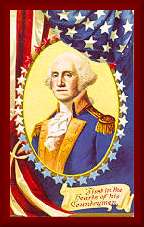
Our nation�s capital was then Philadelphia,they knew Washington well and determined to have a mock funeral service on Dec. 26. It was a large scale reproduction of the Mount Vernon service held nine days earlier. The words spoken by Congressman Henry �Light Horse Harry� Lee are still remembered today,�first in war , first in peace ,and first in the hearts of his countrymen� Lee also remarked that the purity of Washington�s character �gave effulgence to his public virtues�.
The empty bier in Philadelphia was guarded for the next two months by sentries as the city mourned. All wondered if the unity citizens felt when Washington was their leader would now be sustained.
On December 21 the New York newspapers spread the word in black bordered headlines �Columbia Mourns� . Gouverneur Morris was ask to present a proper eulogy. He praised Washington�s wisdom and declared that his clear judgments were the result of a mind that was pure. The huge crowd listen and gave thunderous applause at the conclusion.
It took three days for the word to arrive in Boston from New York.Here the power of Washington�s leadership had special meaning. On January 9, businesses closed all over the city, ships flags were lowered to half-mast, cannon fired salutes and bells tolled. A estimared crowd of 6000 gathered and at precisely noon marched from the new State House through the streets, six abreast,the Old South Meeting House to hear George Richards Minot pay tribute to the beloved Washington.
Abigail Adams remarked that �History will not produce to us a parallel�. and �Simple truth is his best, his greatest eulogy. She alone can render his fame immortal.� <
It as three weeks before the citizens of Lexington ,Kentucky which was 650 miles away from Philadelphia,heard the sad news. The town trustees voted to join a procession on following Saturday �out of respect for the Revolutionary hero George Washington, Commander -in-Chief of the Revolutionary Army of the United States of America� and �who then resumed his station as private citizen in 1783�.The theme of the American Cincinnatus , returning to the plow after saving his country,was used in many of the memorial observances members of that Society organized.
In Lexington,Virginia Liberty Hall, a school which Washington had endowed with $50,000 in his will ,had a procession and memorial service . The trustees changed the school's name to Washington Academy and voted to use the funds to make repairs, buy new library books and pay off its debts.
About the time Kentucky had learned of the death of our first President, England was also reacting with mixed feelings.
John Quincy Adams,in Europe, received the sad news on February 4,1800 . Napoleon ,too, paid honor to the American hero: French battle standards were draped in black, Washington�s bust was placed in the Tuileries beside other modern and ancient heros , eulogies were delivered in Paris.
.. A Dartmouth College student named Daniel Webster wrote to a friend early in February of 1800, wondering how the nation would go on,having lost what he termed �the great political cement�. Across the nation many were also pondering whether the still infant nation could survive.
Even today, there is no nation that has been blessed with greater founders than our own. One in particular, we remember at this time,on bended knee at Valley Forge. Turning to the One he called Divine Providence. Washington clearly believed that the events in his life ,as well as those of this the new Nation did not unfold by action or happenstance, but by divine design. From the time the bullets whistled past him in the wilderness of Ohio to his final days he believed a special presence had led him through every step and was paramount in the fortunes of his beloved country.
Truly, we were blessed with the leadership of this man, George Washington.
Let us remember and honor him on the 200th Anniversary of his death, December 14, 1999.
| HOME PAGE | CHAPTER ANCESTORS | CHAPTER PROGRAMS | COMMUNITY SERVICE AWARD |
| NSDAR | FORT MCCLURE HOUSE PAGE | JAMES MCCLURE PAGE | MEMBERSHIP INFORMATION |