The following
text from: "Antecedents and Descendants of Margaret Ann Rhoads Smith (1860-1949)",
Created primarily by Frances Smith Brownlee with later help for subsequent
printings from Mary Ellen Philips and George Willson White.
But what's really interesting here is what
was this Capt. Cluggage character doing in the
Revolutionary War. It seems, he was fighting Shawnee. Now,
this little bit of history is new to me. (Got it off the web in the
deposition from John Chilcoat.) Didn't know the
Indians were our enemies, too. But a little thinking would make that
an obvious. Turns out, after reading a few of the Native American
links spread throughout this page, the British hired the Indians to bring
in scalps. Not too surprising, the tribes in the districts, were
more than willing to oblige.
If we want to get romantic, we could believe
the reason Daniel Rhoads didn't re-enlist was because they were fighting
Indians, and not British, and that made him sick. On the other hand,
as Brownlee suggests, it could have been that Daniel was hot to get back
home to Eva. That sort of runs in the family. OK on to Brownlee:
The role of Daniel Rhoads, Katie's ancestor, in the Revolution
was shorter than his brother's, but far more romantic. Although only a
private, he was one of the famous Minute Men(1).
At the time of the stirring events around Boston in the spring of 1775,
it was decided to send MinuteMen from the general colonies for the relief
of the Bostonians. The response was so generous that three colonies alone
furnished the eight units called for, and Penna. sent six of them. Her
expert riflemen,  used
to fighting Indians, were most acceptable. Capt. Francis Cluggage,
in whose company our Daniel Rhoads was a 19-year-old private, was ordered
to march to Boston. By the last of August, Cluggage was on his way. Under
the date of August 25, 1775, Philip Fithian, comments on the sorrow of
Mrs. Cluggage, at whose home he was visiting in Bedford:
used
to fighting Indians, were most acceptable. Capt. Francis Cluggage,
in whose company our Daniel Rhoads was a 19-year-old private, was ordered
to march to Boston. By the last of August, Cluggage was on his way. Under
the date of August 25, 1775, Philip Fithian, comments on the sorrow of
Mrs. Cluggage, at whose home he was visiting in Bedford:
"One of her sons has gone as a captain of a company of
riflemen to Boston. Just now gone. Her tears are not yet dried since his
departure. Another of her sons has been chosen captain of the militia here.
There are five brothers of them, and all appear to be men of prudence and
understanding."
One may also read about Cluggage's riflemen in the Pennsylvania
Archives:
"Cluggage' s men were at Bunker Hill (June
17, 1775)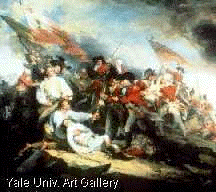 and
Breed's Hill. On the first of January, 1776, the organization of the Continental
Armies began, and this company became a part of the First
and
Breed's Hill. On the first of January, 1776, the organization of the Continental
Armies began, and this company became a part of the First 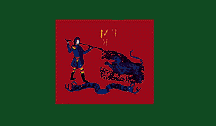 Regiment
of the Continental Army, (aka First Pennsylvania Rifle Regiment) consisting
of 693 officers and men. By March, they were ordered to Dorchester and
later to New York to serve under Gen. Sullivan. Their standard, which now
belongs to the state of Pennsylvania, depicts a green tiger with a spear
attempting to pass, but being held back by riflemen. The company's motto
was Molo Domari (I will not be conquered). When the time for the riflemen
expired on June 30, 1776, they nearly all reenlisted."
Regiment
of the Continental Army, (aka First Pennsylvania Rifle Regiment) consisting
of 693 officers and men. By March, they were ordered to Dorchester and
later to New York to serve under Gen. Sullivan. Their standard, which now
belongs to the state of Pennsylvania, depicts a green tiger with a spear
attempting to pass, but being held back by riflemen. The company's motto
was Molo Domari (I will not be conquered). When the time for the riflemen
expired on June 30, 1776, they nearly all reenlisted."
Daniel Rhoads did not re-enlist. He was homesick for his
mountains and for Eva Foust, the girl he left behind when he had set out
for Boston. Before he was 22, he married this girl, who became sixteen
only one day before her first child was born. After a few more years in
Penna. and after the fourth child was born, Daniel brought his family in
company with his three brothers and their families to Kentucky. They were
part of a large migration from Bedford County under the leadership of Henry
Rhoads, now a man of 45.
Their journey was fraught with toil, hardship, and privation,
particularly through the Alleghenies, over which they had to travel by
horseback or on foot, driving their stock before them. Only the expectation
of good homes, rich land and even wealth beyond the mountains could have
sustained them. Could they have been typical of the following?
"The men carried a gun and an ax on his shoulders; the
wife the rim of a spinning wheel in one hand and a loaf of bread in the
other. Several children had each, according to his size, a bundle. Two
poor horses were each loaded with some poor necessaries. On top of the
baggage of one was an infant rocked to sleep in a sort of wicker cage,
lashed securely to the horse. A cow was one of the company, and she was
destined to perform her share of the service. A bed-cord was wound around
her horns, and a bag of meal was carried on her back."
After reaching Fort Pitt, the men built flat boats, upon
which they placed their large families and a few possessions to float them
several hundred miles down the Ohio River. These boats were mere rafts
with shelters, small and crude fastened upon them. 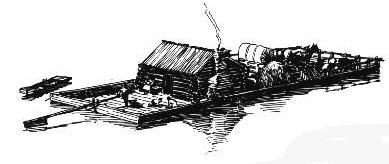 Weeks,
however, were required for their construction. Since there were no saw
mills yet in the wilderness, men had to fell the trees and hew out with
an ax the planks of which the boats were built. Once the Rhodes's were
established on their craft, they still had before them a long and slow
trip to be made with toil and labor amid the greatest peril. (2)
Weeks,
however, were required for their construction. Since there were no saw
mills yet in the wilderness, men had to fell the trees and hew out with
an ax the planks of which the boats were built. Once the Rhodes's were
established on their craft, they still had before them a long and slow
trip to be made with toil and labor amid the greatest peril. (2)
At the mouth of the Salt River, not far from Louisville,
they entered Kentucky at a time when none of its pioneer settlements was
really safe from Indian depredations. Fearing atrocities, they settled
their wives and younger children on some of their military allotments along
the present line between Nelson and Hardin Counties. They went themselves
with their older sons farther west into what now comprises McClean, Muhlenburg,
Christian, and Ohio Counties where they were to survey land both for themselves
and for others. (3)
Henry Rhoads II, married since 1760, brought a wife and
nine children to the new country. Daniel had a wife and four children.
(4) Four more children were added to the
latter's family during those early years in Nelson Co. Four months after
the birth of her eighth child, his first wife died. Though Eva Foust was
only thirty, the bearing of eight children in fifteen years without benefit
of doctor, was, to be sure, not the only hardship this young pioneer wife
and mother had to endure. (5) For a bit
longer than two years, Daniel Rhoads remained a widower, with the two oldest
of his daughters (13 and 11 years) as his housekeepers. At nearly 40, he
was granted a license on March 10, 1794 to marry (the wedding was on March
15) Elizabeth, the 21-year-old daughter of Thomas Newman. (6)
In August of that same year, Mad Anthony Wayne's victory
over the Indians at Fallen Timbers was supposed to put an end to Indian
troubles, but since many Kentuckians and Indians too were a long time in
hearing about, and a longer time learning to respect the terms of the Treaty
of Grenville, atrocities (for the Shawnee
side of the story, go to this fine
page) continued in regions remote from the forts. It is probable
that three or four more years elapsed before any of the Rhodes's unable
to use a rifle expertly went to live on the outlying allotments (7),
which were near the Green River (8).
It may be read in Collins' History of Ky. that the first
fort (these early combinations of fort and village in KY were called stations)
established in McClean County was on the present site of Calhoun, having
been built there by Solomon Rhoads in 1788. According to some traditions,
this fort, called Rhoadsville, was built by David Rhoads, by Daniel, according
to others. The truth is that all of the brothers and some of their oldest
sons had a share in building Rhoadsville, and it was surely in existence
before 1788. (9)
It is well known that almost every foot of land in early
Kentucky was contested in the courts. That settled by the Rhoades was no
exception, for in 1790 they lost the title to Rhoadsville and its environs.
They then moved on a few miles farther south and began to survey the land
in General McClanahan's allotment under a contract, which Henry had made
with him just after the Revolution. In this project also, the brothers
were destined to encounter trouble. (10)
In the final settlement, even Henry's holdings were greatly curtailed.
(1) This information published by
the DAR's around 25 years ago in Illinois in The Revolution about our Daniel
Rhoads is not entirely correct: "Daniel Rhoads was from Massachusetts,
where he served in Capt. Sam Payson's Co., Col. John Groton's Reg. as a
Minute Man, enlisting Apr. 19, 1775 for 8 days. He served 3 mos. in Jos.
Reed's Reg., having enlisted again in Sept., 1776 in a battalion in Hull."
The DAR's are correct only in saying that he was a MinuteMan. The remainder
of the record belongs to another Daniel Rhoads. Our Daniel's pension number
is 20,142.
(2) While some steered the uncertain
vessels by means of long oars and poles past rooks and snags, through shallows
or swift eddies, others, when the topography permitted, walked along the
shores to exercise their cramped limbs, to kill wild game, and to gather
whatever other food the forest or prairie had to offer, for there were,
you may be sure, no shops along the way, and even if there had been there
was little money to be spent. Think what must have been required of the
mothers in preparing food, in keeping the bodies and clothing of the children
clean, in doctoring their little ailments from the bites of insects and
the scratches of briers, in worrying over them when they were beset by
grave diseases, as they often were, in their tragic suffering leaving a
little one in a lonely grave by the River's side! Someone must constantly
be on the alert to prevent the restless children from falling overboard
or from wandering into the wilds whenever they made camp on the shore.
If they traveled by night, they could more easily elude the savage, but
the perils of the River were much greater then. If they moored the boats
to relax on the shore, their encampment was made terrible by the howls
and screams of animals and by the shrieks of Indians, which might pounce
upon them at any moment.
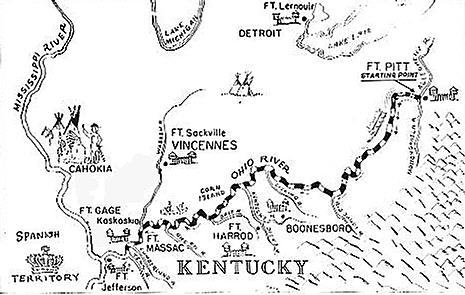
Not even on the water were they safe from the Redmen's
swiftly moving canoes. The Rhodes's may well have had just such an experience
as the one related by one of their neighbors, Judge Rowan of Bardstown,
KY. His family had come there at almost the same time and by the same route
as the Rhodes's. As the Rowans were drifting one night, they saw the Indian
fires and heard their fiendish uproar. The tiny crew of seven people were
determined to sell their lives as dearly as possible. The judge said, "Discovering
us when we had got about midway of their fires, they commanded us to come
to them. We were silent, for my father had given strict orders that no
sound should be made, but that of his rifle, and not that until the Indians
should come within powder-burning distance. Uniting in a most terrific
yell, they rushed to their canoes and pursued us. We floated on in silence.
Not an oar was pulled. They had come within less than a hundred yards with
a seeming determination to board us. Mother arose, collected the axes and
put them by each man where he stood with his gun, touching him on the knee
with the handle of the ax. Then she leaned it by him against the side of
the boat. Returning to her seat, she held. A mallet in her own hand. Though
pursuing three miles, the Indians did not find courage enough to attack
our intrepid band. After we had made good our escape, our brave mother
said, "We have made a providential escape, for which we ought to feel most
grateful."
(3) The land records of Kentucky show
nearly twenty military and other grants to Rhodes's, most of them men from
our family, between 1776 and 1816. The earliest is the grant to Henry.
Other earlier ones are 400 acres to David on Robinson's Creek in Nelson
Co. on 3-24-1786; 200 acres to Daniel on Pond Creek on 6-5-1793. On 6-12-1793,
Henry received a military grant of 6,666 acres on Rock Creek; in 1797,
he obtained grants of 525 acres and 255 acres on Muddy Creek and Green
River and 1,000 acres on Long Fall Creek in Hardin County. All of these
grants to Henry but the last are in the region of the later Rhoads settlement.
(4) We have no data on the family
of Solomon Rhoads, except for the fact that he married Nancy Bradley in
1772 and that she died in Kentucky before 1798; he was 96 at the time of
his death. We know nothing at all about the family of David. Cf. later
note at the bottom of p. 20.
(5) When the Rhodes's first came into
Nelson Co., the cabins in which they were to live had to be raised, and
a spot had to be hewed out or the wilderness on which to plant gardens
and corn. The few neighbors they found already there were kind, giving
them a most hearty welcome. So many young men and experienced soldiers
meant excellent assistance in warding off the savage. The neighbors shared
with them their already crowded rooms and insufficient fare while the new
homes were being prepared. The Rhodes's had brought nothing with them that
could not be carried by themselves and their pack animals. While some stood
guard against the constantly menacing Indians, others raised cabins, built
beds, tables, and stools, and soon they had things fairly comfortable,
even though far below our standards of comfort. Their one-room cabins may
not even have had floors. Whatever floors they had were made of puncheons,
those long planks, split from trees, about 18 inches wide and smoothed
off on the face1 to some degree with the broad axe. The tables were of
split slabs, smoothed off and supported by four round legs, set in augur
holes in the puncheon floors. Some three-legged stools were fashioned in
a similar way. Wooden pins, stuck in logs at the back of the room, supported
clapboards to serve as a cupboard for dishes and cooking utensils. Whatever
of these articles they had not brought from the East were of their own
manufacture, for there were no stores to supply them. Utensils of metal,
excepting the ax, augur, rifle, and a few knives, were rare. Iron forks
and tin cups were luxuries. Dishes for the table consisted largely of wooden
vessels either turned or coopered.
(6) The marriage bond read: "Knowall
men by these presents that Daniel Rhoads, am held and firmly bound unto
----, Clerk of Nelson County, State of Kentucky, in the just and full sum
of $500.00, by which payment well and truly to be made, I bind myself,
my heirs, and assigns for and in the whole, sealed with my seal and dated
this 10th day of March, 1794.
"The condition of the obligation is such that whereas
the above bound Daniel Rhoads has this day made application for license
to join in matrimonial bonds together with Miss Elizabeth Newman, now if
said Daniel Rhoads does not well and truly marry the said Miss Elizabeth
Newman without any fraud, partiality, or illegality attending the said
marriage, then this obligation is to be void; otherwise to be and remain
in full force and virtue of the law. Bondsman, James Murphy."
(7) Will Book A in the Hardin Co.
Clerk's office shows that Henry Rhoads was still claiming a residence in
the relatively safe Hardin Co. as late as 1797, for we read that Stephen
Cleaver, Harrison Taylor, and Henry Rhoads qualified in the Hardin Co.
Court for the March term, 1797.
(8) For years, the Rhodes's made many
a trip between the valley of the Green River and that of the Rolling Fork.
A camping spot on these journeys was near a ford over Richland Creek. We
have read the reminiscences of an old surveyor, a generation or two younger
than the Rhodes's. He used to stop at this spot to eat his lunch when he
was surveying a road which crossed the old trail taken by the Rhodes's
from Bardstown and Elizabethtown to Barnett's and Hartford Stations in
the region of Green River. The surveyor often rested at the old creek ford
under a huge beech tree. The bark was literally covered by names, with
dates, carved into it. Of those people who had visited this spot for some
fifty years past, the Rhodes's had by far the preponderance of oldest names.
(9) In the evidence of an old suit
of John Handley vs. Nyers, Chase, and John Dorsey's heirs, we get much
information about this old station. Feb. 25, 1785, Henry Rhoads, Isaac
Cox and Isaac Morrison were authorized to lay out a town at Long Falls
on the Green River. They were to grant lots to settlers upon their actually
building and settling there. An old historian, who had actually seen a
plot of the station, says that provision was made for 172 half-acre lots
and a public square of four acres within the boundaries. These were to
be more or less secure from Indian attacks. There were to be numerous out-lots
of 8 acres each for farming by those who actually lived within the stockade.
Henry Rhoads, Daniel Rhoads, Sr., Daniel Rhoads, Jr. (Henry's second son,
a man of about 25) are the names leading the list of some 25 subscribers
to the lots. Most of the names are English. Besides the Rhodes's the only
two names notably German are Abel Undel and Sm. Casebier. Indian incursions
were too frequent to allow cultivation of the out-lots as long as the Rhodes's
held control of the station. After about five years, other men, who could
presumably offer a better title to the land on which Rhoadsville had been
built than our ancestors could, took over the site and changed the name
to Vienna. At a much later date, it became the present town of Calhoun,
the county seat of McLean County.
(10) As early as 1786, the Dorseys
of Maryland had entered a series of suits in the Ohio Territorial Courts
to dispute McClanahan's title to this land. Henry Rhoads had laid claim
to and had continued to survey the land in General McClanahan's holdings
to the extent of 17,000 acres. After long litigation, Henry came out in
1797 with only about 7,000 acres. In that year a commission of seven men,
of which Solomon Rhoads was a member, had instructions to divide up the
land. Oct. 25, 1801, the commission gave Henry 2,000 acres as his share.
He added 500 acres to this by purchase, and on this land nine miles from
Greenville, Ky., seven generations of his family have lived and died.
Appearance of John
Chilcoat (1758-1851) Before Cooper Co., MO Court on 4 February 1834
-- Revolutionary War Service Deposition.
Exhibit 0509
State of Missouri
County of Cooper
On the 4th day of February 1834, personally appeared in
open court before the judges of the County Court for the County of Cooper,
aforesaid (the former being a court of Record having a seal) now sitting
John Chilcoat, a resident of the County of Morgan in the state aforesaid
(Missouri) aged 75 years on the 27th day of last November, who being first
fully sworn according to law doth on his oath make the following declaration
in order to obtain the benefit of the act of Congress passed June the 7th
of 1832.
That he entered the service of the United States under
the following named officers and served as herein stated. Giles Stephens,
Lt., Frank Clubbage [Cluggage],
Capt. of the company to which he belonged. 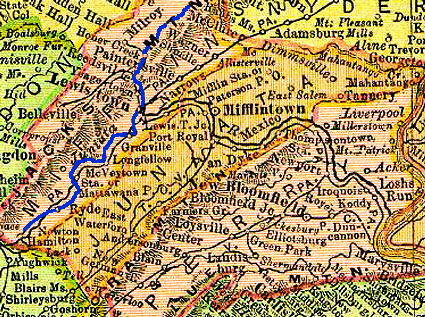 That
he entered the service under said company officers as a volunteer sometimes
in the month of May (the precise day not recollected) in the year 1775
from the County of Bedford in the State of Pennsylvania. That
he was marched in said company up the Juniata River through the Gap of
Jacks Mountain by the standing stones of the North side of Juniata River
up ___ River (having joined General Maynes army at Fort Littleton
in Bedford County. The other field officers not recollected.
That
he entered the service under said company officers as a volunteer sometimes
in the month of May (the precise day not recollected) in the year 1775
from the County of Bedford in the State of Pennsylvania. That
he was marched in said company up the Juniata River through the Gap of
Jacks Mountain by the standing stones of the North side of Juniata River
up ___ River (having joined General Maynes army at Fort Littleton
in Bedford County. The other field officers not recollected.
That he crossed some mountains (the names forgotten) and
marched to a low flat country where they had a skirmish with the Cherokee
Indians (might be Susquehannock,
the Cherokee lands were several miles south west of where he marched.)
These Indians then were commanded by Guy Johnson a white man who was killed
in the fight. That they then marched three or four days on towards the
Cherokee towns
where they halted and General Maynes sent our a company to spy and find
out where the towns were. And in a few days two of the company the was
sent out as spies returned and reported that all the rest had been killed
by Indians--upon which General Maynes marched us all (the whole army) to
the Cherokee town which we found deserted by the Indians except some old
men, women and children. We cut all their corn and destroyed it and also
burned and destroyed a full store of goods. We then marched two or three
weeks to a place called the White Fields where this claimant with some
others were honorably discharged after nine months service of this claimant
and returned home where this claimant stayed till the ensuing spring when
the time precisely not recollected.
He again entered the service as a volunteer under Capt.
Thomas Blain, Jar Milking, Lt., who commanded a camping company. They marched
from home (the County of Bedford aforesaid) over the Blue _____ Mountain
and camped between it and Broad Mountains and returned home later in the
fall after a service of at least seven months without being in any engagement.
That they were ordered by their captain after returning home to keep in
readiness to march again when called on.
That they accordingly hold themselves in readiness until
the next spring when they were again called on by the same officers and
marched upon the waters of the Red Stone and ranged between the Glades
and Basic Hill about and at least six months and returned home and after
remaining a week we were marched over Jacks Mountain after Indians when
we came across a party of Indians and killed thirteen of them and captured
one white man and two wounded and continued camping and spying at least
three months longer. Then they returned home and were discharged.
That he was afterwards out in scouting companies divers
times as necessity required and was thus engaged at least six months longer.
This claimant further states upon oath that [he] cannot
recollect from infirmity of body or further consequent decay of memory
the precise length of his service but from the best of his recollection
he was engaged in active service as above stated at least two years and
seven months in the capacity of private soldier and a volunteer and that
he makes oath to this declaration before this County Court of Cooper instead
of the County of Morgan County where he resides for the reason that Morgan
County being a new County recently established, is not yet provided with
a seal and the County of Cooper is. And that he claims a pension for the
two years and seven months as above stated. That he has no documentary
evidence and that he knows of no person whose testimony he can procure
who can testify to his service.
He hereby relinquishes every claim to whatever to a pension
or annuity except this present and declaring that his service is not on
the pension rolls of this agency of any state.
Sworn to and subscribed this day and year aforesaid and
in open court.
/S/ John--his X mark--Chilcoat
The Susquehannock
lived in a number of large, fortified villages (perhaps as many as 20)
that stretched along the Susquehanna River and its branches across Pennsylvania
into southern New York. How far west their territory extended on the western
fork of the Susquehanna and the Juanita Rivers is unclear
History
of Shawnee
The cycle of atrocity and revenge continued during 1781,
In the spring Daniel Brodhead burned the Delaware capital at Coshocton.
Women and children were taken prisoner, but men were executed by tomahawk.
By the time a war council met at New Chillicothe in June, there were no
neutral tribes in Ohio. During the summer, war parties, often led by Simon
Girty, struck throughout Kentucky and Pennsylvania. By August George Rogers
Clark was gathering an expedition to capture Detroit, but a group of Pennsylvania
militia coming to join him was ambushed near the mouth of the Miami River
(Cincinnati) by Canadian Iroquois and Tories led by the Mohawk Joseph Brant.
Afterwards, Brant waited to ambush Clark on the Ohio. Clark, however, avoided
the trap and reached safety at Fort Nelson (Louisville), but Detroit remained
in British hands until 1795.
In March, 1782 Pennsylvania militia massacred 90 peaceful
Moravian Delaware at Gnadenhuetten (Ohio) giving the Delaware good reason
for revenge. In June an American offensive against the Sandusky villages
was defeated during a two-day battle in northern Ohio. The American commander,
Colonel William Crawford was captured by the Wyandot and turned over to
the Delaware. While Simon Girty watched and taunted him, the Delaware burned
Crawford (a personal friend of George Washington) at the stake. In August
Girty led another raid against Kentucky, this time at Bryan's Station.
Pursued by militia, he ambushed them at Blue Licks on the Licking River.
Sixty Americans were killed including Daniel Boone's son Israel. The Mingo
burned Hannastown, Pennsylvania, and in October a 300-man war party attacked
Fort Henry at Wheeling, West Virginia for a second time. The following
month, Clark with 1,100 mounted riflemen defeated the Shawnee on the Miami
River and burned six of their villages, including New Chillicothe.
TIMELINE
FOR UPPER AND LOWER TURKEYFOOT TOWNSHIPS
1753---George Washington passed through and mapped area, designating
this "Turkeyfoot"
--
1766---Proclamation prohibited settlement in this area.
1768---Indian treaty signed at Fort Stanwix, N.Y. selling land west
of Alleghenies to Penn.
2/23/1769---Land Office opened giving access to land west of Alleghenies.
Bedford County and Brother's Valley Township created.
1773---Somerset County created
11/27/1779---Divestment of land from William Penn to the Commonwealth
1795---Turkeyfoot Township reduce to 1/6 of Somerset County
1848--- Turkeyfoot Township devided into Upper and Lower townships.
From: History of Bedford and
Somerset Counties
"In a letter written at Delanceys Mills by Colonel
Hand to General Washington, he speaks of congress having an objection to
the advancement of his oldest captain (Captain cluggage), and submits to
the General a list of the names and ranks of the captains under his command,
that he (Washington) may forward the same to congress with a recommendation
for the appointment of a major therefrom. Whilst Captain Cluggage,
of the Bedford county company, ranked first on the list, congress took
occasion to turn him down, and on September 25 appointed Captain James
Ross as major. This action induced the resignation of both Captains
Cluggage and Smith. Captain cluggage's resignation was couched in
very dignified language, and was accompanied by his best wishes for the
success of the arm's cause, and will be foud in Force's Archives, 5th series,
vol. 2, page 921."
Roll of Captain Robert Cluggage's Company, Fall of
1776
Captain: Robert Cluggage
First Lieutenant: John Holliday, commissioned
June 25, 1775
Second Lieutenant: Robert McKenzie, died February
12, 1776
Benjamin Burd, from third Lieutenant
Third Lieutenant: Benjamin Burd, October, 1775,
promoted second Lieutenant
Sergeants:
James Holliday
Daniel Stoy, discharged at Long Island, July 1, 1776;
resided in Somerset County Pa., in 1811
Querinus Meriner
David Wright
Corporals:
Aquilla White
William Lee
Josephy McKenzie
Angus McDonald
Drummer:
Timothy Sullivan
Privates:
-
Adam Anderson, resided in Westmoreland county in 1818
-
Philip Beechy
-
John Bowman
-
Thaddeus Broughdon, discharged February 10, 1776
-
Thomas Brown
-
George Bruner
-
John Campbell
-
Thomas Casek
-
Stephen Cessna
-
Patrick Clark
-
Philip Conner
-
James Corrowan
-
Joshua Craig, resided in Cumberland county in 1820
-
John Crips
-
Alexander Crugren
-
Thomas Cunningham
-
James Curran
-
John Davis, afterward adjutant Flying Camp
-
Cornelius Dilling
-
William Donelin, re-enlisted First Pennsylvania
-
Matthew Dougherty
-
Laurence Dowling
-
Daniel Franckks
-
George Freeman
-
Amariah Garrett
-
Daniel Geberland
-
Reuben Gillespy
-
Richard Hardister
-
Conrad Hanning
-
Francis Jamison, re-enlised First Pennsylvania
-
Andrew Johnston, enlisted June 25, 1775; promoted lientenant
First Pennsylvania
-
Matthias Judy
-
John Kelly, "September 14, 1775, John Kelly, one of Captain
Cluggage's men, shot one of captain Chamber's men through the head for
stabbing him," Wright's Journal
-
Peter King
-
James Knight
-
William Laird
-
Charles Lenning
-
Robert Leonard
-
John Lesley, re-enlisted in eleventh Pennsylvania
-
Henry McCartney, discharged at Long Island, July 1776,
weaver resided in Lycoming county in 1820
-
Daniel McClain, re-enlisted First Pennsylvania
-
John McCune
-
John McDonald
-
Patrick McDonald
-
Thomas McFarlane
-
Thomas Magee
-
Daniel Mangaw
-
Michael Miller
-
Robert Piatt
-
John Pitts
-
Samuel Plumb
-
Martin Reynolds
-
Daniel Rhoads
-
Philip Ritchie, re-enlisted First Pennsylvania
-
Thomas Shehan
-
Francis Shires
-
Alexander Simonton, re-enlisted First pennsylvania
-
Emanuel Smith
-
Henry Smith
-
Daniel Stoy, promoted Sergeant
-
John Stuart
-
Jonathan Taylor
-
James Turmoil
-
Sandre Tween
-
James Vanzandt
-
Daniel Vanderslice, re-enlisted First pennsylvania
-
Samuel Wallace, re-enlisted First pennsylvania
-
Solomon Walker
-
James Warford
-
Thomas Ward
-
Alexander Wilson
-
goerge Whitman, enlisted June, 1775, re-enlisted in First
Pensylvania
-
Samuel Woodward