The "Separate Baptists" originated from the Great Awakening in
New England in the 1730's and the 1740's. They could not find religious
satisfaction in the Congregational (Puritan) Churches of New England. A group
moved to the south, settling on Sandy Creek in central North Carolina in 1755.
From Sandy Creek, the Separate Baptists spread like wildfire into rural North Carolina, South Carolina and
Virginia.
Estimates of the size of the "Traveling Church" range between
five and six hundred, including perhaps two hundred church members, their
children,their slaves, and other emigrants who wished to travel in a large
company for safety. Military expertise was provided by Capt. Wm. Ellis, a
revolutionary soldier and pioneer who had previously visited Kentucky in 1779.
Ellis was to become one of the foremost settlers in early Fayette Co, KY, and an
early member of the Bryant's Station and David's Fork churches.
The journey to
Kentucky was marked by great difficulties. At Fort Chiswell,
about nine miles east of the present Wytheville, Virginia, they had to give up
their wagons because the rest of the Wilderness Road was so narrow.
By the third week of September, 1781, the travellers had
reached the fort in the Wolfe Hills (now Abingdon) near the Holston River, the
extreme western settlement of Virginia. Here news reached them of great danger
from Indians on the road into Kentucky, and they were forced to pause in their
journey until a safer time. Here also they encountered another "traveling
church," a group of Baptists who had left Virginia in December, 1780. This
group, upon arrival in Kentucky, became the Providence Baptist Church, Clark
County.
Early in November, danger from Indians seemed to have declined,
and the Travelling Church moved on. Battling wintry weather and occasional
Indian attack, they plodded on, crossing Cumberland Gap in early December.
Traveling past the present sites of Babourville, London, Mt. Vernon, and
Crab Orchard, they finally
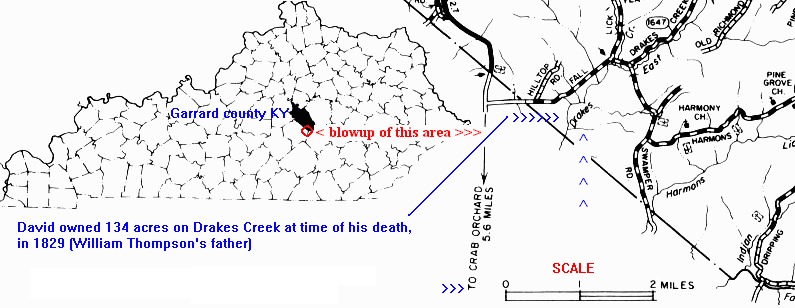
halted at a site known as Gilbert's Creek, in present-day Garrard county, about three miles
southeast of Lancaster, nearly six hundred miles from their point of departure.
On the second Sunday in December, 1781, they enjoyed a season of worship as the
first church that ever assembled in central Kentucky.
In his book, Fredericksburg Baptist Church (Publ. 1959), Rev.
Oscar Darter quotes two lists from the records of the Baptist minister Morgan
Edwards. Darter quotes Edwards as giving a list of 25 persons, who were on Nov.
20, 1767 constituted into a church by James Reed, Dutton Lane and others. Darter
says that among the charter members of the upper branch of the Upper
Spotsylvania Church, there appeared: David
Thompson. Rev. Darter notes that this is a list of only 24
persons, and suggests that a wife of John Saunders could be the missing 25th
person. (I would like to suggest it could be David Thompson's wife). Apparently
both of these lists are of members of the church located 20 miles southwest of
Fredericksburg, now known as "Craig's Church." The present Craig's Church is
located in the small town of Paytes, Virginia. A granite monument marks the
original location out in the countryside. This may or may not be my David Thompson.
One reason for the difficulty in tracing David beyond
Crab Orchard is because his roots had many name changes ~
1645- the area
between the Potomac and the Rappahannock was called the Indian Chickacoan
district. Out of this area ..... 1648- Northumberland County, VA was
formed. 1651- Lancaster County, VA was formed from part of it. 1652-
Rappahannock County was formed from part of it. 1692- Essex County was formed
from part of it. 1721- Spotsylvania County was formed from part of
it. 1734- Orange County was formed from part of it. 1745- Augusta County
was formed from part of it. 1770- Botetourt County was formed from part of
it. 1772- Fincastle County was formed from part of it. 1792- Kentucky was
formed from Fincastle County and gained statehood. 1796- December; Garrard
County was formed from Madison, Lincoln, and Mercer Counties. This area was
settled because of its closeness to the Wilderness Road. The Traveling Church
relocated here 1781, and David's first child was born the following
year.
Note- the year that David Thompson is on the Lincoln County Tax
Roll; 1796- Kentucky Governor Shelby carries out plans to widen and improve the
Wilderness Road to a wagon road from Gap to Crab Orchard. If David didn't settle
in this area because of the Traveling Church, this major road improvement might
have been his reason to be in this area.