Natural Features
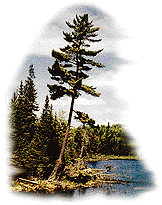 Algonquin stretches across 7,725 square kilometres of wild and beautiful lakes and forests, bogs and rivers, cliffs and beaches -- a canoeist's and camper's paradise as far as the eye can see. Established in 1893, Algonquin in Ontario's first and perhaps best known provincial park.
The essence of Algonquin is its vast interior of maple hills, rocky ridges,spruce bogs, and thousands of lakes, ponds and streams.
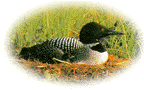
Hear the call of a loon echoing from rocky lakeshores, gaze at the sunset silhouetting a soliary pine, and watch a beaver forging a rippling wedge across a glassy pond. A fish splashes, a moose raises its massive head to stare at passing paddlers, and high above a windy cliff, a croaking raven surveys a landscape of lakes, forests, streams and bogs from horizon to horizon.
More than 250 bird species have been recorded in the park. Many southern and overseas birders make special trips to Algonquin to see northern specialties such as the Gray Jay and the Spruce Grouse, not to mention the rich variety of warblers of Algonquin's most famous bird of all -- the Common Loon, found nesting on just about every lake.
Park Facilities & Activities
The only way to explore the rugged beauty of Algonquin's Interior is by canoe or on foot. For a less demanding vacation, there is a "second" Algonquin -- the Parkway Corridor, a 56 kilometre stretch of Highway 60 running through the southwest corner of the park. Here you can enjoy camping, swimming, museums, hiking, learning and picnicking with the comfort of modern amenities. Easily accessible for daytrippers, about one-third of all Algonquin visitors stay nearby and come to the Park to visit a museum, walk a trail, or go for a swim and a picnic. Swimming is especially good at the beautiful sand beaches at Lake of Two rivers.
Camping
 Roughly, 1,200 campsites are available in eight campgrounds along the parkway corridor, while another 1,900 campsites dot the Interior. The eight campgrounds in the corridor accommodate tent or trailers, and offer a range of amenities, including comfort stations, showers, laundromats, boat-launching ramps, beaches and picnic grounds.
There are special, paddle in campsites on Canisbay Lake for people wanting to have a slightly more rugged experience. Algonquin can be enjoyed year round. Some campgrounds open as early as late April(opening of trout season) and some close for the season as late as mid-October. Camping is permitted in one campground in winter. Explore more than 80 kilometres of cross-country ski trails and unlimited snowshoeing possibilities.
Wildlife Viewing
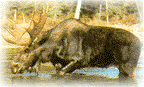 Algonquin offers good opportunities for wildlife watching, and is unequalled in Ontario for seeing moose. Moose viewing is best in spring, early summer and during the mating season in late September.
White-tailed deer and bear also forage these woods. The park is famous for its timber wolves which are heard but not often seen. Join park staff on wolf howling expeditions held every August.
Autumn In Algonquin
Cool nights and sunny days with no mosquitoes make autumn an ideal time to camp and hike in Algonquin. Fall colour usually peaks the last week of September, and the spectacle of hundreds of square kilometres of red and golden orange forest, blue lakes and shores lined with evergreens is not to be missed.
For further information you may telephone 1-705-633-5572 and for reservations call 1-705-633-5538.
To learn about the Rondeau Park, established in 1894,that has wetlands, plants and animals found nowhere else in Canada, please continue onto the next page.


This page hosted by  Get your own Free Home Page
