|
|
|
|
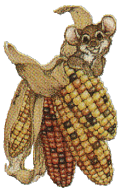
Corn was a very important crop for the people of the northeast woodlands. It was the main food and was eaten at every meal. There were many varieties of corn -- white, blue, yellow and red.
Some of the corn was dried to preserve and keep it for food throughout the winter months. Dried corn could be made into a food called hominy. To make hominy, the dried corn was soaked in a mixture of water and ashed for two days. When the kernels had puffed up and split open, they were drained and rinsed in cold water. Then the hominy was stir-fried over a fire. You can buy canned hominy in most grocery stores. Perhaps someone in your class would like to bring some for everyone to sample.
Corn was often ground into corn meal, using wooden mortars and pestles. The mortars were made of short logs which were turned upright and hollowed out on the top end. The corn was put in the hollow part and ground by pounding up and down with a long piece of wood which was rounded on both ends. This was called a pestle.
Corn meal could be used to make cornbread, corn pudding, corn syrup, or could be mixed with beans to make succotash. A special dessert was made by boiling corn meal and maple syrup.
All parts of the corn plant were used. Nothing was thrown away. The husks were braided and woven to make masks, moccasins, sleeping mats, baskets, and cornhusk dolls. Corncobs were used for fuel, to make darts for a game, and were tied onto a stick to make a rattle for ceremonies.
Corn was unknown to the Europeans before they met the Indians. Indians gave them the seeds and taught them how to grow it. Today in the U.S.A., more farm land is used to grow corn (60 million acres) than any other grain.
From: Woodland
Culture Area,
Ross/Fernandesm
1979
STORY OF THE CORN HUSK DOLL
This legend is told
by Mrs. Snow,
a talented Seneca
craftswoman.
Many, many years ago, the corn, one of the Three Sisters, wanted to make something different. She made the moccasin and the salt boxes, the mats, and the face. She wanted to do something different so the Great Spirit gave her permission. So she made the little people out of corn husk and they were to roam the earth so that they would bring brotherhood and contentment to the Iroquois tribe. But she made one that was very, very beautiful. This beautiful corn person, you might call her, went into the woods and saw herself in a pool. She saw how beautiful she was and she became very vain and naughty. That began to make the people very unhappy and so the Great Spirit decided that wasn't what she was to do. She didn't pay attention to his warning, so the last time the messenger came and told her that she was going to have her punishment. Her punishment would be that she'd have no face, she would not converse with the Senecas or the birds or the animals. She'd roam the earth forever, looking for something to do to gain her face back again. So that's why we don't put any faces on the husk dolls.
From: Our Mother
Corn
Mather/Fernandes/Brescia
- 1981
Copyrighted by
The Center For World
Indigenous Studies and
The Fourth World
Documentation Project


 Get your own Free Home Page