May St. Patrick guard you
wherever
you go and guide you in
whatever you do -- and
may his loving
protection be a blessing
to you always.
(Irish
Blessing)
O God, you sent St. Patrick
to preach your glory Irish people. Through his merits and intercession
grants that we who have the honor of bearing the name of Christians may
constantly proclaim your wonderful designs to men.
(St. Patrick's
Prayer)
Early years
Saint Patrick was born
some time around 385 A.D. His family was Gaelic and had migrated
to Britain. His birthplace is not known, but, it is believed to have been
in southwestern Britain or in Scotland near the town of Dumbarton.
Patrick was able to speak the language of the British Celts as well as
Latin. His real name is supposedly Maewyn Succat. The name Succat means
"warlike". He was given the name of Patricius which means "noble"
when he was baptized. His father was a wealthy land owner and a deacon
in the village church. He also knew that his father held this position
for tax advantages rather than out of love for God. His grandfather
was a presbyter. Patrick at the time preferred to go off with
his friends rather than attending school. He took the name of Patrick
or Patricus after becoming a priest.
Captive Years
Irish raiders, probably
under the command of high-King Niall of the Nine Hostages, descended upon
the village where St. Patrick lived. They were under orders to secure a
large amount of captives and other things of value. Thousands of
captives, St. Patrick included, were brought from Britain by these
particular raiders. It is believed that St. Patrick was approximately 16
at the time he was captured. The captives were sold as slaves, and
scattered among the many tribes throughout Ireland, even to the farthest
part of Ireland. It should also be noted that Laoghaire who was the
son of King Niall would later play a large part in Patrick's mission to
convert Ireland to Christianity.
Patrick was bought by Miliucc,
one of the pagan chieftain-kings. The king's herdsman took charge
of Patrick and didn't hesitate to curb the boy's lazy ways with a stout
club. He was assigned to care for a large flock of sheep belonging
to the king. He spent his days and nights with the sheep on a mountain
in Ireland called Slemish. While still a slave he learned the Irish
language, which would be of benefit to him when he returned to Ireland
years later. It was also during this period that he began to speak
with the God whom his Christian grandfather had told him about. In
his confession he stated that he prayed many times a day and that the love
of God caused his faith to strengthen and that the spirit within
himself was inflamed. As his faith grew stronger, Patrick started
having Christian visions which were to guide his life.
Escape from
Slavery
Patrick spent six years
in slavery before he made his escape. When he escaped, it was because
of the word's God had spoken to him in a vision. A voice told him
a ship would be waiting to bring him home. He had to go through bogs and
scale mountains, avoiding roads in fear of being discovered, in order
to reach the sea This was a journey of some 200 miles before he arrived
at the boat which was to take him back to his homeland. When he first
spoke with the Captain asking for passage, he was refused. He slowly
walked away praying and suddenly a young sailor called to him, saying that
the captain had changed his mind and was willing to take him. So,
Patrick made his escape on a boat headed for France which had a cargo of
Irish Wolfhounds, which were greatly valued at that time.
While travelling home to
Britain, he was captured by a band of brigands, who once again returned
him to a life of slavery. He was to spend only two months in slavery,
before being liberated from their hands. He was to spend the next
seven years travelling around Europe trying to decide what his purpose
in life was. He came to the conclusion that he was to become a servant
of God, taking his message throughout the world. He studied at the
Lerin Monastery, on an island off the Cote d'Azur. He returned to
Britain as a priest upon completion of his studies. It
was later revealed in a voice to Patrick that he was to return to Ireland
in order to convert them to Christianity. Because of his limited
education, he went to the Monastery of Auxerre in France to complete his
studies. While he was at Auxerre, the monks had decided that it was
the right time to send a mission to Ireland. Patrick was deeply disappointed
when another monk, Palladius, was chosen for this mission instead of himself.
Patrick continued in his studies for another two years until news of
Palladius's death reached the monastery and it was decided to send another
mission to Ireland which Patrick would lead. In 432 A.D. Patrick
was made a Bishop by Pope Celestine, before commencing his mission to
Ireland.
Return to Ireland
As in his earlier visions,
Patrick once again returned to Ireland in 432 A.D. This time
to spread the word of God and convert the pagans to Christianity.
He was confident the Lord was with him in this mission and travelled far
and wide preaching the word of God. Many said that Patrick had an
unusually winning personality which helped him to win converts. Patrick
spread the word of God, built churches, schools and monasteries even though
his life was constantly in danger. He had been arrested several times
by the Celtic Druids who were upset by the number of converts he was winning.
Each time he was arrested, he managed to escape and continued his teachings
of God. During this time, Patrick was able to convert almost the
entire population of Ireland to Christianity. Patrick spent approximately
forty years preaching in Ireland before his death. He retired and
spent the rest of his life in County Down, where he died on March 17th,
in 461A.D.
It should be noted that
when Patrick began his mission, Ireland was overrun by paganism. Druid
priests performed human and animal sacrifices to the local Gods.
Spiritism and black magic were practiced regularly through incantations
and occult rituals. At this time the Irish knew nothing of Jesus.
Upon his arrival in Ireland
Patrick returned to the mountain where he had prayed as a captive years
earlier. Patrick's first aim was to visit the king under whom he
been enslaved to tell him about Jesus. The king in fear of Patrick's
religion gathered his possessions around him and set fire to his house,
where he also was consumed by flames. Patrick and the band of 25
religious crusaders, who were with him, found shelter in a barn that was
owned by Dichu. He was to convert to Christianity and gave
the barn to Patrick where he prayed and celebrated Christian rites.
This was to be his first church in Ireland, one that would always have
special meaning for him. Patrick and his group spent the winter here
and in spring they travelled to Tara to see Laoghaire the high-king of
Ireland at this time to obtain permission to evangelize throughout
the island. Patrick arrived at the Hill of Slane which is within
site of Tara on Holy Saturday.
The high-king Laoghaire
and two of his druid priests, Lochru and Lucetmael were preparing to celebrate
the feast of Beltine (the great Celtic fire festival) which also
coincided with Easter that year. This festival was held as a greeting to
the coming of Spring and all fires throughout the land were to be extinguised
until Sunday morning. It was custom of the pagan festival,
that the high king would be the first to light the bonfire, before any
others in the land. Anyone disobeying this custom faced the penalty
of death. Patrick knowing this has already lit the Pascal fire which
all could see including those gathered at the castle. King Laoghaire was
infuriated that someone would dare to break protocol by lighting a fire
first. The druids believed that if this fire was not extinguised
at once, it would last forever. He set out with the princes of Ireland
in the war chariots to find the person responsible for this fire.
King Laoghaire was impressed by Patrick's composure and quiet confidence
whose voice was clear and concise as he explained who they were and their
reasons for being there.
Patrick and his group
were invited to the Royal Court at Tara the following day. They
arrived at Tara bearing a cross and singing a hymn that is still know as
the Breastplate of St. Patrick. King Laoghaire asked Patrick to explain
what this religion was that he and his companions wished Ireland to accept.
He explained that Christians worshipped only one God who had three personalities
- the Father, the Son, and the Holy Spirit. The druids had a struggle
trying to grasp this concept thinking it ridiculous and unbelievable.
It was then, through inspiration that Patrick used the shamrock to explain
the concept of the Trinity. He explained it by saying "There is one
stem but there are three leaves on it. So it is with the Blessed Trinity.
There is one God but three persons stemming from the same divinity."
Impressed by Patrick's devotion, King Laoghaire, although he did not embrace
this new creed, had no objections or stood in the way of Patrick's
mission. With the King's permission Patrick freely travelled the
Land. He was able to convert crowds of people to Christianity where
ever he went. Although it went slowly, eventually Ireland became
a Christian land.
Letter to
Coroticus
Many of the innocent
Christians whom Patrick had converted were murdered by soldiers of North
Britian. Patrick inflamed by these injustices wrote a letter to Coroticus,
a British prince who had raided Ireland, carrying off many youths and maidens
to be sold into slavery.
"You deliver the members
of Christ as it were to a house of ill-fame. What manner of hope in God
have you, or any who cooperate with you? God will judge. Aye, and where
shall Coroticus with his most villainous followers, who distribute baptized
damsels as rewards, and that for the sake of miserable temporal things
which verily pass away in a moment like a cloud of smoke which is dispersed
by the wind. That they may liberate the baptized captive women whom
they have taken, so that they may deserve to live to God and be made whole
here and in eternity. Did I come to Ireland without God or according
to the flesh? Who compelled me! I am bound by the spirit, not to see any
of my kinsfolk? Is it from me that I show godly compassion towards the
nation who once took me captive and harried the men-servants and maid-servants
of my father's house? I was free-born according to the flesh. I am
born of a father who was a decurion, but I sold my nobility, I blush not
to state it, nor am I sorry for it, for the profit of others."
Durint the time Patrick
spent in Ireland he was asked to join the Irish kings to revise the laws
of Ireland and to incorporate the teachings of Christianity into the national
law. Thus, his mission to Ireland was deemed to be a success.
Through out this, Patrick himself did not feel the success, he still
thought of himself as a humble man, a man of little importance.
St. Patrick's
Death
Patrick died on March 17th,
461A.D.. Many believe he was buried in Downpatrick, which was
where his first Church in Ireland was established. That day has been
honoured as St. Patrick's Day ever since. A community grew around
his burial place, but the round tower which marked his grave still remains.
The National Museum in Dublin has the bell which Patrick used to summon
his congregation and visitors look upon it with special reverence.
There is also a reliquary beside the bell which was made in his honor by
one of the Norman lords of West Ireland, one of the De Berminghams.
The reliquary is covered with the figures of French saints who were popular
at that time. In Ireland today there are over sixty churches and
cathedrals named after Patrick with the most fameous of these being St.
Patrick's Cathedral in Dublin. The grounds of this Church also bears
a mark where he baptized his converts.
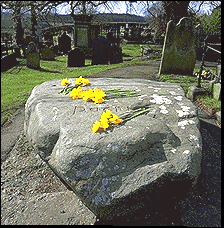
Flowers mark the grave
of St. Patrick
No one actually knows
where the true
site of St. Patrick's
burial place is. There
have been many places
throughout Ireland
that claim St. Patrick
was buried there.
Legends
Surrounding St. Patrick
Shamrock
Apparently Patrick had
a hard time converting the people of Ireland to Christianity. It
was almost impossible for them to understand the Trinity. It
was only after inspiration Patrick used the Shamrock to explain the meaning
of Trinity. In picking the Shamrock and pointing out the three leaves,
he was able to explain living proof of the Trinity. Supposedly
Patrick used the Shamrock during his sermons to represent how the Father,
the Son, and the Holy Spirit could all exist as separate elements of the
same entity. Since that time, the Shamrock hsd been adapted as the symbol
of the land of Ireland.
Snakes
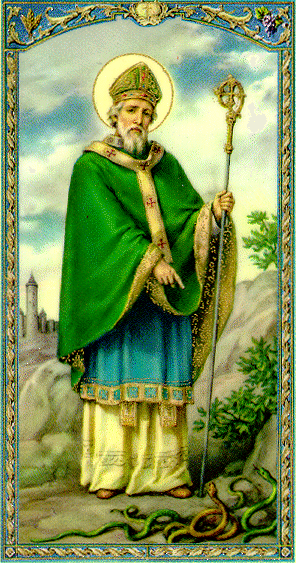
Patrick is also said to
be responsible for driving the snakes from Ireland. At the
time Patrick was in Ireland, snakes were a symbol of paganism, so, by driving
the snakes out of Ireland, it could be taken as driving out paganism.
The reason we can this is eventually Ireland was to become a predominately
Christian Land.
Another legend says that
Patrick had sworn to rid Ireland's soil of these poisoness snakes as he
had had rid Ireland of the Druids paganism. He stated that he would
make a drum and drum them out of the country. He set about making
a drum and cut two strick as batons. He marched across the land,
drumming all the while, serpents, snakes and scorpions fled before him.
In his fervour, he struck the drum so hard, he caused a hole in his drum.
It is said that an angel appeared and patched the hole in drum. Patrick
continued to use his drum until the last of the snakes were driven into
the sea. He then blessed the land, so that they could never return
to Ireland. Apparently no one has ever seen a Druid or a snake in
Ireland.
Battle
It is said that Patrick
made a prilgrimage to Croagh at the age of fifty. While in dovotion,
satan tried to tempt Patrick, but he resisted. For his courage in
denying the devil, God sent an angel to reward him. Patrick was to
be granted a request from the Lord. Patrick asked that the Irish
keep their Christian for all time and that they be spared the horrors of
Judgement Day. He asked that he be allowed to judge the Irish people
whom he had come to love himself. Therefor it is said the Ireland
will be drowned under a sea of water seven years before the Day of Judgement
comes.
Saint Patrick Toast
Irish people have a toast for just about everything. Some are very serious and others use the humor
which the Irish are fameous for:
St. Patrick was a gentleman
Who through strategy and stealth
Drove all the snakes from Ireland.
Here`s toasting to his health.
But not too many toastings
Lest you lose yourself and then
Forget the good St. Patrick
And see all those snakes again.
 Shamrock
  Snakes