There's a dear
little plant that grows in our isle,
'Twas Saint Patrick
himself, sure, that set it;
And the sun of
his labor with pleasure did smile,
And with dew from
his eye often wet it.
It grows through
the bog, through the brake, through the mireland
And they call
it the dear little Shamrock of Ireland
(Irish
Blessing)
The Shamrock dates back to 1571 in written
English and in written Irish to 1707 where it is known as seamrog, which
means. It was referred to for the first time as a badge worn on the
lapel for Saint Patrick's feastday in 1681. During the era of Grattan's
Parliament in the 1770's, Irish Volunteers used the shamrock as their emblem,
before The Act of Union came into effect. In Queen Victoria's time
the wearing of the Shamrock was looked upon as rebellious and Irish regiments
were forbidden to display it. Civilians at that time began wearing
a little paper cross coloured red and green. The Shamrock has long
been known as a symbol of Ireland and has been integrated into the symbology
of the United Kingdom as has the Rose, the Thistle and the Leek of
England, Scotland and Wales. Now, each year on St. Patrick's Day,
the Irish Guards, a regiment of the British Army is presented with a Shamrock
by the British Royal Family.
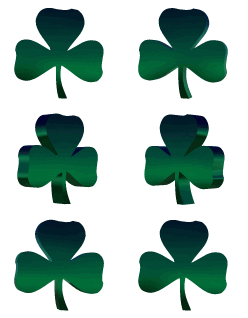
The Shamrock is unique to Ireland. It is a tiny wild green trefoil that comes up out of a blown-in seedpod. It is a fragile plant which does not live long once it has been picked. It is only recently that people have been able to grow and wear the Shamrock.
It is unclear exactly which member of the clover is the true shamrock picked by St. Patrick to explain the Trinity. Many believe it is the hop clover, which has yellow flowers and blue-green leaflets. Others say it is a variety of white clover or the black medic. And yet still, many believe it is the European wood sorrel which is found in Europe and Asia.
Before Christianity the Shamrock,
which was once known as Seamrog, was a sacred plant of the Druids because
its leaves formed a triad. Numbers were an important part of Celtic symbolism
with the number three being the most sacred and mystical number.
Three multiplies to nine, which is sacred to Brigid. It is said that, in
Ireland, everything of significance usually comes in three such as:
| Father | Son | Holy Spirit |
| Past | Present | Future |
| Love | Valour | Humour |
| Faith | Hope | Charity |
| Sky | Earth | Underworld |
Three is Ireland's magic number, and everything which is good or enjoyable comes in three. The Irish tradition of story telling is established on threefold reiteration. This accomplishes both intensification and exaggeration. Even today, Irish men cannot resist embellishing on a story in order to stretch a point.
The Shamrock has always been associated
with St. Patrick. It is said that he used to Shamrock while preaching the
doctrine of the trinity. Apparently during his teaching he picked
the Shamrock, pointed out the three leaves as living proof of the Holy
Trinity. He used the Shamrock, which resembles a three-leafed clover
as a metaphor to explain the concept of the Trinity. He explained that
there is only one stem which holds three leaves as it is with the Trinity.
He was able to use the Shamrock in showing how the Father, the Son, and
the Holy Spirit could all exist as separate components of the same person.
Index
Table of Contents



This page hosted by
 Get your own Free Home Page