EASTER BUNNY
EASTER BUNNY
History
The origins of the Easter
bunny like many other Easter traditions dates from the pre-Christian era.
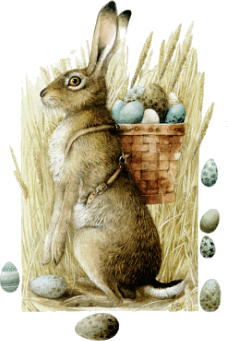
Although it was not know as the Easter bunny at that time, the hare
and rabbit were part of the spring fertility festival derived from the
pagans. The Hare and rabbit being the most fertile animals
known were symbols of new life duirng the Spring season. They are
natural symbols of fertility and played an import part during these festivals.
The rabbit is also the symbol of the Egyptian moon - and the moon is used
to determine the date of Easter each year.
 |
Although, bunnies and eggs are still symbols of Easter they have taken on a different meaning. The Easter bunny has no real relationship to this holiday, but, it has still been carried over from the pagan festivales, although it is not thought of in this way. The missionaires who first brough Christianity to the pagans did not seemed to concerned about the symbols of bunnies and eggs as the people did not actually worhip them. Consequently the custom of painting Christian art on eggshells began, as for the bunnies the missionaires tolerated them. The missionaires did not think it was practical or necessary to abolish a native culture, so they incorporated existing traditions into Christianity, wherever possible. |
In Germany the hare or rabbit is an extremly important Easter symbol. The hare is as important to the Germans as is Santa Claus in the United States. They belief the hars is responsible for laying eggs and hiding them. The theory is that while the children were hunting for Easter eggs they came across rabbits in the area who were scared away due to the activity of the children. The bunny as an Easter symbol, actually dates back to the 1500s, where it was first mentioned in writings from Germany. The first edible bunnies were made during the early 1800s in Germany. These consisted of pastry and sugar and not what we now commonly know as chocolate Easter bunnies and eggs.
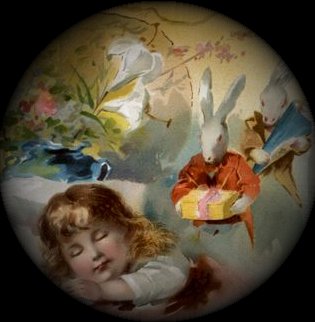
The Easter bunny was first introduced to American folklore by German settlers who arrived in the Pensylvania Dutch country during the 1700s. The Easter bunny was referred to as "Oschter Haws" and like Santa Claus is a childhood favorite. Children believed if they were good that the Easter bunny would lay a nest of colored eggs. The children built nests in secluded places within the hom, the barn or the garden. Boys would use their caps while the girls uses bonnets to make the nests. The use of Easter baskets as a tradition of the Easter bunny was adopted at a later date and the tales of this fameous spread throughout the country.
EASTER SONG
Peter Cottontail
 |
Hoppin' down the bunny trail, Hippity, hoppity, Easter's on its way. |
 |
|
Things to make your Easter bright and gay. He's got jelly beans for Tommy, Colored eggs for sister Sue, There's an orchid for your Mommy And an Easter bonnet, too. |
||
 |
Hoppin' down the bunny trail, Hippity hoppity, Happy Easter day. |
 |
|
Hoppin' down the bunny trail, Look at him stop, and listen to him say: "Try to do the things you should." Maybe if you're extra good, He'll roll lots of Easter eggs your way. |
||
 |
And you'll know that he was there When you find those choc'late bunnies That he's hiding ev'rywhere. |
|
|
Hoppin' down the bunny trail, Hippity hoppity, Happy Easter day. |


 Get your own Free Home Page