SAINT NICHOLAS
St. Nicholas was born in 280
AD, to wealthy parents in Patara, a city of Lycia, in Asia Minor. He was
still quite young when his parents died leaving him a vast fortune. As
a teen-ager, Nicholas' modesty was already evident. He was extremely generous,
often aiding those less fortunate than himself. Not wishing to take credit
or having people feel indebted to him most of his generous acts were done
under the cover of darkness. Just how many people Nicholas aided will never
be known, but helping the less fortunate children for him was a priority.
Nicholas decided to give up all his worldly goods and
wealth when it became evident that he was being called to enter the ministry.
When the bishop who |
|
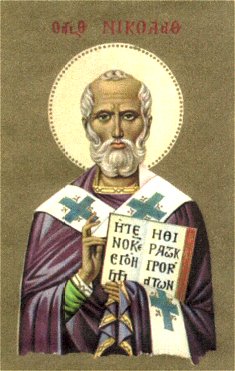 |
resided over the churches in the area died bishops and
ministers came from other cities and villages to elect a new bishop. Nicholas
was elected to become the next bishop after an ageing minister told the
group of bishops and ministers of his vision, which pointed to Nicholas
as being the successor. He served in the Church of St. Nicholas in the
town of Demre up until the time of Emperor Diocletian. Nicholas was destined
to lead his congregation through the worst difficulties Christians had
yet to face.
In 303 AD, the Roman Emperor Diocletian proclaimed
war against Christianity. He ordered that all those who proclaimed to be
Christian or who were suspected of practising Christianity be sacrificed
to pagan gods. Ministers, bishops as well as thousands of followers of
our Lord who lived in this empire were thrown into prisons. These prisoners
suffered horrendous tortures of unspeakable nature. Some were fed to wild
animals while others were forced to fight gladiators for their lives while
onlookers were screaming for their deaths. People were beaten senseless
and others set aflame while still alive. How these Christians suffered
for their belief and yet even then the Roman Emperor was not able to stamp
out Christianity.
The people thought those who survived these tortures
by Diocletian of as "saints" or "confessors". They never once even thought
of forsaking our Lord to avoid their fate instead their faith in Our Lord
grew stronger. They developed a much deeper relationship with God.
After years of imprisonment Bishop Nicholas was finally
freed by order of the new Emperor Constantine. Upon his arrival in the
city, his people surrounded him calling him "Nicholas! Confessor! They
once again welcomed their Bishop whom they loved and admired home with
open arms. He continued to serve the Lord for another 30 years, bringing
many to Christianity. Constantine converted to Christianity and convened
the famous Council of Nicea in 325 AD where Nicholas also a participant
supported the doctrine of the Trinity. He died on December 6, 343 AD.
 |
|
|
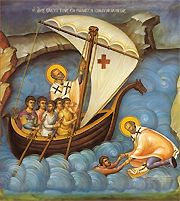
Saint Nicholas is known as patron saint of sailors,
Sicily, Greece, as well as being the patron saint of children. He is credited
with performing many miracles both before and after his death. Emperor
Justinian I rebuilt the church in Constantinople where Saint Nicholas had
served as archbishop during the 4 century after it was destroyed
by an earthquake during the 6 century. The Church was once again restored
by Turkish archaeologists in |
1964. December 6, the date of his death is the day which
the Church celebrates the feast of Saint Nicholas.
In 1087 Saint Nicholas's bones were removed from Myra
and brought back to Bari in south Italy my Italian merchants. Even today
some of his bones are displayed in the Antalya Museum.
Eightball
and ThunderCloud's Holiday Graphics
Next
Index
Home Page


This page hosted by  Get your own Free Home Page