 |
|
|
1783 - Treaty of Versailles
The Treaty of Versailles, acknowledged the independence of the 13 colonies which formed the United States. Because of their loyalty to the King and the Empire a growing number of United Empire Loyalist emigrated north to the British colonies of Nova Scotia, New Brunswick and Quebec. Many settled along the upper St. Lawrence and the shores of Lake Ontario and Lake Erie.
The colony of Nova Scotia has been divided in two since 1783 with the north side of the Bay of Fundy forming New Brunswick. Cape Breton was also a separate colony at that time. No territorial changes were to take place in the west or the north.
Boundaries were then set between the British colonies and the United States. These boundaries are as follows:
They were to begin at the Bay of Fundy running up the St. Croix River to its source; from there due north to the height of land between the St. Lawrence and the Atlantic; along the height of land to the Connecticut River, to latitude 45°. From that point west to the St. Lawrence, through the Great Lakes and their connecting rivers to the west side of Lake Superior, and by a series of small lakes and rivers to the Lake of the Woods.
From Lake of the Woods the boundary ran due west to the Mississippi forming the western boundary of the United Sates down tothe Spanish territories along the Gulf of Mexico. It was later discovered that it was physically impossible to run a line due west to the Mississippi.
Nova Scotia consisted all the mainland east of Chaleur Bay, and Cape Breton Island.
1791 - Constitutional Act
On August 24, 1791, the province of Quebec was divided into Upper and Lower Canada. This was done by the Imperial Order in Council and is known as the Constitutional Act of 1791. The object of this act was to give settlers an opportunity to develop the country west of the Ottawa River. Lower Canada consisted mainly of a french speaking community while Upper Canada was primarily English.
A House of Assembly, was added to the existing office of the Governor and Legislataive Council, which had the power to pass laws concerning the colonies. In 1792, an Executive Council was formed and members were appointed by the King. This council was answerable only to the Governor who was answerable to the imperial government.
1792, saw the first election campaign for Lower Canada and consisted of 50 seats. The results of this election consissted of 34 French-speaking and 16 English-speaking members. The House of Assembly of Lower Canada officially opened in December of 1793 at the Bishop's residence in Quebec City.
Jean-antoine Panet was elected as the first Speaker or President of the Assembly. The Assembly ended up divided into two blocs due to the language issue. At this time the French language had no legal status but official documents had always been published in both French and English since the Conquest. The Assembly finally passed a law stating that both languages were official but London disagreed and imposed English as the only official language of Lower Canada. Tension between the English and French remained high causing numerous conflicts. The Tories(English) wanted a society that copied the British life which was characterized by political power in the hands of the aristocracy, intense trade, loyality to the British Empire and a culture prevaded by Protestant reform. The Canadaian Party on the other hand wanted local sovereignty, with power exercised on behalf of the working classes and supported by agriculture, domestic trade, the Customs of the French, Catholicism and local markets. At times these differences between Upper and Lower Canada led to outright war.
Another conflict between the two groups was the question of subsidies, the amount of money the Assembly granted to the Governor and Esecutive Council to balance the budget. It was discovered that a group of individuals under the Governor's wing were often payed for doing nothing, to non-residents and that fictious salaries were used to supplement their income.
The sharing of custom
duties between Upper and Lower Canada was also another source of conflict
as this was the main source of revenue for the colony. As Lower Canada
had the only seaport it was determined they were required to remit a portion
of the duties collected to Upper Canada. The English
knew their only hope for becoming leaders of a majority party would be
by joining the two colonies and forming one. If they could accomplish
this they would then be able to develop business opportunities along the
St. Lawrence Valley without objections. In 1822, the secretly
made a presentation in London advocating unification of the two Canadas
which at that time was turned down. During the following years,
unrest and war was common between the two colonies until the imperial government
introduced the Union Act in 1840, reuniting the two colonies uner one parliament
and once again proclaiming English the only official language. This
Act came into force on February 10, 1841, re-establishing the Constitutioinal
Act of 1791.
Confederation of Canada
A resolution was passed by the Maritime provinces to meet in March/April 1964 to discuss the possibility of forming a union of the three provinces. In June the Province of Canada, asked the Maritimes if they also could attend to propose a union of all British North America. With this in mind a further conference was planned for October which was to be held in Quebec.
Fathers
of Confederation who attended the Charlottetown and Quebec
conferences
painted
by: Robert Harris.
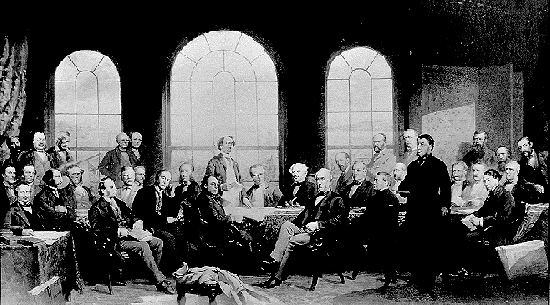
Second Row: W.H. Steeves, John Hamilton Gray, Alexander Campbell, Hector L. Langevin, Oliver Mowat, Thomas D'Arcy McGee
Third Row: Charles Fisher, George Coles, J.C. Chapais, Sir Étienne-Paschal Taché, Alexander T. Galt, J. Cockburn, William McDougall, J. McCully
Fourth Row: W.A. Henry, E.B. Chandler, Adams G. Archibald, Georges-É. Cartier, Thomas H. Haviland, J.H. Gray, A. Macdonald
Fifth Row: Hewitt Bernard (secy.), Ambrose Shea, John A. Macdonald, Peter Mitchell, W.H. Pope, J.M. Johnson
Sixth Row: (back) E. Palmer, F.B.T. Carter, R.B. Dickey
All the delegates met
in Quebec and terms for the British North America Act were drafted. Sir
John A. Macdonald chaired a conference in London, Englad in December 1866,
which was attended by the leading Fathers of Confederation. On May
8, 1867, this act was passed by the Imperial Parliament which proclaimed
Canada as "one Dominion under the name of Canada," which was
were we got our frist name "Dominion of Canada." This act
was to take effect on July 1, 1867 with Sir John A. Macdonald becoming
the first prime minister. This then brought the proviences of Canada, Nova
Scotia and New Brunswick into the new Dominion. Although Prince Edward
Island and Newfoundland were represented, both rejected the union proposals.
The main controversy was that Parliament should be formed with representation
based on a population quota. It was not until 1873 that Prince Edward Island
came into Confederation.
Fathers
of Confederation
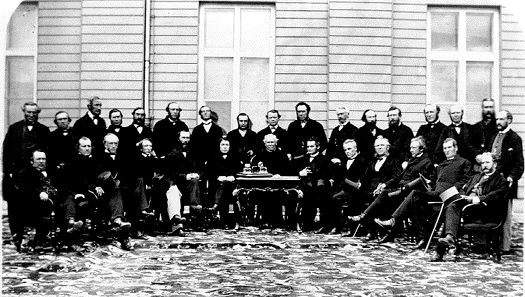
Back Row: G. Coles, H.L. Langevin, E. Palmer, O. Mowat, J.M. Johnson, A.G. Archibald,
C. Fisher, J. Cockburn, J.C. Chapais, W.A. Henry, R.B. Dickey, A.A. Macdonald, W.H. Pope,
J.A. Shea, F.B.T. Carter, H. Bernard, J.H. Haviland
In 1869 the Dominion
had acquired the rights of the Hudson's Bay Company and transformed the
western part which was known as Rupert's Land and the region beyond to
the Rocky Mountains, into the North-West Territories. The Red
River settlement joined the Dominion in 1870 as the province of Manitoba
with British Columbia joining the untion in 1871. Alberta and Saskatchewan
became provinces of the Dominion in 1905.
Index
Home Page


 Get your own Free Home
Page
Get your own Free Home
Page