Canadian Flags
St. George's Cross
This is reportedly the first flag to be flown
on Canadian soil. This is an English flag from the 15th century and
was carried by John Cabot, a Venetian who sailed under Engish colours at
that time. He apparently landed on the east coast of Canada in 1497,
planting the St. George's Cross there. |
 |
Fleur-de-lis
 |
This flag was carried by Jacques Cartier who
landed and claimed the "Canadian new world for France," in 1534.
This flag remained a symbol of French sovereignty in Canada until the early
1760s, when Canada was relinquished to the United Kingdom. There
were a variety of other military flags used by the french, but, none received
the prestigiousness of the Fleur-de-lis, which even to this day hold a
place of promiinence in Quebec. |
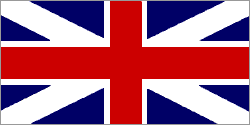
Royal Union Flag
Although this flag was first flown over Canada
in 1621, it only became the official British flag during the early 1760s.
It is more commonly knows as the Union Jack. Britain used the Royal
Union flag in all establishments on the North American continent.
Historians often refer to this flag as the flag of Canada's United Empire
Loyalists. |
 |
After the Act of Union between Great Britian and
Ireland in 1801, the Royal Union flag underwent new changes. The
diagonal Cross of St. Patrick was incorporated with England's St. George's
Cross and Scotland's Cross of St. Andrew. This then became the new
Royal Union Flag and was used all across British North America. Canada
still continued to use this flag even after Confederation in 1867.
 |
The Union Jack was the affirmed national symbol
from 1904 and was the flag under which Canadian troops fought during the
First World WarThe Union Jack maintains its presence in Canada through
its incorporation in the provincial flags of Ontario, Manitoba, and British
Columbia |
The Red Ensign
The Red Ensign was created in 1707, and was known
as the flag of the British Merchant Marines.
With the addition of a shield in the fly bearing
the quartered arms of Ontario, Quebec, Nova Scotia and New Brunswick, it
was used on land and sea as Canada's flag from 1870 to 1904. Although this
flag. |
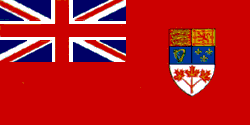 |
was used it was never actually given authorization
except by the public. In 1892, the British admiralty approved the
use of the Red Ensign for Canadian use at sea. Thereby the name the
Canadian Red Ensign came into use.
As each new province joined Confederation or upon
a mark of identification, that mark was incorporated into the shield of
the Canadian Red Ensign. By the turn of the century, the shield was
made up of the coat of arms of the seven provinces then in Confederation.
In 1924, the Red Ensign was changed by an Order
in Council and the composite shield was replaced with the shield from the
royal arms of Canada, which is commonly known as the Canadian Coat of Arms.
In 1945 authorization was given for the use of this flag on federal buildings
within Canada as well as government buildings abroad. This
flag was used until February 15th 1965, when it was replaced by Canada's
new flag, the red and white maple leaf.

Next
Index
Home
Page



This page hosted by  Get your own Free Home
Page
Get your own Free Home
Page