The Bay De Nord
Micmac Cross
One of the most extensively reported principles of Micmac spirituality is their adoration
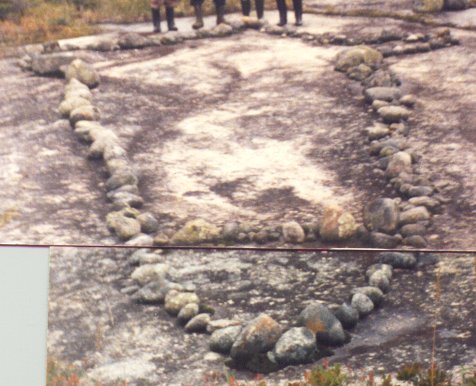
of the "Bay De Nord Holy Cross" as a religious monument. Although it has Christian qualities,
principles of belief connected with the Cross imply aboriginal spiritualism. The Cross is formed
out of rocks that are worn down smooth from the effects of the climate. The large rocks are
about ten to twenty pounds each and had to be transported over a great distance to the site
because their are none like it in the area. The Cross is laid out as if it were constructed from a
pair of rosary beads. Although the Cross is only roughly drafted, it is completely apparent that it
is noticeable. It is located on a barren stretch of land about twenty square feet on the top of a
large plateau accessible only by climbing a steep ravine just north of Bay De Nord. Not much is
known about the descent of the Cross with regard to when it was constructed or how it was
constructed but the Cross is held in magnificent adoration by the Micmac Indians.
It is rumored that the Cross was first rediscovered in 1830 by a hunter. A later visitor to
the Cross from Conne River, Melvin Jeddore was quoted saying, "if you pick up one of those
rocks lying there, you will find a hollow or depression under it where it has been worn down
because of the wind I guess now it must have taken a long time to do that!"
The people of Micmac descent today visit
the Cross usually on the Feast of St. Anne ( July
26th ) with great respect and reverence. The journey
is usually by boat and made by everyone from
grandparents to grandchildren. While there
religious devotions are performed by moving
around the Cross on their knees and reciting the
Rosary. The Micmac also believed the Cross
protected and cured the people. Because of this
people would bring a rock to replace the one that
they took from the formation to place in their home
to ward off such things as bad health, fire, bad luck,
and misfortune. A removed rock was considered
"A Charm".
 The sick would also visit the Cross to seek
spiritual healing. A brook nearby the Cross, aptly
named the Cross Brook is considered to have a powerful healing effect partly because it never
runs dry in the warmest summers or turns to ice during the coldest winters. One reported miracle
was of a Conne River resident Mary Benoit, who was cured of partial blindness after visiting the
Cross.
The sick would also visit the Cross to seek
spiritual healing. A brook nearby the Cross, aptly
named the Cross Brook is considered to have a powerful healing effect partly because it never
runs dry in the warmest summers or turns to ice during the coldest winters. One reported miracle
was of a Conne River resident Mary Benoit, who was cured of partial blindness after visiting the
Cross.