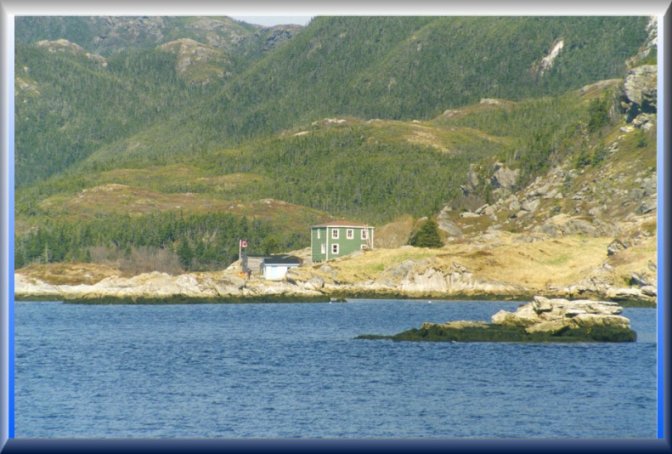
Great Jervis
Great Jervis is a resettled fishing community located in a small harbour protected by Great Jervais Island, near the northwestern entrance of Bay d'Espoir. Great Jervis was known as Great Jervois in 1884, Great Jervais in 1836, and Man of War's Harbour in 1845.
Great Jervis's economy consisted of the fishery and ship building. The Newman &
Company, based at Harbour Breton built several vessels at Great Jervis. However, the earliest
settlers of Great Jervis were brought to the harbour as fishing servants for the Newman
Company. The settlement first appeared in the Census of 1836 with a population of 19, in two
household. In 1845 there was 47 year round residents, and by 1857 the population had grown to
61.
The only school in the area was maintained at nearby Pushthrough, by an old fisherman named "John Lilly." It only served Protestant children, and Great Jervis was a Catholic community. A school inspector at this time noted "There are a dozen Catholic children at Great Jervis of an age to go to school, and they would most willingly avail themselves of this school at Pushthrough, yet small as is the distance, being entirely by seas, it is impossible they could profit by its establishment, and they are left without any possible means of education." A school was finally built in 1872, but because of its isolation there was a hard time obtaining a teacher. A Roman Catholic church was also built in 1874 for the community, which now had 121 people.
The main merchant at this time was John Penny of Ramea. He became a resident merchant with land in Great Jervis by 1870. The Newman and Co., which were involved in boat building and supplied fishermen in the area, still supplied some necessities at this time. The 1871 Newfoundland directory listed John Penny as the merchant in Great Jervis. It also stated the resident planters and fisherman in that year as Samuel Allen, Robert Crant, Patrick Farrell, Silas Hull. John and Timothy Long, Francois Roix, Henry Rose, Joseph Sours and Joseph Woolcot. David Woolcot was listed as a lumberman and George King as a clerk.
Great Jervis had a strong cod, halibut, salmon, and winter turbot fishery. The Cod
fishery was a year round business with small boats catching the fish, mainly by hook and line,
near the coast. Cash, a rarity, was obtained by selling herring to American fishing schooners
fishing for cod and halibut with bultow along the coast. Local fishermen also supported
themselves by hunting (hares, deer, geese, and ducks), farming and berry picking.
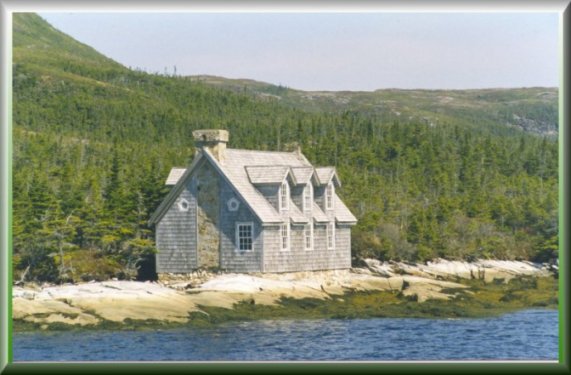
Great Jervis reached its peak population in 1874. From 1884 onward, the population slowly declined as residents looked for employment and services in larger centers on the south coast of Newfoundland, mainland Canada, and the United States. The inshore fishery remained the main source of income in Great Jervis. Some people got work as lumbermen in Bay d'Espoir, or as seamen on the larger vessels from bigger centers.
In 1956 there were 24 residents, and in 1951, only 9. Most of the people resettled all along the south coast. Today people who lived there, along with their ancestors still go back to Great Jervis for a reminder of the place that once was their home.