by: Denver R. Douglas
EIU 4042-003
Telecommunications in the Third Millennium
Instructor: Sue Kaufman
April 8, 1998
Abstract
The story of Microsoft and its name appearing in the headlines for the latest antitrust allegations against it is a phenomenum unlike what one might suppose without research. In just twenty years Microsoft has grown from a startup company with only "smarts" as its assets to one with revenues of billions of dollars annually. Coupled with this is an outdated, inefficient and arbitrary set of guidelines with which the United States Department of Justice is attempting to call Microsoft's practices monopolistic. What is true is that Microsoft is successful because they have succeeded at playing the economic game and have come out a big winner. The downside to this is the apparent lack of ability for Microsoft to extend their foresight into other areas outside of the personal computer or software realm. If they had succeeded with foresight in both areas, there would be no doubt that Microsoft would be just as successful, but they would not come under the scrutiny of defending their position in the courts.
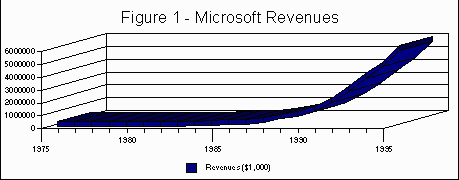
Figure 1 - Microsoft Revenues 4
Table 1 - A Brief History of Microsoft 6
In 1975, Paul Allen and Bill Gates co-founded a small computer company whose purpose it was to sell traffic measuring devices, using a small ALTAIR hobby kit personal computer, and using a programming language they had written for that machine. Twenty years later that company, now headed solely by Gates after Allen's retirement in 1983, is the world's preeminent leader in sales of operating systems and 25 per cent of applications programs. Operating systems are the programs that control the basic functions of the computer, and allow the applications programs to run, whereas applications programs themselves allow the computer user to accomplish some type of work (Cusamano & Selby, 1995, p. 2). From the humble beginnings of two young men's ideals, the company grew in profits and stature over the intervening twenty years. The following chart, based on data from Cusamano and Selby (p. 3), gives the growth of Microsoft based on annual revenues:
It can be seen that Microsoft has been growing and continues to grow at an exponential rate. This apparent success is founded on Gates founding principle that in the computer software industry, the company that sets the standards will sell the most products and the company that sells the most products will continue to set the standards that others must follow. It is a natural cycle of market economics and it is the foundation of success underlaying the basic philosophy of Microsoft. Gates was quoted in his recent Senate testimony as saying "at the end of the day what really counts is building good software" (Alvarez, 1998). The company isn't necessarily structured to reap large profits, but again by being the standard by which others are judged. By being the company that sets the standards it can naturally be followed that net profit is the logical result.
Since its inception, Microsoft has had a dual identity as being both the industry leader and standard setter, but it has also been often plagued with software that was not without errors or "bugs". This has not deterred Microsoft nor the buying public from a continual upgrade of Microsoft products to make full use of the ever increasingly powerful hardware on which the software runs. When unable to succeed at setting the standards or making a product that is competitive as with their product Money, Microsoft has sought other means to capture the majority of market share for that particular application. This has been the focus of many of the government inquires by the Federal Trade Commission and the United States Department of Justice. This was definitely the case when Intuit's product Quicken beat Microsoft's Money to the market place and prompted a long series of talks between Microsoft and Intuit about the purchase of the more successful product by Microsoft (Stross, pp. 193-208). This was blocked in 1995, but it shows the desire of Microsoft to win. Other key dates in the history of Microsoft are summarized in the following table:
| Date | | 1975
| Microsoft founded by Paul Allen and Bill Gates | 1980
| Microsoft chosen by IBM to create operating system for its first PC. The
program is called MS-DOS | 1983
| Microsoft introduces Word word-processing program and plans to create
Windows, which would improve MS-DOS with graphical icons that make PCS
easier to use. | 1991
| Federal Trade Commission begins to investigate claims Microsoft
monopolizes the market for PC operating systems. | 1993
| The FTC deadlocks on two votes to file a formal complaint against Microsoft
and decides to close investigation. Justice Department and European
Commission antitrust investigators begin independent probes. | October 1994
| Microsoft makes deal to buy Intuit, maker of the personal finance software
Quicken. The tentative takeover would be the largest software merger ever
and raises further concern about Microsoft's growing influence in the industry. | April 1995
| Justice Department blocks Microsoft purchase of Intuit, saying the deal could
lead to higher software prices and diminish innovation | August 1995
| Microsoft launches Windows 95. | November 1995
| Microsoft releases Internet Explorer 2.0 for Windows 95, giving it away for free
in challenge to Netscape's Navigator internet browser. | December 1995
| Microsoft and NBC announced deal to create cable channel and on-line news
service, MSNBC. | April 1997
| Microsoft buys WebTV Networks and plans to expand the pioneering maker of
devices for viewing the Internet on ordinary TVS. | June 1997
| Microsoft invests $1 billion in Comcast Corp., a deal that could bring
high-speed online access to millions of homes via cable TV. | September 1997
| Microsoft launches Internet Explorer 4.0 in stepped-up challenge to Netscape,
whose share of browser market slips to less than two-thirds of internet users. | October 1997
| Justice Department sues Microsoft, accusing Microsoft of violating the 1994
consent decree by forcing computer makers to use its Internet browser as a
condition of using its popular Windows operating software. | April 1998
| Justice department is urged by other software vendors to adopt a ten step
proposal to curb the power of Microsoft. | |
Background- Antitrust Laws
With this success has come power and with this power fear has been instilled in the public in general and therefore the government specifically. The fear is that other companies cannot compete against such an apparently monopolistic giant such as Microsoft. It is this fear that has prompted probes by the U.S. Department of Justice, the U.S. Federal Trade Commission and the European Union all focusing on the pricing, marketing and management practices of Microsoft (Cusamano & Selby, p. 4). These probes are based on the Sherman Act of 1890 whose two sections call for "every contract...in restraint of trade or commerce...is illegal" and "every person who shall monopolize...or conspire...any part of trade...is illegal" (Stelzer, 1966, p. 309).
The Sherman Acts first section outlaws actions that would not necessarily be considered controversial today (Stross, p. 177). It was written during a time in our history when governmental action was necessary to curb the abuses of companies that in fact were occurring at the time that congress passed it over one hundred years ago. The second section, is the one most often used to chastise Microsoft and its language is particularly vague and uncommitted. It does not specifically identify what a conspiracy is nor does it identify specifically the meaning of the word "monopoly".
Historically, the Sherman act had one of its first tests in "Standard Oil of New Jersey vs United States." In that case the court held that because of unfair practices Standard Oil, controlled by John D. and William Rockefeller, had illegally " obtain[ed] preferential rates and large rebates from the railroads...the combination of was able to force companies to join it or be driven out of business. As a result, the combine obtained control of 90 per cent of the petroleum industry...[This] enabled it to fix the price of both crude and refined petroleum" (Stelzer, p 3-4). Other cases against IBM and AT&T have all found some sort of actual practice that caused higher prices to buyers than would have been possible under a more open market environment.
Microsoft and the Application of Antitrust Laws
The current Justice department cases against Microsoft have not been able to concretely come to the same type of conclusive evidence of price fixing or legal restraint of trade. Rather, Microsoft may very well be guilty only of being very successful. Judge Learned Hand once made the comment, "the successful competitor, having been urged to compte must not be turned upon when he wins" (Stross, p. 176). Microsoft may be the modern age anomaly, a successful company, playing by the rules, that has grown to appear to be monopolistic entirely by the nature of natural business cycles, economics and processes. Such a corporation was not the target of the legislation passed by Congress in 1890 with these anti-trust laws. Rather the targets of the Sherman Anti-trust act were companies that made little secret of their desire for an accumulation of wealth and power by whatever means (Stross, p. 229). They had no desire to make any improvements in the standards of living of the citizens effected, they had only the pursuit of profits as a guiding principle. They were later given in history such labels as: "magnates," "tycoons," "industrialists," and of course, the unflattering "robber barons" (Stross, p. 136).
Stross best summarizes both the Judge Hand's comment and ties it to the way the United States Justice department has tried to use antiquainted laws to enforce a possible ambiguous standard.
...it was only expected that Microsoft would bring the antitrust issues to the fore. But a different impression emerges if we look at the puzzling way in which the U.S. government has gone about its many investigations of Microsoft. Even if we dissent from [Judge] Learned Hand's argument and reserve the possibility that even a fair-playing winner may need to be restrained---and ultimately Microsoft may indeed turn out to be precisely such a winner---it is difficult to see where the government to date has come close to making a compelling case against Microsoft. The way in which the government has blundered along in its pursuit of the company, using technically antiquated and misinformed premises, undermines the very concept of antitrust. History tells us that the nature of Microsoft's domination is fundamentally different from that of Standard Oil, yet government decided to fight the last war all over again, without recognizing how the circumstances have changed in the digital era (p. 177).
One of Gate's employees, Myhrvold, vice president of product development, wrote in a 1993 memo "Road Kill on the Information Highway," that the real "revolution" isn't the "PC revolution", but that the real revolution is yet to come. "Unlike the "robber barons"...[who] flouted contemporary laws that were anything but ambiguous...a more defensible line would be to note the critical ways in which Microsoft's rise to power does not resemble the patterns of U.S. Steel or Standard Oil in the past" (Stross, p. 137).
Microsoft as an "Evil Giant" or a "Small Footnote"?
The real essence of the "Road kill memo however was Myhrvold's statements about where Microsoft should be headed and the importance to date of the role Microsoft has played in the "PC age"
The real revolution would come when industries that had not yet experienced the vertigo- inducing pace of exponential change were caught up in the same whirlwind the personal computer industry had experienced from its inception. Telecommunication services; telecom equipment manufacturers; banks and financial services; brokerages; book, magazine, and newspaper publishers; television broadcasters; and Hollywood would all be affected...technical change[s], which would be enabled by another millionfold improvement in semiconductor technology that would follow the millionfold improvement of the preceding twenty years (Stross, p. 137).
Thus in 1993, Microsoft set its course for a broader base. Rather than just being a dominant software vendor, the company looked to invest in the future. "[I]ts leading rivals were no longer the then much smaller software companies like a Lotus (compared to Microsoft's 3.8 billion in revenue in 1993, Lotus's was $981 million) or an even smaller Borland ($394 million), [or Netscape]. Instead its rivals [partners] were similarly sized cable-TV companies like TCI ($4.1 billion), ...Bell Atlantic ($12.9 billion),...Time Warner ($14.5 billion), and even the giant that dwarfed everyone else, AT&T ($67 billion)." (Stross, pp. 139-140)
Does this make the current Microsoft appear less a foe when compared to those companies in whose presence it now finds itself? In the coming "information age", it is quite possible that Microsoft may not be able to succeed in fields where it has no underlying expertise, at least not to the extent it has succeeded in the "PC age". If Microsoft does not successfully maneuver into a broader base and invest in coming technologies it may be later written off by future historians as a mere footnote.
Microsoft and a New World Order
Any cases brought against Microsoft now or in the future "should balance the need to foster competition, which generally benefits consumers (except when there is market confusion over standards, as in the case of VHS versus Beta in video recorders), with the danger of placing too many restrictions on perhaps the most internationally competitive company in the United States" (Cusumano & Selby, p. 437). The benefit of standards are that generally a better product is brought to market. Although, this is not always the case, VHS over Beta has been mentioned, but there is also the QWERTY keyboard over other more easily learned alternatives and 33 1/3 rpm LPS over the superior 45 rpm. "...defacto standards also end up increasing efficiency and innovation in a field until technology itself advances enough to spur new standards..." (Rothstein, 1998). Microsoft's success can be summarized by its unending desire to standardize in an industry that is prone to incompatibilities and its ability to reevaluate and revise products in and unending process (Stross, p. 253).
"[T]he personal computer industry's, promise is --- that with ever more powerful personal computers and a communication web to link them ultimately will come a brighter future for us all" (Stross, p. 228). In actuality Microsoft and the entire computer industry may be looking at the world from a tainted perspective. For them there may be a brighter future, but for the rest there is not agreement. We may have made great strides in distributing processing power with Moore's Law stating processor speeds doubling every 18 months (Stross, p. 266). But,
An ever larger percentage of the nation's households acquire the machines and get wired into humming cyber communities, yet we also do not seem to have improved any of the usual measures of social wealth being measured by real income in all but the upper two quintiles of income distribution, degree of job security, investment in education, amity among racial and ethnic groups, accessibility of health care, freedom from crime, quality of environment, and all other items that bear directly on the quality of life than the problems computers have been able to address so far (Stross, p. 241).
Thus, Bill Gates can boast "that software makers had created more than 2 million American jobs, had contributed $100 billion to the economy last year and generated an awesome rate of technological change" (Lohr, 1998), it doesn't make for an economy without increasing job displacement. "Wether society could put the labor that has been 'freed-up' to work on socially useful tasks is not the issue" (Stross, p.243). What is the issue is that the computer industry is painting a picture of prosperity where perhaps one doesn't exist. It is possible that the government feels intervention is necessary in this industry and where better to start than with the largest. It satiates the public to know that the company, Microsoft, and the individual, Bill Gates, that together represent the largest disparagement of income when compared to the minimum wage or unemployed worker. The 2 million American jobs that Gates refers to certainly are not the types of jobs for which the minimum wage worker qualifies. It is the lack of any true quality of life contribution and the large income differential that prompts the "evil empire" sentiment and it is these same arguments that are the real dilemma Microsoft must solve. They cannot have it both ways, to say they are benefiting the economy and yet have the facts show that the lower sixty percent of the population are not really themselves profiting only widens the gulf and sets Microsoft up for government intervention.
Associated Press, The. (1997, December 25). Important Dates in Microsoft's History. [On-line]. Available: http://www.nytimes.com/library/cyber/week/122597 microsoft-chrono.html.
Cusumano, M. & Selby, R. (1995). Microsoft Secrets. New York: Free Press.
Lohr, S. (1998, March 4). In Senate Testimony, Gates Champions Microsoft. [On-line]. Available: http://www.nytimes.com/library/tech/98/03/biztech/articles/04microsoft.html.
Rothstein, E. (1998, January 12). Sympathy for the 'Evil Empire'. [Online]. Available: http://www.nytimes.com/library/cyber/techcol/011298techcol.html.
Stelzer, I. (1966). Selected Antitrust Cases: Landmark Decisions. Homewood, IL: Richard D. Irwin, Inc.
Stross, R. (1996). The Microsoft Way: The Real Story of How the Company Outsmarts Its Competition. Reading, MA: Addison-Wesley Publishing.