Home -- Links -- Lessons -- Resources -- E-mail
Dawes Rolls 1898-1902
The next step is to go to the Dawes. The Dawes Rolls show how the land was divided by the government for the Cherokees, from 1898-1902. A large number of Cherokees refused to participate in the Dawes Act because:
They believed that the government had no right to take away the lands that had been given to them "for as long as the grass should grow" or until the land that the whites didn't want and was useless. (Oddly enough, in 1835 the land became very valuable to the white man because of the discovery of rich oil fields 60 years later.)
A stipulation to the Dawes Act was that to receive benefits, our ancestors had to physically go to the Indian Territory now Oklahoma.
So both of these can be contributing factors in why you might not be able to find an ancestor on the Dawes Rolls, because they simply did not participate.
If you wish to be registered
with the Cherokee Nation
you must connect
to a direct ancestor listed on
the Dawes Roll.
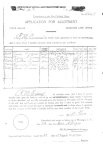
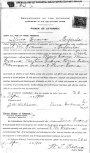
govt. questions Dawes Roll Allotment App. Census Card Power of Attny. You'll be interested in the index to these microfilms, Bob Blankenship's Dawes Rolls Plus, since the microfilms of the actual Dawes Rolls are National Archives Record Group M1303, and are on 468 rolls. Again, Bob cross-referenced entries for your ancestors if he also found them on the Guion Miller Rolls.
From the National Archives Native American Microfilms Applications for Enrollment of the Commission to the Five Civilized Tribes, 1898-1914. M1301. 468 rolls. 16mm. "This microfilm publication reproduces the application forms filled out by persons seeking to claim official enrollment in the Five Civilized Tribes under the Dawes Commission. The applications contain additional information not abstracted to the census cards, filmed in M1186, Enrollment Cards of the Five Civilized Tribes, 1898-1914, and are numbered according to a different set of numbers. The application number may be obtained from the census card in M1186. The applications are grouped first according to tribe, and relationships such as "by blood" or "minor," and finally numerical order. The originals of these applications are in the National Archives-Southwest Region in Fort Worth, TX. If the application is not found filmed here, write to the regional archives for further information."
The Friends of the Oklahoma State Historical Society have produced a Dawes Roll index on their Native American CD. I think this is simply "the best!" I was surprised when I typed in my ancestor's name, Alexander Posey and I found his picture!
From the Friends of the OSHS: "This valuable compilation produced by the Friends of the Oklahoma Historical Society Archives, GenRef, Inc., the Archives staff, and volunteers contains the Dawes Final Rolls with the names of the citizens and freedmen of the Five Civilized Tribes of Indian Territory. The CD also contains scanned versions of three rare and out of print books. If purchased just one of these books (D.C. Gideon's Indian Territory: Descriptive Biographical and Genealogy published in 1901) would sell for $750.00. In addition, H.F. and E.S. O'Beirnes' The Indian Territory: Its Chiefs, Legislators, and Leading Men (1892) as well as Paul W.H. Dewitz's Notable Men of Indian Territory, (1904-1905) is included. Chilocco Indian School records are also available, as well as 1896 Dawes Enrollment Applications; Dawes Rejected Names."
Next Step Okay, so you find your family on the Dawes where do you go from there? You'll need to get:
the census card numbers
Dawes enrollment packet numbers
These numbers are included on Bob Blankenship's Dawes Plus and Guion Miller Plus books mentioned above. The Dawes Plus will also give you the age in 1902 and degree of blood.
More Native America Research Lessons

©1999 -- [email protected] -- all rights reserved.