Home -- Links -- Lessons -- Resources -- E-mail
Old Settler Rolls
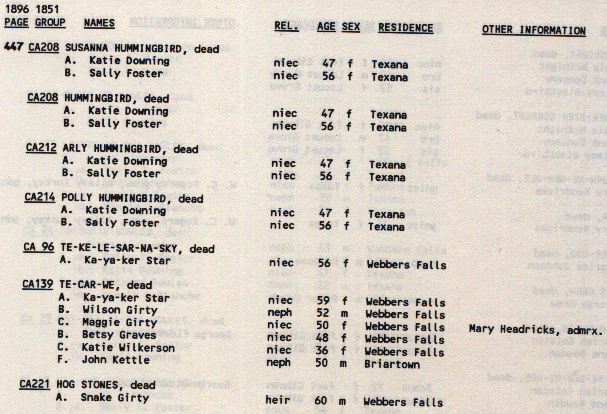
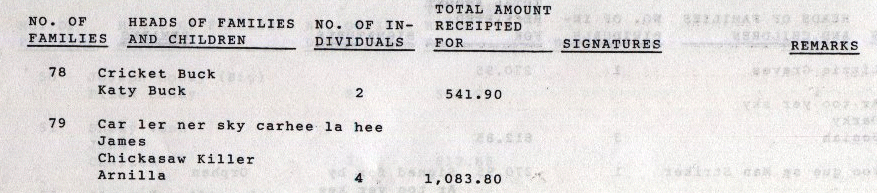
(click on small pictures to see samples of Old Settler Roll entries.)
With this first lesson we are going to go over the "Old Settler Rolls" for Cherokee Families. This is part of a lecture we gave in the Native American Forum on AOL. The lecture was given by Barbara Benge and myself. This is one of the first rolls or censuses to be taken of our people.
The Cherokee Nation after the Trail of Tears was divided into several different categories.
Those that remove prior to this forced removal - The Old Settlers
some of who went into Texas and became known as the Texas Cherokees
the Treaty Party
and the Emigrant Cherokees
There were also those who were able to stay in the Old Cherokee Nation and became known as the Eastern Cherokees.
So add this to the mix blood- full blood problem and you can see there was a great deal of strife in the Nation. Today, I will try to explain one of such parties, the Old Settlers and how to go about researching these ancestors.
Who was involved? There were large number of the Cherokees who became known as the Old Settlers because they removed to Indian Territories before the forced removal on the Trail of Tears. You'll find they mostly settled in Arkansas, between 1817- 1835. They "removed" so as to get away from the whites who were intruding on the Cherokee Nation. Not only were they the mixed blood families but full bloods who left the original Cherokee lands.
The problems back in the East were very bad indeed. Most Native Americans were afraid of even leaving their homes because when they returned there would often be a white family that had moved in. The Cherokees had very little recourse in these matters, so, for a large number of them, the territories west of the Mississippi looked pretty good. The Cherokees were unable to press suit against the white settlers.
The Government Plan 1817-1835 If the Natives signed up for removal between 1817-1835, each head of the family was to receive from the US government:
a good rifle
a blanket
a kettle
5 pounds of tobacco
and compensation for all improvements abandoned.
Additionally, all members of the family received a blanket. Each head of household removing at least 4 persons with him received $50. The US government also paid for the cost of removal and subsistence for one year afterwards.
Native Reaction There were said to be 1,000 Cherokees that had already "removed" before 1817, but it was not regulated, no payments were made by the government and no government census was taken of the Old Settlers prior to 1851. In 1835, roughly one third of the Cherokee population had removed to Indian territory including Sequoyah. Some of the earliest Old Settlers were Tal-on-tee-skee and his brother John Jolly. Tal-on-tee-skee was Chief of the Old Settlers also known as the Western Cherokees. He opted to go to Arkansas after he and Doublehead took bribes from the US government. This is said to be one of the reasons that Major Ridge, a cousin and companion to Doublehead, assassinated him.
After Doublehead's execution, Tal-on-tee-skee who also was related loosely to Doublehead and his brother in law, decided he would be better off leaving the Cherokee Nation or face the same fate. Tal-on-tee-skee settled on the White and St. Francis rivers, in what is now known as NE Arkansas in approximately 1810. The Bowl (Duwali) a half blood son of a Scottish trader who was killed when he was 12, and a full blood, an Usliwai (or Fox) settled close by. There apparently had been other times that the Cherokees had been in this area to hunt because earlier the Osage had made complaints about them hunting on their lands.
The Osage fought the Cherokee, trying to prevent encroachment on their tribal lands, causing many a battle. Even though the Osage out numbered them, the Cherokees won most of these battles, due to the fact that most of the fierce Chickamauga were amongst this group.
The Chickamauga were in the most part full blood warriors who had not adopted the white man way's. They lived traditionally and followed the Old Cherokee customs and laws. Some of the most noted were Dragging Canoe, the Bowl, Blackcoat and Ta-kah-ko-kuh a distinguished Chief and warrior.The US refused to give aid to these Cherokees because the land in Arkansas was not exchanged for land in the East. The Cherokees that remained in the East refused to secede any more land but finally relented signing the Treaty of 1817 in which two tracts of land were ceded- one in Northern Tennessee, the other in East Georgia. The Arkansas Cherokees fought to have the U S government recognize them as a separate but distinct Cherokee Nation.
Working backwards in time Its impossible to start with the 1817 annuity and 1835 census of your Native American ancestors. You need to start with yourself, and collect information on your parents, grandparents and great-grandparents. Ask about the old stories -- the traditions. Ask about Indian names and where your people come from. Write everything down, or better yet, use a genealogy program on your computer to keep track of all the names, dates and places that are important to your family history. Be sure to make copies of birth, marriage and death certificates, and other important papers other members of the family have on hand.
Once you have gathered these bits of personal recollections, you are ready for actually doing Old Settler research.
Step 1: Old Settlers' Roll - 1895 Old Settler Cherokee Census Roll, 1895, and Index to Payment Roll, 1895. T985. 2 rolls. Roll Contents 1 Index to Payment Roll for Old Settler Cherokee, 1896 2 Old Settler Cherokee Census Roll, 1895
Step 2: Old Settlers' Annuity - 1828. In the Treaty of 1817 the US had provided for a separate census for annuity payments to the Old Settlers, however the US left the lands in Arkansas undefined and refused annuity payment. The government was trying to encourage more of the Cherokees to move to Arkansas so the Americans could get more land.
The matter of the Old Settlers receiving an annuity was not solved until 1828 when a payment was made top the Arkansas Cherokees. Terri Moore has put this list up on the Internet. It is very helpful in searching for information if the Old Settler had removed prior to 1828. I myself use this list often even though it only lists the head of household and number of individuals in the family. Still, it often provides vital clues.
Old Settlers' Payments - 1896 These are located in National Archives: Old Settler Cherokee Census Roll, 1895, and Index to Payment Roll, 1895. T985. 2 rolls.
David Keith Hampton has put out a book, Descendants of Nancy Ward, A workbook for Further Research that has both the Old Settlers payment in 1896 (this is the census roll) and the Old Settlers roll that was done in 1851. This book is an incredible asset for those that are looking to find Old Settlers and also those Emigrant Cherokee that might have family that was Old Settlers. In it they list the people who descend from them, their relationships, their ages and where they were living in 1896. If they were still living in 1896 they would be eligible to claim there own share. I have found that the best age calculation from this roll is to minus the age given from 1894.
Also it should be noted that males under 21 and females under 18 had guardians appointed over them. It is very important to note these minors guardians since often times they were other family members and this in itself can provide a valuable clue when looking for "orphaned children". If a descendent from the Old Settlers roll was dead in 1896, their share was distributed to their grandchildren, nieces, nephews and cousins, etc.
This Old Settlers roll also names those who they could not find any direct descendants or did not have direct family members as heirs. These can be very confusing to beginning researchers. An example can be an aunt or cousin only by marriage because there is some difficult family tie that is not readily explainable.
ASSIGNMENT:
Look for your ancestors on the Old Settler's rolls as mentioned above.
Make photocopies of the pages that mention your ancestors.
Place these photocopies in a top loading sheet protector, found at office supply stores. This saves the document from excess handling and prevents it from sticking to other pages in a notebook or file.
Begin to organize your family history using a genealogy program. There is a free windows program called PAF Personal Ancestral File 4.0. John Scroggins also has some additional ideas - Genealogy Software Links.
More Native America Research Lessons

©1999 -- [email protected] -- all rights reserved.