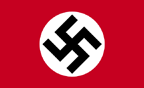
Adolph Hitler
Adolph Hitler
Born: April 20, 1889
*************************************************
By early 1921, Adolf Hitler was becoming highly effective at speaking in front of ever larger crowds. In February, Hitler spoke before a crowd of nearly six thousand in Munich. To publicize the meeting, he sent out two truckloads of Party supporters to drive around with swastikas, cause a big commotion, and throw out leaflets, the first time this tactic was used by the Nazis.
Hitler was now gaining notoriety outside of the Nazi Party for his rowdy,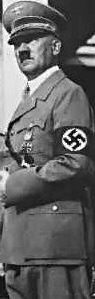 at times hysterical tirades against the Treaty of Versailles, rival politicians and political groups, especially Marxists, and always the Jews.
The Nazi Party was centered in Munich which had become a hotbed of ultra right wing German nationalists. This included Army officers determined to crush Marxism and undermine or even overthrow the young German democracy centered in Berlin.
Slowly, they began looking toward the rising politician, Adolf Hitler, and the growing Nazi movement as the vehicle to hitch themselves to. Hitler was already looking at how he could carry his movement to the rest of Germany. He traveled to Berlin to visit nationalist groups during the summer of 1921.
But in his absence, he faced an unexpected revolt among his own Nazi Party leadership in Munich.
The Party was still run by an executive committee whose original members now considered Hitler to be highly overbearing, even dictatorial. To weaken Hitler's position, they formed an alliance with a group of socialists from Augsburg.
Hitler rushed back to Munich and countered them by announcing his resignation from the Party, July 11, 1921.
They realized the loss of Hitler would effectively mean the end of the Nazi Party. Hitler seized the moment and announced he would return on the condition that he was made chairman and given dictatorial powers.
Infuriated committee members, including Anton Drexler, founder of the Party, held out at first. Meanwhile, an anonymous pamphlet appeared entitled, "Adolf Hitler: Is he a traitor?" It attacked Hitler's lust for power and criticized the violence prone men now surrounding him. Hitler responded to its publication in a Munich newspaper by suing for libel and later won a small settlement.
The executive committee of the Nazi Party eventually backed down and Hitler's demands were put to a vote of the party members. Hitler received 543 votes for, and only one against.
At the next gathering, July 29, 1921, Adolf Hitler was introduced as F�hrer of the Nazi Party, marking the first time that title was publicly used to address him.
***********************************************
Hitler on Trial for Treason
The trial of Adolf Hitler for high treason after the Beer Hall Putsch was not the end of Hitler's political career as many had expected. In many ways marked the true beginning.
Overnight, Hitler became a nationally and internationally known figure due to massive press coverage. The judges in this sensational trial were chosen by a Nazi sympathizer in the Bavarian government. They allowed Hitler to use the courtroom as a propaganda platform from which he could speak at any length on his own behalf, interrupt others at any time and even cross examine witnesses.
Rather than deny the charges, Hitler admitted wanting to overthrow the government and outlined his reasons, portraying himself as a German patriot and the democratic government itself, its founders and leaders, as the real criminals.
"I alone bear the responsibility. But I am not a criminal because of that. If today I stand here as a revolutionary, it is as a revolutionary against the revolution. There is no such thing as high treason against the traitors of 1918."
Hitler considered the traitors of 1918 to be the German politicians responsible for the so called 'stab in the back,' who prematurely ended World War One and established the German democratic republic. In Hitler's mind and among many Germans, their Army had not been defeated on the battlefield but had been undermined by political treachery at home.
In reality, German Army leaders themselves had opened negotiations with the Allies to end the war which they were losing.
But newspapers quoted Hitler at length. Thus, for the first time, the German people as a whole had a chance to get acquainted with this man and his thinking. And many liked what they heard.
During 24 days of long, rambling arguments, Hitler's daring grew. As the trial concluded, sensing the national impact he was having, Hitler gave this closing statement.
"...The man who is born to be a dictator is not compelled. He wills it. He is not driven forward, but drives himself. There is nothing immodest about this. Is it immodest for a worker to drive himself toward heavy labor? Is it presumptuous of a man with the high forehead of a thinker to ponder through the nights till he gives the world an invention? The man who feels called upon to govern a people has no right to say, 'If you want me or summon me, I will cooperate.' No! It is his duty to step forward. The army which we have now formed is growing day to day. I nourish the proud hope that one day the hour will come when these rough companies will grow to battalions, the battalions to regiments, the regiments to divisions, that the old cockade will be taken from the mud, that the old flags will wave again, that that there will be a reconciliation at the last great divine judgment which we are prepared to face. For it is not you, gentlemen, who pass judgment on us. That judgment is spoken by the eternal court of history...Pronounce us guilty a thousand times over: the goddess of the eternal court of history will smile and tear to pieces the State Prosecutor's submissions and the court's verdict; for she acquits us."
The court's verdict - guilty. Possible sentence - life. Hitler's sentence - five years, eligible for parole in six months.
The three judges in the trial had become so sympathetic that the presiding judge had to persuade them to find him guilty at all. They agreed to find Hitler guilty only after being assured he would get early parole.
Other Nazi leaders arrested after the failed Putsch got light sentences as well. General Ludendorff was even acquitted.
On April 1, 1924, Hitler was taken to the old fortress at Landsberg and given a spacious private cell with a fine view. He got gifts, was allowed to receive visitors whenever he liked and had his own private secretary, Rudolph Hess.
The Nazi Party after the Putsch became fragmented and disorganized, but Hitler had gained national influence by taking advantage of the press to make his ideas known. Now, although behind bars, Hitler was not about to stop communicating.
Pacing back and forth in his cell, he continued expressing his ideas, while Hess took down every word. The result would be the first volume of a book, Mein Kampf, outlining Hitler's political and racial ideas in brutally intricate detail, serving both as a blueprint for future actions and as a warning to the world.
***************************************************
Hitler Becomes Dictator
After the elections of March 5, 1933, the Nazis began a systematic takeover of the state governments throughout Germany, ending a centuries old tradition of local political independence. Armed SA and SS thugs barged into local government offices using the state of emergency decree as a pretext to throw out legitimate office holders and replace them with Nazi Reich commissioners.
Political enemies were arrested by the thousands and put in hastily constructed holding pens. Old army barracks and abandoned factories were used as prisons. Once inside, prisoners were subjected to military style drills and harsh discipline. They were often beaten and sometimes even tortured to death. This was the very beginning of the Nazi concentration camp system.
At this time, these early concentration camps were loosely organized under the control of the SA and the rival SS. Many were little more than barbed wire stockades know as 'wild' concentration camps, set up by local Gauleiters and SA leaders.
For Adolf Hitler, the goal of a legally established dictatorship was now within reach. On March 15, 1933, a cabinet meeting was held during which Hitler and G�ring discussed how to obstruct what was left of the democratic process to get an Enabling Act passed by the Reichstag. This law would hand over the constitutional functions of the Reichstag to Hitler, including the power to make laws, control the budget and approve treaties with foreign governments..
The emergency decree signed by Hindenburg on February 28, after the Reichstag fire, made it easy for them to interfere with non-Nazi elected representatives of the people by simply arresting them.
As Hitler plotted to bring democracy to an end in Germany, Propaganda Minister Joseph Goebbels put together a brilliant public relations display at the official opening of the newly elected Reichstag.
On March 21, in the Garrison Church at Potsdam, the burial place of Frederick the Great, an elaborate ceremony took place designed to ease public concern over Hitler and his gangster-like new regime.
It was attended by President Hindenburg, foreign diplomats, the General Staff and all the old guard going back to the days of the Kaiser. Dressed in their handsome uniforms sprinkled with medals, they watched a most reverent Adolf Hitler give a speech paying respect to Hindenburg and celebrating the union of old Prussian military traditions and the new Nazi Reich. As a symbol of this, the old Imperial flags would soon add swastikas.
Finishing his speech, Hitler walked over to Hindenburg and respectfully bowed before him while taking hold of the old man's hand. The scene was recorded on film and by press photographers from around the world. This was precisely the impression Hitler and Goebbels wanted to give to the world, all the while plotting to toss aside Hindenburg and the elected Reichstag.
Later that same day, Hindenburg signed two decrees put before him by Hitler. The first offered full pardons to all Nazis currently in prison. The prison doors sprung open and out came an assortment of Nazi thugs and murderers.
The second decree signed by the befuddled old man allowed for the arrest of anyone suspected of maliciously criticizing the government and the Nazi party.
A third decree signed only by Hitler and Papen allowed for the establishment of special courts to try political offenders. These courts were conducted in the military style of a court martial without a jury and usually with no counsel for the defense.
On March 23, the newly elected Reichstag met in the Kroll Opera House in Berlin to consider passing Hitler's Enabling Act. It was officially called the "Law for Removing the Distress of the People and the Reich." If passed, it would in effect vote democracy out of existence in Germany and establish the legal dictatorship of Adolf Hitler.
Brown-shirted Nazi storm troopers swarmed over the fancy old building in a show of force and as a visible threat. They stood outside, in the hallways and even lined the aisles inside, glaring ominously at anyone who might oppose Hitler's will.
Before the vote, Hitler made a speech in which he pledged to use restraint.
"The government will make use of these powers only insofar as they are essential for carrying out vitally necessary measures...The number of cases in which an internal necessity exists for having recourse to such a law is in itself a limited one," Hitler told the Reichstag.
He also promised an end to unemployment and pledged to promote peace with France, Great Britain and the Soviet Union. But in order to do all this, Hitler said, he first needed the Enabling Act. A two thirds majority was needed, since the law would actually alter the constitution. Hitler needed 31 non-Nazi votes to pass it. He got those votes from the Center Party after making a false promise to restore some basic rights already taken away by decree.
Meanwhile, Nazi storm troopers chanted outside. "Full powers - or else! We want the bill - or fire and murder!!"
But one man arose amid the overwhelming might. Otto Wells, leader of the Social Democrats stood up and spoke quietly to Hitler.
"We German Social Democrats pledge ourselves solemnly in this historic hour to the principles of humanity and justice, of freedom and socialism. No enabling act can give you power to destroy ideas which are eternal and indestructible."
Hitler was enraged and jumped up to respond.
"You are no longer needed! - The star of Germany will rise and yours will sink! Your death knell has sounded!"
The vote was taken - 441 for, and only 84, the Social Democrats, against. The Nazis leapt to their feet clapping, stamping and shouting, then broke into the Nazi anthem, the H�rst Wessel song.
They had brought down the German Democratic Republic legally. Democracy was ended. From this day on, the Reichstag would be just a sounding board, a cheering section for Hitler's pronouncements.
Interestingly, the Nazi party was now flooded with applications for membership. These latecomers were cynically labeled by old time Nazis as 'March Violets.' In May the Nazi party froze membership. Many of those kept out applied to the SA and the SS which were still accepting. However, in early 1934, Heinrich Himmler would throw out 50,000 of those 'March Violets' from the SS.
The Nazi Gleichschaltung now began, a massive coordination of all aspects of life under the swastika and the absolute leadership of Adolf Hitler.
Under Hitler, the State, not the individual, was supreme.
From the moment of birth one existed to serve the State and obey the dictates of the F�hrer. Those who disagreed were disposed of.
Many agreed. Bureaucrats, industrialists, even intellectual and literary figures, including Gerhart Hauptmann, world renowned dramatist, were coming out in open support of Hitler.
Many disagreed and left the country. A flood of the finest minds, including over two thousand writers, scientists, and people in the arts poured out of Germany and enriched other lands, mostly the United States. Among them - writer Thomas Mann, director Fritz Lang, actress Marlene Dietrich, architect Walter Gropius, musicians Otto Klemperer, Kurt Weill, Richard Tauber, psychologist Sigmund Freud, and Albert Einstein, who was visiting California when Hitler came to power and never returned to Germany.
In Germany there were now constant Nazi rallies, parades, marches and meetings amid the relentless propaganda of Goebbels and the omnipresent swastika. For those who remained there was an odd mixture of fear and optimism in the air.
Now, for the first time as dictator, Adolf Hitler turned his attention to the driving force which had propelled him into politics in the first place, his hatred of the Jews. It began with a simple boycott on April 1, 1933 and would end years later in the greatest tragedy in all of human history.
A N D ........M O R E
HITLER, leader of the German Nazi party and, from 1933 until his death, dictator of Germany. He rose from the bottom of society to conquer first Germany and then most of Europe. Riding on a wave of European fascism after World War I and favored by traditional defects in German society, especially its lack of cohesion, he built a Fascist regime unparalleled for barbarism and terror. His rule resulted in the destruction of the German nation-state and its society, in the ruin of much of Europe's traditional structure, and in the extermination of about 6 million Jews. He was eventually defeated, but his temporary success demonstrated frighteningly, at the brink of the atomic age, the vulnerability of civilization.
Early Years
Hitler was born on April 20, 1889, at Braunau-am-Inn, Austria. Alois, his father, had risen from a poor peasant background to become an Austrian customs official and was able to provide his son with a secondary school education. Adolf, a bright and talented student at his village school, felt out of place in the much larger urban secondary school. He gave himself up to aimless reading, dreamed about becoming an artist, and developed a talent for evading responsibilities. Poor school marks prevented him from obtaining the customary graduation certificate. After the death of his father, he left his home in Linz, Upper Austria, in 1907 to seek his fortune in Vienna.
Hitler's professed aim in Vienna was to study art, especially architecture, but he twice failed, in 1907 and 1908, to get admitted to the Academy of Fine Arts. These failures destroyed what little order he had established in his life. He withdrew completely from family and friends and wandered aimlessly through the city, observing its life. Though he continued to read voraciously, he derived most of his knowledge from secondhand sources, coffeehouse talk, newspapers, and pamphlets. He encountered the writings of an obscure author whose racist and anti-Semitic ideas impressed him. Politically, he turned to a fervent German nationalism and a vague anti-Marxism. But at this time he was probably mainly interested in being accepted as an artist and architect.
When the money left by his parents ran out, Hitler fell into total poverty, lodging in a men's hostel. Grudgingly, he decided to support himself by painting postcards and watercolors and to accommodate himself to the mixed company of tramps, outcasts, cranks, and transients that populated his lodgings. In both respects he did the barest minimum; he never learned to work regularly, and he remained essentially a loner. But he learned an invaluable lesson: how to evaluate and exploit the mentality of these marginal people, the Lumpenproletariat. He never considered that they posed a social problem, however, and for the rest of his life he mistook them for the real working class.
Military Service
In 1913, Hitler moved to Munich in the hope both of evading Austrian military service and of finding a better life in the Germany he admired so much. Opportunities for making a living, however, were even fewer in Munich than in Vienna, which partly explains his relief and enthusiasm at the outbreak of World War I. Hitler served throughout the war as a volunteer in a Bavarian infantry regiment, operating mostly in the front line as a headquarters runner. He was wounded in the leg in 1916 and gassed in 1918. Significantly enough, he was never promoted to a leadership position, but he was awarded unusually high decorations for bravery in action. The war had a profound influence on him. It provided him, finally, with a purpose that filled the void in his life. He was especially impressed by, and learned much about, violence and its uses. Hitler the artist was dead, and the politician was soon to emerge.
Rise to Political Leadership
The end of the war and Germany's humiliating defeat again deprived his life of meaning, and he turned against the revolution in Germany and the pacifist Weimar republic that he imagined had caused him to be so deprived. Soon afterward he discovered his power as a public speaker when, after his return to Munich, the Bavarian military command appointed him an instructor in a program for the political indoctrination of the troops. In September 1919, while an army political agent, he encountered the German Workers' party (Deutsche Arbeiterpartei), a small group interested in extending the message of nationalism to the workers. It later renamed itself the Nationalsozialistiche Deutsche Arbeiterpartei (National Socialist German Workers' party, NSDAP, or Nazis).
Hitler quickly recognized that this party offered him a better chance for his new goal: political power. In April 1920 he left the army to devote all his time to his position as chief propagandist for the party. He developed a new system of political propaganda, one that emphasized mass emotionalism and violent provocation. Hitler was a masterly demagogue, and the party soon became a factor in Bavarian politics, mainly attracting the urban petty bourgeoisie. In July 1921, he became party chairman with dictatorial powers.
His goal was to overthrow the government, but he had to compete with numerous other Bavarian right-wing groups and with his friend Ernst Roehm, a Bavarian staff officer. Roehm advocated the primacy of the military and wanted to incorporate the party's paramilitary units, called the SA, or Storm Troopers (Sturmabteilung) into his secret army, while Hitler insisted on the primacy of politics. When the French occupied the Ruhr in January 1923, German nationalist feelings ran high, and military authorities prepared for mobilization. The views of Roehm and the other right-wingers now seemed to be prevailing; Hitler thereupon tried to regain control of the movement by his Beer Hall Putsch of Nov. 8-9, 1923. The putsch was aimed at capturing, first, the government of Bavaria, and then the nation's, but the Bavarian authorities were able to suppress it.
The failure of the putsch destroyed the party organization, severed its army ties, and resulted in prison terms for Hitler and other leaders. Hitler used his trial to gain nationwide attention for his cause. He served nine months of his 5-year sentence in the fortress of Landsberg, where he wrote Mein Kampf in an effort to demonstrate that his leadership was based on intellectual as well as political superiority.
Hitler's writing in Mein Kampf is crude and disorganized, and his ideas are not original, but the book is still an important document. The most persistent theme is social Darwinism: the struggle for life governs the relationships of both individuals and nations. He argued that the German people, supposedly racially superior, were threatened by liberalism, Marxism, humanism, and bolshevism, which were directed from behind the scenes by the Jews. Relief would come from a plebiscital dictatorship that would fight a relentless war against internal and external foes, in the process conquering Lebensraum (living space) that would make Germany militarily and economically unassailable. Hitler was much more effective when writing about the techniques of power and demagoguery. He appears in the book as a man determined, and to some degree able, to implement even the maddest schemes.
Rebuilding the Nazi Party
When Hitler left prison and tried to rebuild the party, he met with great difficulties. He was challenged in northern Germany by the " socialist Nazi left leader Gregor Strasser, who aimed his appeal at the workers. To meet the challenge, Hitler wooed certain extremist military groups, the leftovers from World War I. While the workers ignored Strasser's program, the military outcasts eagerly followed Hitler. At a party conference in May 1926, Hitler outflanked Strasser and won back the dictatorial chairmanship, which he subsequently reinforced by declaring the party program unalterable, thus undercutting any attempt to revive the controversy over socialism.
Social conditions still prevented the party from growing, however. Interest in extremist solutions had waned as Germany had regained economic and political stability. In addition, Hitler was prohibited from speaking, which deprived him of his most powerful weapon. His breakthrough came in 1929, when the German Nationalist party made him politically respectable by soliciting his help in its vicious campaign against the Young Plan's arrangements for German reparations. In September 1930, after the depression had hit Germany, the Nazis made their first substantial showing (18.3% of the vote) in national elections, and from then on Hitler seemed to rise irresistibly. He still used propaganda, demagoguery, and terror, but he now proclaimed, and defended against strong party opposition, a policy of legality. While his propaganda appealed to the lower class victims of the depression, his insistence on legality made him acceptable to the conservatives, nationalists, and the military.
Personal Life and Rise to Power
During this period, Hitler lived mainly from royalties for his book and fees for newspaper articles. He was able to afford an apartment in Munich, a villa in the Alps, and a car, but his style of life remained modest. He had a craving for pastries, movies, and Richard Wagner's music. His behavior still alternated between outbursts of energy and periods of inactivity and laziness. His sex life seems to have been abnormal. In 1928 he began a passionate affair with his niece Geli Raubal. The affair ended tragically in 1931 when Geli, feeling suffocated by his tyranny, committed suicide. After he became dictator, he made Eva Braun, a clerk, his mistress, but refused to marry her in order to preserve his image as a self-denying public servant.
In 1932, with Germany close to anarchy, Hitler's career approached its crisis. He narrowly lost to the incumbent Paul von Hindenburg in the presidential elections in April, and the Nazis polled their highest vote (37.2%) in the July elections. In the November elections, however, the Nazi vote decreased to 33.1%. Hitler had lost prestige through his stubborn insistence on "total power; the party was psychologically and financially exhausted; and the depression was beginning to wane. At this moment, a conservative group led by former Chancellor Franz von Papen arranged for Hitler to enter the government. On Jan. 30, 1933, the aged President Hindenburg appointed him chancellor in a coalition government with the conservatives.
The conservatives deluded themselves in thinking they could use Hitler for their own interests. Within four months, Hitler had dramatically established his mastery over them and over all other political groups. He had destroyed the Communist and Socialist parties and the labor unions; forced the bourgeois and right wing parties to dissolve; emasculated or destroyed the paramilitary organizations; eliminated the federal structure of the republic; and on March 23, 1933, won from a decimated and intimidated Reichstag an enabling law that gave him dictatorial powers. His success came from a combination of pseudo-democratic mass demonstrations; terror by the SA and the Nazi-controlled police, which accelerated after the Reichstag fire in February; and a seemingly conservative program that kept the conservatives quiescent.
Consolidation of Power
In early 1934, however, he faced new conflicts, mainly from within the party. The SA, still led by Roehm, and the Nazi left vigorously opposed his alliance with business and military leaders, and a group of monarchists was campaigning for a restoration of the monarchy. Hindenburg's deteriorating health raised the question of his succession. Hitler survived the crisis by adopting the most radical methods. He rallied behind himself the party leaders, the army, and Himmler 's SS (the Schutzstaffel, or Blackshirts), and on June 30, 1934, he struck. A number of SA leaders, monarchists, and other opponents were murdered; the influence of the SA was drastically reduced; and Hitler emerged as the undisputed master of Germany. When Hindenburg died on August 2, Hitler officially assumed the title of Fuhrer, or supreme head of Germany.
From 1935 to 1938 he consolidated his dictatorship. The basis of his power was still his control over the masses, who admired him as the "man of the people and falsely credited Germany's economic recovery to him. (Its real architect had been Hjalmar Schacht, a conservative banker.) In 1937-1938 the economy reached full employment, thanks to an increasingly reckless rearmament policy. Hitler also protected his position by promoting rivalries among his subordinates, and he encouraged Himmler to build a formidable apparatus of terror by means of the SS, the Gestapo, and the concentration camps. He then escalated the persecution of the Jews through the Nuremberg Laws of 1935, which deprived Jews of their citizenship and forbade marriages between Jews and non-Jews. Additional restrictive laws were passed during the next few years, and Hitler's policies resulted in a large-scale emigration of Jews, socialists, and intellectuals and in the virtual destruction of Weimar Germany's highly creative culture.
Preparations for War
In foreign affairs, as long as Hitler felt weak, he shielded his regime by peaceful declarations and by treaties, such as those with the Vatican in July 1933 and with Poland in January 1934. Nevertheless, he indicated his true intentions in October 1933, when he withdrew from the League of Nations. As his strength increased, he proceeded to remove the restrictions imposed by the Versailles Treaty by proclaiming open rearmament in March 1935 and by remilitarizing the Rhineland in 1936. Simultaneously, he tried to win the neutrality of Britain through a naval treaty in June 1935, and gained Italy's allegiance by supporting MUSSOLINI's Ethiopian war (1935-1936). The Italian alliance materialized in October 1936, strengthened by their joint interference in the Spanish Civil War.
From the outset, Hitler had been determined to conquer Lebensraum. In November 1937 he disclosed his war plans to his ministers, and when they objected, he dismissed Schacht and the heads of the army and of the foreign ministry. By replacing these men, he eliminated the last traces of the conservative alliance and cleared the way for war. Under the guise of a policy of self-determination, Hitler annexed Austria in March 1938 and the Sudetenland, the German-inhabited border areas of Czechoslovakia, in October. By disclaiming any further expansionist aims, he won approval of the Sudetenland occupation from Britain, France, and Italy at a conference in Munich. When he nevertheless extended his rule over all of Czechoslovakia in March 1939 and then threatened Poland, Britain and France abandoned their appeasement policy and guaranteed Poland's integrity. Unimpressed, Hitler continued his preparations by signing a nonaggression pact with Russia on August 23. When he attacked an unyielding Poland on September 1, Britain and France surprised him by declaring war.
Early Successes in World War II
Allied inactivity and a lightning victory over Poland permitted Hitler to mobilize his forces fully and to persuade his reluctant generals to intensify the war effort. In April 1940, German troops conquered Norway and Denmark; in May and June they swept through the Netherlands, Belgium, and France. On June 22, a triumphant Hitler forced France to sign an armistice at Compiegne, the site of the armistice of 1918. He was at the peak of his career, having now proved himself a superior military commander, and he began to build his New Order in Europe. The New Order's only tangible result was Heinrich Himmler's policy of racial reorganization. It combined a senseless resettlement of racially "valuable populations with a relentless suppression and extermination of "subhumans, among them about 6 million Jews, through slave labor, concentration camps, gas chambers, firing squads, and starvation.
Meanwhile, Britain's determination and the imminent conflict with Russia forced Hitler to go on. After unsuccessfully trying to defeat Britain through a heavy bombing attack on the British Isles and a ground offensive against British troops in North Africa, Hitler turned with full force to the east. On June 22, 1941, he launched his attack on the Soviet Union. But the German advance was stopped before Moscow by a harsh winter and a Russian counterattack. At the same time Japan, with which Germany had a nonaggression pact, attacked Pearl Harbor, and Hitler declared war on the United States.
Military Reversals
In 1942, Hitler was still scoring victories in the Ukraine and in North Africa, but his judgment increasingly failed him. He withdrew into his headquarters, concentrating on military affairs to the exclusion of politics and diplomacy, and quarreling with his generals' judgments. With the German defeat at Stalingrad and the Allied reconquest of North Africa in 1943, the war was lost. Hitler, however, ordered the total mobilization of the economy and tried to rebuild Mussolini's regime in northern Italy after its collapse in July 1943. He also maintained his almost hypnotic power over his entourage and the masses, assisted by Allied air raids against the cities, which rekindled the fighting spirit of the people.
Hitler's Last Days
A group of civilians and officers had been conspiring since 1938 to overthrow Hitler. But Hitler's popularity with the masses, the conspirators' need for complete secrecy, and their recurring doubts about the rightness of their cause handicapped them. Furthermore, they failed to reach an understanding with the Allies. The energy of Col. Claus von Stauffenberg finally brought the plot to a head on July 20, 1944, but his attempt on Hitler's life and the subsequent putsch failed, confirming Hitler's belief in his own invincibility.
On June 6, 1944, the Allies invaded France; later, the Russians broke through in the east, forcing Hitler to move his headquarters to Berlin. He showed increasing signs of physical and mental disintegration, intensified by an illness that had not been properly treated by his physician, a quack doctor, upon whom Hitler had become dependent for injections. With the Allies crossing the Rhine River and the Russians closing in on Berlin, he at last acknowledged defeat and decided to commit suicide; but he wanted Germany to follow suit. Germany, he argued, had proved itself unworthy of his genius and had failed to prevail in the struggle for life.
As his personality disintegrated, however, so did the loyalty of his lieutenants. Albert Speer, the minister of armaments and munitions, refused to carry out Hitler's order to institute a scorched-earth policy in Germany; Goering, from his retreat in Bavaria, tried to usurp Hitler's leadership; and Himmler attempted to negotiate with the Allies. Hitler condemned them, but without effect. Only Goebbels, Bormann, and Eva Braun, whom he now married, remained with him. Hitler dictated his political testament and appointed Adm. Doenitz his successor. With the Russians rapidly approaching his bunker in Berlin, Hitler and Eva committed suicide on April 30, 1945.
O R
