
It was less than an hour since our plane had landed at New Orleans International Airport, and my husband, Ray, and I had already retrieved our luggage, rented a car, and taken a quick drive down I-10 to get a glimpse of the city and the Mississippi River. Now, as we pulled up in front of a small diner in Marrero, our three-day exploration of New Orleans and its environs was about to begin in earnest, and the itinerary was planned around food, a festival, and a plantation.
At our first stop, on the West Bank of the Mississippi across the river from New Orleans, we wasted no time in ordering seafood gumbo, stuffed crab po� boy, fried oyster po� boy, bread pudding, and iced tea. Our conversation took a hiatus while we savored every delicious bite, and empty dishes soon covered the tiny Formica tabletop. Yes, we could now say that we had truly arrived back at one of our favorite places in the United States.
Ray lived in New Orleans before we met, and despite his repeated efforts to convince me that it is �my kind of city,� for years I nixed his suggestions for a visit. Perhaps thinking of all the stories I had heard of Mardi Gras excesses and debauchery, I had decided this city was too crass for my taste.
However, when an opportunity for a business trip to New Orleans presented itself some years ago, my resistance finally wore down. My first steps into the French Quarter, on infamous Bourbon Street, were not as unpleasant as I had anticipated. In fact, the delicious aromas of food that wafted from the restaurants were quite inviting. As we made our way to Royal Street, my eyes lit up at the assortment of antiques stores, galleries, and shops before me. Each display window was more appealing than the last. At the Caf� du Monde, just steps from the river, I had my first taste of caf� au lait and beignets and then reluctantly admitted that I had been flat-out wrong about this city. That trip was to be the first of many we would make to New Orleans.
But on this particular visit, we had places to go and people to meet. After lunch, we drove just a few miles up the road to Boutte, where the annual Alligator Festival was underway. Unfortunately, a downpour the previous evening had turned the festival grounds into a site more suitable for a mud bog. Workers were feverishly placing straw over the puddles and mud, but the soggy ground was swallowing up the straw as soon as the workers laid it down. We tromped through the arts and crafts tents, bought some souvenirs (among them, a fine example of bayou couture--an apron with a wide-mouthed alligator on one side and a camouflage design on the reverse side), and had our first taste of alligator. The gator burger was heavily seasoned, so the pure flavor of the meat itself remains a mystery, but the sandwich (dressed, in the Southern style, with lettuce and tomato) was delicious.
Because we had reservations for the evening in White Castle, some 60 miles north, we decided to get on with our drive--but taking the round-about, scenic route on smaller roads rather than the interstate highway. We drove west on Highway 90, crossing bayous and passing the small towns of Les Allemands and Raceland. Huge fields of sugarcane were lush and green, and never having been face-to-face with a sugarcane plant before, I was amazed to discover that they were ten to fifteen feet tall. The vast size and number of sugarcane fields in this part of the state were constant reminders that sugarcane is still a profitable crop and an important component of the Louisiana economy.
Continuing north on Highway 1 from Thibodaux, we soon were approaching Nottoway, our evening destination. Nottoway is the largest of the prized plantation houses that have survived from the mid-1800s when wealthy planters built elaborate homes along the Mississippi River. Built in 1859, the huge white Greek Revival-Italianate mansion has 64 rooms that are attractively furnished with antiques.
As we arrived at Nottoway in the late afternoon, the tours for the day had just ended, and the few people we encountered seemed to be settling in for a quiet evening. We checked in with a young man at the desk next to the gift shop (now closed, as Ray was a bit too eager to point out), and then the three of us slowly walked across the lawn and through a garden toward the house. I commented on the lovely evening, and mentioned how glad we were that we had not arrived the previous day--remembering the unfortunate aftereffects of the rain at Boutte. The young man said he had been playing in a high school football game during the rain, and he could vouch for our good luck with the weather.
We walked up a narrow, angled flight of stairs to the second floor of the Boys Wing, behind the main house, and then down the verandah, past white wooden rocking chairs, to our room. The room, decorated in a style reminiscent of the era when Nottoway was built, featured a large brass bed, fireplace, secretary, and windows overlooking the broad expanse of lawn and trees on the other side of the house. The same sense of peacefulness we had felt as we walked across the grounds extended into our room.
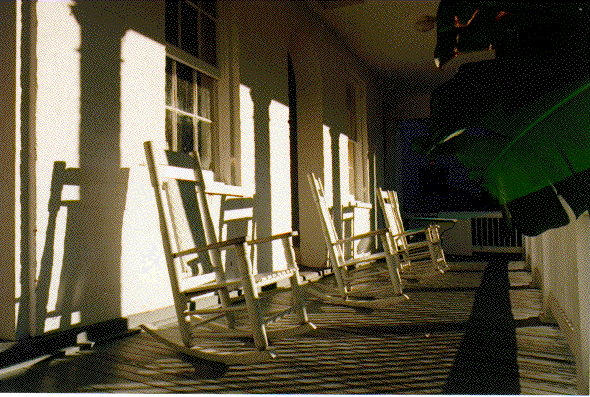
As we unpacked, our welcoming treat of peanuts and sherry was delivered. We took a moment to relax in the chairs on the verandah and imagine what life would have been like here in the late 1850s. For those who called Nottoway "home," it must have been a wonderful time.
With the sun setting, we decided to walk across the road and up the levee to take another look at the Mississippi River, which was just a short walk from the front lawn of the house. A barge was drifting down the river in the waning rays of the sun, creating a classic river scene. Old Muddy didn�t look particularly brown on this day; in fact, it looked downright sparkling as it reflected the sunlight and gently lapped the shore.
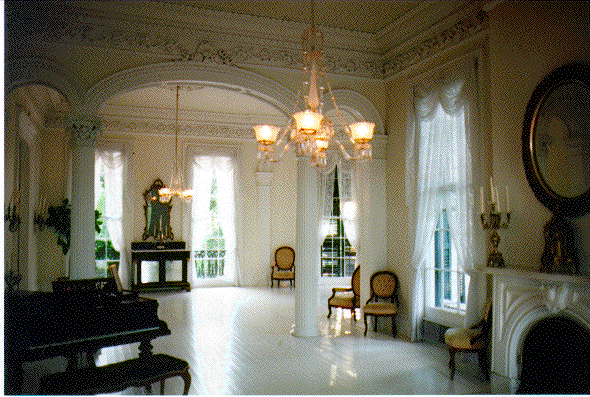
One of the benefits of staying at Nottoway is that overnight guests can walk through the main house at their leisure after the tours end. Ray and I used our special key and entered through a door at the back of the house. Considering that it is nearly 140 years old, this dowager still has a lot of style and class. While all of the rooms in the house are elegantly furnished with period pieces or replicas, the room that will forever remain in my memory is the White Ballroom. The floor, walls, and ceiling are white, with the only color coming from the rich wood of the furniture, the paintings, and the floral displays. Intricate moldings and columns that have survived time and war remain intact. Who couldn�t imagine swaying to the music at a dance in such a stunning room?
Our big decision of the evening was where to have dinner, and we opted to drive to the nearby town of Plaquemine to find a restaurant. What a happy discovery it was to come upon the City Caf� in a renovated downtown building. Filled with families and couples, nearly all of whom seemed to know each other, the caf� was a bustling, comfortable spot. We ordered seafood platters, complete with salad, hush puppies, and french fries, and the delicious shrimp, fish, and oysters sated somewhat our constant craving for fresh seafood. Bread pudding (twice in a day!) was a sweet finish to the meal.
The following morning, awaking in our comfortable room after a sound and quiet night�s sleep, we were treated to a breakfast snack of sweet potato muffins, orange juice, and coffee. This was just what we needed to get us energized for a walk down the levee before our full breakfast. With the sun shining brilliantly, we headed for the service road that runs along the top of the levee, and walked for about three miles down and back. We looked to one side and saw the Mississippi River, and to the other side and saw shimmering green fields of sugarcane. The breeze was cool and invigorating. It was a glorious morning!
Breakfast at Nottoway is served in a room in the basement of the house that was formerly the bowling alley. Our meal consisted of eggs, bacon, sausage, grits, toast, fruit, juice, and coffee. A group of Japanese tourists was at a nearby table, and we wondered what they thought of this fine example of Southern cooking. Their expressions indicated that it pleased them as much as it did us.
Once again, we had places to go and people to meet, and once again we opted for the local roads rather than the interstate highway for our return trip to New Orleans. There are bridges and ferries to take you across the river to I-10 on the East Bank, but we stayed on the West Bank and followed the curves of the Mississippi on Highway 18 as we meandered back to the city.
We knew that our plantation state of mind had been left behind as soon as we checked into the Meridien Hotel in New Orleans. An ultramodern hotel with all possible conveniences, one of its main attractions is its location on Canal Street just across from the French Quarter. So, after settling into our room, we walked across the street and headed to Acme Oyster Bar for, you guessed it, more Southern-fried delights. It would be sacrilege to order anything other than seafood at Acme, so we gladly obliged by requesting two oyster po� boys with fries and two Barq�s root beers. The raucous crowd on this Sunday afternoon was watching a football game on TV. A young man walked over from the bar and sat down with the couple at the table next to us, saying that he hoped it would be OK for him and his companion to join them. Southern hospitality must know no bounds, for the foursome soon were chatting as if they were old friends.
Later we wandered through the French Quarter, stopping at favorite spots, such as The Rodrigue Gallery of New Orleans, home of the �blue dog� paintings; Jackson Square; the Caf� du Monde; and the French Market.
The next day, we had just a few free hours for some last-minute exploring. We found a new favorite spot for breakfast--Mother�s on Tchoupitoulas Street, where we ate blackened ham omelets with grits, toast, and lots of strong, hot coffee. Then we hiked up to St. Charles Avenue to catch the streetcar for a ride through the Garden District. Warm morning breezes washed through the car as we passed lovely homes on our way toward Tulane University and Carrollton Avenue. And then we realized, this time sadly, that there were still more places to go and more people to meet--but now, that meant it was time to return home.
New Orleans and the surrounding area have so much to offer, one long weekend is just enough time to tantalize you and make you want more. And it�s not just the food, or the grand homes, or the excitement of the French Quarter that draws you. There�s a word you�ll hear in New Orleans that means �a little something extra,� and it�s that lagniappe that keeps you coming back to Louisiana, time after time.
10/96
G. Berg
[email protected]

|
Click here
to join!

This page is owned by The Bergs |

|
| List Sites | Previous 5 Sites | Skip Previous | Skip Next | Next 5 Sites | Random Site |
