Receipts, Outlays and the National Debt
How the Government determines how much to Spend
You would think that the amount that the government spends is determined by the expenses it has. But the government, just like you and me, somehow manages to spend all it receives. Unlike most private citizens and businesses, however, the government consistently spends just a tad more than its income.Ideally, folks like you and me as well as the government, should have expenditures based primarily on its expenses. That is, no matter what our income is, spending ought to be somewhat based on real costs. It is conceivable that we might have a comfortable life style with an income that far exceeds the costs and we would simply salt away or give away the excess. On the other hand, it is conceivable that we could have emergencies and/or unanticipated large expenses that would cause us to spend more in some periods than the income. We might have to make use of the wonderful concept of borrowing to carry us through these periods.
In any case, over the long haul, the reality is that most of us will adjust our spending to match our income but with periods in which they may be temporarily out of whack. When income exceeds the costs, we will put the excess in savings and when the expenses temporarily exceed the income, we will borrow.
The government operates the same way. Except, in recent times, rather than feeling a moral obligation to match expenditures with income, the government has drifted in the mode of spending a bit more than the income. As you and I determine our ratio of spending to income based on what we are psychological comfortable with -- most people like expenses to be a small percentage less than income, with the excess going into savings -- the government also determines it's psychologically comfortable ratio. For the last 20 years or so, the government has felt comfortable with spending about 10% more than its income.
This is a very important and profound concept. That ratio of spending to income that the government is comfortable with is determined by public pressure -- not by what is actually needed to support government functions! That means that if you somehow convince the government to cut out some wasteful program, they will find another way to spend the money until they reach that comfortable ratio again!
For this reason, the idiotic concept promoted by the media and many liberals that we ought to increase taxes so that the government can carry out needed functions results in disastrous consequences. For whatever we give the government, they will spend it -- plus a little bit more. Based on this observation then, the only way to control government spending is to control it's income.
Here is a graph of the Federal Deficit since 1930 (1999-2000 estimated).
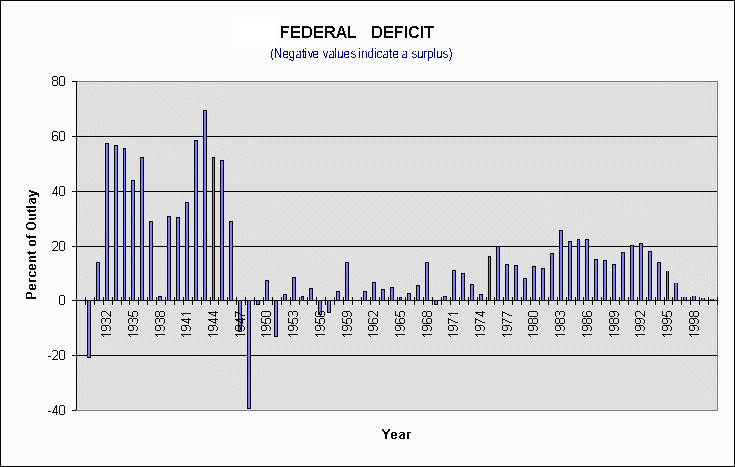 (Data based on Statistical Abstract for years 1946-1998, World Almanac for earlier years and CBO for recent years)
(For a view of the actual deficit data keyed to the party in power, consult Kelley Ross's Federal Budget chart. For other views, see Michael Hodges' Grandfather Federal Government Debt Report.)
We see that up until 1975 or so, the deficit fluctuated as you would expect when the expenses vary from year to year. In particular, we see the obvious impact of World War II on the deficit. But since 1975, regardless of the tax rate changes and large temporary expenses, we have a deficit that is a fairly constant percentage of the total expenditures -- about 15%. From 1998 on the projected deficit is very low but that remains to be seen. I predict that it will not be so low.
It appears that spending 20% per year more than in the receipts was just more than the public could handle. So, the public started to make a uncomfortable noises and the politicians concluded that maybe they should restrain themselves a bit. So they are cutting back to an excess of around 10%. They cut back to the level that the public will bear.
In summary, the amount that the government spends is determined by whatever it can take in -- plus certain percentage more determined by what the public will allow. What the government spends, on the other hand, is not determined by real need. They will generate programs to absorb their income plus a little more. Thats all.
How the Government Determines How Much to Tax
First, let us look at another chart, a plot of receipts and outlays as a percentage of GDP. Note that the GDP is primarily composed of our National Income.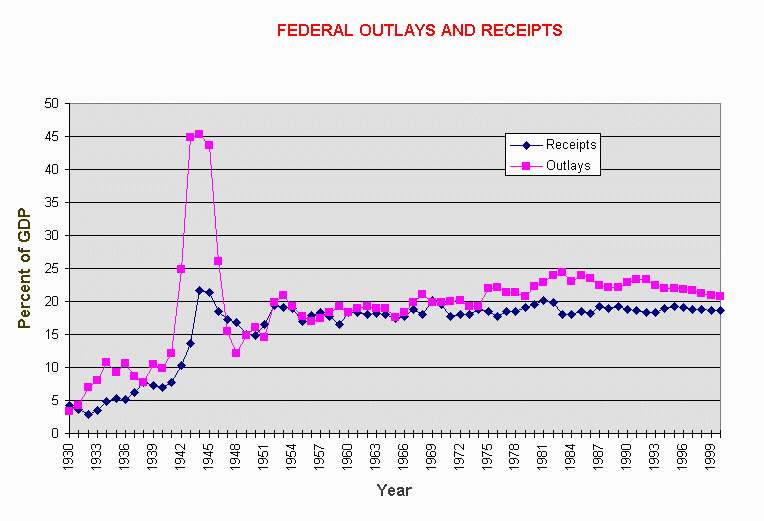

The components of the spending is plotted in the chart at the right (courtesy of Michael Hodges' "Grandfather Report".
The plot of the receipts (which is mostly taxes) is particularly striking. While the components may vary, the total amount of taxes that the government needs to operate, since World War II, is almost exactly 20%! In that period, at various times, we have had two major wars, a massive space program, a massive star wars program, a massive social program, and other assorted disasters, yet the amount of money needed just happens to be 20% of the amount of money we earn! What would you think if you were hiring a contractor to manage your sawmill and when you asked him how much will it cost, he said, "How much do you make?" Well, that is exactly how the government decides how much it needs to operate -- 20% of how much we make!
Another important observation is that before WWII, the government managed to get along with only about 5% of our GDP. What happened? Well, an amazing discovery was made! The government came up with the idea of PAYROLL DEDUCTIONS! Without payroll deductions, 5% is about all the people will let you take without a lot of screaming. With payroll deductions, people are quite happy to contribute 20% and possibly more! (There is another technique that the government uses to make the pill easier to swallow: separate the outlay from the receipt as much as possible. For example, you might balk at buying a lot of new equipment for your local police force if you had to pay it directly. But if you send all your money to the Federal Government and they then send a portion of it back to your local police force, it is all painless! Very expensive but painless.)

Sources for more Information
A wealth of factual information is available on line from the Institute for Policy Innovation. Detailed charts and graphs on all aspects of our governments monstrous growth is presented in a small book, Government: America's #1 Growth Industry, available for a paltry $7.95, postage paid or you can download some of the book here.As mentioned above, Michael has a comprehensive series of charts with explanations at "Grandfather Economic Reports".
Another great source of information -- presented mostly in graphical form -- has been provided by Mason Clarke on the his page, Political Economic Graphs. Very professional.
Most of the data that I have presented above and that in the above mentioned book was obtained from government sources. While there is some reason to believe that the government is not above, "cooking the books" occasionally, most of us would not be able to afford obtaining the data any other way.
Much of the government data is on the internet. A huge amount of historical and other information is available from the Census Bureau. The 1998 Statistical Abstract of the United States is online with easy access. Loads of charts and graphs from which if you study it you will know as much as your representative for that is their primary source of information. You might as well access the thing and get what you can out of it, for you paid for it!
If you have the stomach for it, you might want to peruse the Federal Budget, also on-line. And for those with a really strong stomach, you can learn much about where we came from and do your on estimates of where we are going by looking at the historical tables on the Federal Budget. What makes for an interesting challenge is to try to find some major expenditure in this massive budget. Let us say that you are aware that the government is about to buy a new computer installation for a thousand million dollars, or some such and you would like to find in the budget. Good luck! For as massive as the budget is, I have never been able to find most of the major expenditures that I happen to know about. Maybe you will have better luck.