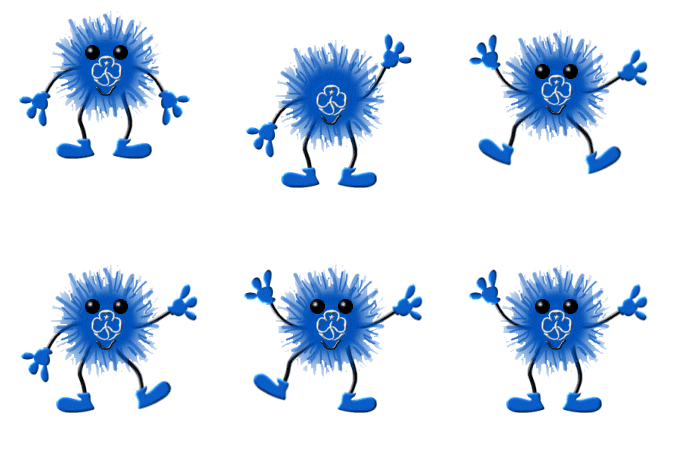
The Hairy Boguk occurs in two distinct subspecies,
the Greater Hairy Boguk (Boguk caerulea hirsuta) and the
Lesser Hairy Boguk (Boguk caerulea hirsuta minima,) the main
distinguishing feature being a matter of size.
Description
Both varieties of Boguk are small and, as might be surmised
from the common name, hairy. Their coat is a shade of blue commonly
referred to as "Guide blue" and is dense, waterproof and
windproof, helping these hardly little creatures survive all kinds
of inclement terrain and activities such as campsites, hikes etc..
The Boguk's distinctive trefoil-shaped nose is an indication of
its evolutionary path to the present form. Their most obvious characteristic
is the way they keep leaping up and down, shooting one hand in the
air, and displaying a total inability to say "No."
Diet
Boguks are omnivores and like the
species most often associated with them, the Common Guide and the
Voracious Brownie, will eat anything which doesn't move fast enough
to get away. They are particularly fond of Camp Fry-Ups, Hot Chocolate
with Marshmallows and S'mores although food of any type is always
appreciated.
Habitat
The Boguk thrives in company and is rarely
seen alone. Boguks prefer to be around humans, preferably female,
and can become very tame, especially if the said female humans dress
in blue or yellow.
Distribution
The Hairy Boguk, like the Collared Dove, is one of nature's
success stories. From a single pair first reported in the UK in
May 2001 they have spread across the Net and are now believed to
have successfully bred in the USA, Canada and Australia. This rapid
world-wide spread has been attributed in part to the custom of "sending
a Boguk" via e-groups and lists.

Back to Home Page