 !!!
!!!
!!!
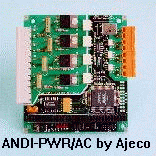
ANDI-PWR/AC Pulse Encoder Input & Triac Output Card
Click here to jump to ANDI-PWR/AC Specifications
The ANDI-PWR/AC is a compact PC/104 card
featuring four powerful Triac outputs and two pulse encoder
inputs. The board can be used for switching AC loads and reading
encoder data. The Triacs act like semiconductor relays and the
encoder inputs provide a system with motion or displacement
information. The card is also equipped with a positioning logic
making it especially useful for control of tilt/pan type of
motors commonly used in CTV applications. All inputs and outputs
on the card are isolated from the computer system.
The four Triac-switches on the card can be used
for controlling AC loads up to 230VAC. The card is suitable for
driving constant speed AC motors, lamps, solenoids, contactors,
relays and much more. The Triac outputs can be individually
controlled from software. All Triacs feature zero crossover
voltage detection and a reliable snubistor circuitry, ensuring
safe switching of inductive loads.
The ANDI-PWR/AC is equipped with inputs for
two, industry standard, pulse encoders. The card interprets the
encoders quadrature encoded, bi-phase position- or displacement
information, using 11 bit up/down counters. The pulse signals
from the encoders are processed thorough digital filters on the
board, efficiently removing noise and transients, preventing
false counts from occurring.
The ANDI-PWR/AC features two, user programmable, digital comparators that monitor the movement/displacement counts from the pulse encoders. The comparators can be programmed with values for a desired displacement or position. When the encoder count equals the user programmed value in a comparator, an interrupt will occur. This indicates that a desired position/displacement is found. This significantly simplifies a positioning task since the high speed real time processing is done in the hardware.
In addition to general purpose AC load switching and interfacing of encoders, the card is especially suitable for controlling tilt/pan type of AC motors commonly used in CTV applications. It is customary for these motors to have separate AC drive signals for moving two axes left, right, up and down. The Triacs on ANDI-PWR/AC can directly drive the AC motors. The axis movement or displacement feedback is taken from pulse encoders. The card can be programmed to function in an automatic mode. When the cards automatic mode is used with a tilt/pan motor, the onboard logic will decide without user intervention, which Triac and direction of movement to be activated when new tilt and pan coordinates are entered.
| Power requirement: | +5Vdc, �5%, 175 mA, 0.875 W |
| Dimensions: | 91 x 96 x 16 mm (3.6" x 3.8" x 0.6"), PC/104 |
| Operating environment: | 0...70�C, 5...95% relative humidity, non-condensing |
| Number of encoder inputs: | Two isolated input channels |
| Encoder type: | Quadrature encoded, bi-phase |
| Encoder signal level: | 5 to 24 V, current sink |
| Encoder connector wire thickness: | Up to 2.5mm�, AWG16 |
| Number of Triac outputs: | 4 isolated outputs |
| Triac specification: | 600 V, 20 Arms |
| Maximum allowed Triac voltage: | 230 Vac |
| Zero crossover voltage switching: | Yes |
| Transient suppression: | Triacs are RC protected |
| Triac connector wire thickness: | Up to 2.5mm�, AWG16 |
| Software: | Examples routines in 'C', includes source code |
For more information, e-mail [email protected]
[Return to Zytronix Home Page] [Top of Ajeco Page] [ANDI-DAS][ANDI-FG] [PCI+Grabber][ANDI-MB] [ANDI-MM] [ANDI-OPTO] [ANDI-PWR/AC] [ANDI-PWR/DC] [ANDI-RTD] [ANDI-SERVO] [FrameLocker] [PowerFramer]
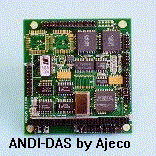
ANDI-DAS 32 Channel Data Acquisition System
Click here to jump to ANDI-DAS Specifications
The ANDI-DAS is an extremely compact, versatile
and PC/104 compatible data acquisition system board for use in a
multitude of applications.
ANDI-DAS features up to 32 single ended or 16
differential analog inputs or a mix of both - The input
configuration is software selectable. The analog input resolution
is 12 bits plus sign. Up to four analog voltage outputs with 12
bit resolution, eight TTL-level inputs and eight outputs, plus
three cascadeable 16 bit timer/counter channels provides
outstanding performance on a board measuring only 91 x 96 mm.
The ANDI-DAS card offers high speed, low power
operation, with extremely flexible software configurability. The
card has programmable acquisition sequencers, window comparators
that monitor input voltages, data acquisition buffer RAM, all
accessible through software. These features enable a totally
independent operation, freeing the host CPU from exhaustive data
acquisition routines.
ANDI-DAS can generate interrupts form a variety
of different software selectable sources. The window comparators
causes interrupts if analog input voltages enters or exits user
programmed limit ranges, an interrupt occurs if the acquisition
buffer is full or if the power supply voltage drops below 4 Vdc.
The sampling time and acquisition frequency can
be set from software. The A/D converters are programmable,
performing instruction sequences and loops.
Three independent 16 bit timer/counters can be
used as general purpose counters or as pacers for remote
equipment. One of these timers can use the onboard 4 MHz
oscillator as clock source.
The ANDI-DAS card can sustain a 90 kHz data
throughput to the host computer enabled by the onboard buffer RAM
and IRQ support.
| Power requirement: | +5 Vdc, �5%, 185 mA, 0.925 W |
| Dimensions: | 91 x 96 x 16 mm (3.6" x 3.8" x 0.6"), PC/104 |
| Operating environment: | 0...70�C, 5...95% relative humidity, non-condensing |
| Max. number of analog inputs: | 32 single ended, 16 differential (or a mix) |
| Analog input resolution: | 12 bits plus sign |
| Input voltage range: | 0 - 2.5 Volts, �2.5 Volts differential |
| Sampling speed: | 87 kHz, programmable |
| Max. number of analog outputs: | 4 channels |
| Analog output resolution: | 12 bits |
| Output voltage range (factory set): | �2.5, �5, �10, 0-2.5, 0-5, 0-10 Volts |
| Timer/Counter: | 3 timer/counter channels (82C54) |
| Timer/Counter resolution: | 16 bits |
| TTL-outputs: | 8 channels, 20 mA (100 Ohms in series) |
| TTL-inputs: | 8 channels, 10 kOhms pulldown |
| Software: | Examples routines in 'C', includes source code |
For more information, e-mail [email protected]
[Return to Zytronix Home Page] [Top of Page] [ANDI-DAS][ANDI-FG] [PCI+Grabber][ANDI-MB] [ANDI-MM] [ANDI-OPTO] [ANDI-PWR/AC] [ANDI-PWR/DC] [ANDI-RTD] [ANDI-SERVO] [FrameLocker] [PowerFramer]
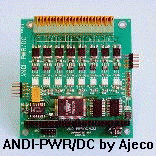
ANDI-PWR/DC Optoisolated MOSFET Digital I/O Card
Click here to jump to ANDI-PWR/DC Specifications
The ANDI-PWR/DC is an eight channel power
MOSFET card, designed for switching DC loads including lamps,
relays, solenoids, DC- and stepper motors, magnetic valves and
much more. Connection of these type of loads to a computer system
requires optoisolation and overvoltage protection found in the
industry proven ANDI-PWR/DC design.
The eight power MOSFET transistors at the cards
output stages, are isolated from each other and the computer
system, providing a high level of security. Each output features
protection for transients and spikes generated by inductive loads
such as DC-motors or relays. The isolation of all output channels
will efficiently prevent harmful parasitic currents from
occurring when switching loads connected to different power
supplies or potentials.
Each MOSFET on the card, is a power device
capable of sinking up to 1.5 amperes at 24 volts. The peak
current is 6 amperes and absolute maximum voltage is 60 volts
which ensures a good safe operating area. The low on-resistance
of approximately 150 milliohms, result in a very low heat
generation in the MOSFET. Eight ultrabright LED-lamps indicates
clearly an active output channel.
The ANDI-PWR/DC card features eight
non-isolated, TTL-level inputs. Each of the input lines have a
100 ohms resistance in series, in addition to a 10 kOhms
resistance pulling the line down. This is a simple, yet very
efficient way of increasing the cards inputs durability for
electrostatical discharge.
The card also features an unique pre-load
register, specifically designed for installations where exact
deterministic performance is required. The pre-load register
contains programmable "on" or "off"
information, that is immediately transferred to the MOSFET output
stage when triggered by a remote signal. The triggering signal
can be a raising edge of TTL-level introduced at the cards
control connector.
| Power requirement: | +5 Vdc, �5%, 80 mA, 0.4 W |
| Dimensions: | 91 x 96 x 16 mm (3.6" x 3.8" x 0.6"), PC/104 |
| Operating environment: | 0...70�C, 5...95% relative humidity, non-condensing |
| Number of isolated outputs: | 8 current sinking MOSFETS |
| Maximum load voltage: | 50 Vdc |
| Maximum load current: | 1.5 A @ 24 Vdc |
| Connector type for outputs: | Field wiring, spring loaded |
| Wire thickness: | 0.08...0.5mm�, AWG30...AWG22 |
| Number of inputs: | 8 TTL-level, 10 kOhms pulldown |
| Trigger signal: | Rising edge, TTL-level |
| Software: | Examples routines in 'C', includes source code |
For more information, e-mail [email protected]
[Return to Zytronix Home Page] [Top of Page] [ANDI-DAS][ANDI-FG] [PCI+Grabber] [ANDI-MB] [ANDI-MM] [ANDI-OPTO] [ANDI-PWR/AC] [ANDI-PWR/DC] [ANDI-RTD] [ANDI-SERVO] [FrameLocker] [PowerFramer]
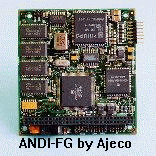
ANDI-FG Color Video Frame Grabber
Click here to jump to ANDI-FG Specifications
The ANDI-FG is a PC/104 compatible video
acquisition and image processing card with a digital signal
processor. This multistandard card can be used with NTSC, PAL and
SECAM color video signals.
The ANDI-FG is suitable for various image
processing task in industrial environments. Applications include
character recognition, remote surveillance, machine vision etc.
Images are digitized in real time and stored in
the boards frame memory, where they are processed by the digital
signal processor. The digitation resolution is 768 pixels x 625
lines in PAL/SECAM and 640 pixels x 525 lines in NTSC. The host
PC can upload the images in 24 bit RGB, 8 bit greyscale, 4:2:2
YUV or JPEG formats. The image can be uploaded with a desired
resolution and the area of uploading can also be specified
through software calls.
The card does not occupy any extended or
expanded memory in the host PC making it easily usable in various
operating systems including Windows (tm), OS/2 (tm), DOS, Linux
and Unix, to mention a few. Except for a few I/O ports, the card
does not occupy conventional memory.
The ANDI-FG card is shipped with a library of
'C' routines allowing access to the card's many features. User
may modify and use this library without added cost or
obligations. A technical manual with example and demo programs on
a floppy disk is also included.
An optional JPEG compression utility is
available as well as third party image processing and enhancement
software.
The ANDI-FG is also suitable for portable,
battery powered, applications. The card features a programmable
power down mode, reducing significantly the power requirement.
| Power requirement: | +5 Vdc, �5%, 510 mA oper. (240 mA stdby.), 2.5 W (1.12W) |
| Dimensions: | 91 x 96 x 16 mm (3.6" x 3.8" x 0.6"), PC/104 |
| Operating environment: | 0...70�C, 5...95% relative humidity, non-condensing |
| Number of video inputs: | 3 channels, 75 Ohms, software selectable |
| Video signal type: | S-VHS, Composite and Monochrome |
| Video signal level: | 1 Vpp nominal |
| A/D converters resolution: | 8 bits |
| Sampling speeds: | 29.5 MHz and 24.5 MHz |
| Digitation resolution: | 768 x 625 in PAL/SECAM, 640 x 525 in NTSC |
| Internal image representation: | 4:2:2 YUV |
| Image uploading modes: | 24 bit RGB, 8 bit grayscale, 4:2:2 YUV and JPEG |
| Image memory: | Two 512 kByte banks |
| Image memory access time: | 20 ns |
| Digital Signal Processor: | Motorola DSP56001A, 27 MHz |
| DSP performance: | 13.5 MIPS |
| DSP programmability: | User programmable, Motorola DSP Assembler |
| DSP Program memory: | 8 kWords |
| Software: | Library routines in 'C' and demo
programs, includes source code. Optional JPEG compression. Third party image processing software. |
For more information, e-mail [email protected]
[Return to Zytronix Home Page] [Top of Page] [ANDI-DAS][ANDI-FG] [PCI+Grabber] [ANDI-MB] [ANDI-MM] [ANDI-OPTO] [ANDI-PWR/AC] [ANDI-PWR/DC] [ANDI-RTD] [ANDI-SERVO] [FrameLocker] [PowerFramer]
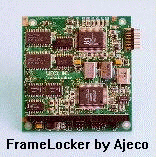
FrameLocker Monochrome Video Frame Grabber
Click here to jump to FrameLocker Specifications
The FrameLocker is a versatile, cost-efficient
and easy-to-use PC/104 card intended for monochrome video frame
capturing. This compact card is suitable for use in many embedded
and distributed applications including remote surveillance,
machine vision, image processing and many more.
The card features automatic detection of NTSC
and PAL video signals. The video signal is digitized in real time
from two software selectable video inputs, and the image is
stored in onboard RAM, accessed from the host computer.
Frame rates of up to 25 images per second may
be selected as a function of the desired image resolution. The
board supports polled and interrupt driven uploading of images.
Contrast and brightness can be adjusted from
software. The automatic gain control (AGC) can also be
deactivated from software.
The image resolution is programmable supporting
arbitrary horizontal and vertical scaling. The card has also a
user-programmable cropping of the video window and an arbitrary
programmable temporal decimation supporting reduced frame-rate
video sequences.
The FrameLocker features very low power
consumption, and a power down sleep option can place the board in
an energy saving mode. Software routines and examples in 'C'
allow the card to be easily implemented in user applications.
| Power requirement: | +5 Vdc, �5%, 310 mA oper. (205 mA stdby.), 1.65 W (1.02W) |
| Dimensions: | 91 x 96 x 16 mm (3.6" x 3.8" x 0.6"), PC/104 |
| Operating environment: | 0...70�C, 5...95% relative humidity, non-condensing |
| Number of video inputs: | 2 channels, 75 Ohms, software selectable |
| Video signal type: | Composite and Monochrome |
| Video signal level: | 1 Vpp nominal |
| A/D converters resolution: | 8 bits |
| Sampling speeds: | 2x oversampling 35.46 MHz and 28.63 MHz |
| Image resolution: | Programmable, max. 768 x 576 in PAL, 720 x 480 in NTSC |
| Internal image representation: | 8 bit grayscale |
| Image memory: | 512 kByte FIFO |
| Brightness adjustment range: | 255 steps, representing �50% of full luma range |
| Contrast adjustment range: | 512 steps, representing 0..+236% of full signal |
| Software: | Library routines in 'C' and demo
programs, includes source code. Optional JPEG compression. Third party image processing software. |
For more information, e-mail [email protected]
[Return to Zytronix Home Page] [Top of Page] [ANDI-DAS][ANDI-FG] [PCI+Grabber] [ANDI-MB] [ANDI-MM] [ANDI-OPTO] [ANDI-PWR/AC] [ANDI-PWR/DC] [ANDI-RTD] [ANDI-SERVO] [FrameLocker] [PowerFramer]
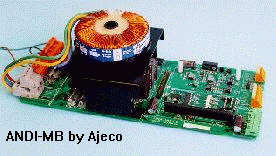
ANDI-MB Motherboard With Power Supplies & Auxiliary Interfaces
Click here to jump to ANDI-MB Specifications
The ANDI-MB is a motherboard that integrates
power supplies, cabling connectors and a PC/104 card stack into a
compact solution for embedded applications. The motherboard is
designed for various CTV applications and is easily installed in
enclosures for outdoor surveillance cameras, but this does not
limit its use in other embedded applications.
The ANDI-MB features three switching power
supplies. Two of these supplies, generates +5 Vdc and +12 Vdc for
the PC/104 system stack. The third supply is isolated from the
others, providing power for auxiliary devices on the board. The
power supplies feature current and heat sense, protecting from
damage at malfunctions.
The motherboard contains a quadruple half-H
driver circuitry that can be used for motor-lenses, low power
motors, relays and other DC-loads. The driver circuitry is
optoisolated and controlled by a TTL-level signal provided by,
for example, the ANDI-MM board. The driver is specified to
deliver 150 mA into to the load.
The motherboard is also equipped with signal
conditioning electronics for temperature sensors. Two industry
standard Pt100 sensors can be connected to the board, and by
using the ANDI-MM data acquisition card, temperatures can be
measured and monitored - a useful feature for many embedded
systems.
The flexible design of ANDI-MB allows it to be
used with a variety of raw power sources. The motherboard can
accept 24 Volts AC and DC, and can also, depending on the
application, be used with 12 Volts.
A black anodized metal heatsink for the onboard
switchmode power supplies serves also as a mounting platform for
an optional toroidal mains transformer, allowing the ANDI-MB to
be used in 110/230VAC systems. The Motherboard is equipped with
robust field wiring connectors for cabling.
| Input Power: | 12...24 VDC/VAC |
| Dimensions: | 315mm(l) x 125mm(w) x 55mm(h), includes connectors & heatsink 12.4" x 4.92" x 2.16" |
| Operating environment: | 0...70�C, 5...95% relative humidity, non-condensing |
| Nominal output power, supply 1: | +5 Vdc, 3A, 10 mVrms ripple, to PC/104 bus |
| Nominal output power, supply 2: | +12 Vdc, 1A, 15 mVrms ripple, to PC/104 bus |
| Nominal output power, supply 3: | Isolated +5 Vdc, 300 mA, to field wiring connectors |
| Motor driver circuit: | Isolated half-H bridge |
| Motor driver current: | �150 mA, 12 Vdc |
| Motor driver power dissipation: | 5 W Absolute Maximum (80�C) |
| Cable connectors: | Field wiring, screw terminal |
| Cable thickness: | 2.5mm�, AWG16 max. |
| Number of sensor inputs: | 2 channels |
| Current excitation for temp. sensors: | 100 uA |
| Temperature sensors: | Pt100, four wire connection |
| Software: | Calibration and temperature measurement software in 'C' for optional ANDI-MM, includes source code |
For more information, e-mail [email protected]
[Return to Zytronix Home Page] [Top of Page] [ANDI-DAS][ANDI-FG] [PCI+Grabber] [ANDI-MB] [ANDI-MM] [ANDI-OPTO] [ANDI-PWR/AC] [ANDI-PWR/DC] [ANDI-RTD] [ANDI-SERVO] [FrameLocker] [PowerFramer]
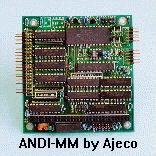
ANDI-MM Data Acquisition Card
Click here to jump to ANDI-MM Specifications
The ANDI-MM is a highly versatile multipurpose
data acquisition card which conforms to the PC/104 standard. The
card features 4 protected analog inputs, 2 analog outputs, 16
TTL-level inputs and 16 outputs with a drive capability of 20 mA.
Its compact size and low power CMOS design allow it to be used in
a variety of applications from stand-alone embedded systems to
distributed process control and automation systems. It can even
be used in battery powered, portable applications.
The ANDI-MM card's simultaneous sampling
feature means it can be used in more applications. The
simultaneous, matched sampling of its 4 analog inputs, result in
an extremely low time difference between the channels. This is
equivalent to having 4 analog-to-digital converters working in
parallel. This makes it ideal for applications requiring relative
phase information. Up to 4 ANDI-MM cards may be installed in per
computer, allowing simultaneous sampling of up to 16 analog
inputs.
The ANDI-MM is provided with a connector for
various control signals. These signals may be used for remotely
starting conversion, interrupt controlling, sharing reference
voltages between multiple ANDI-MM's, interrupt daisy chaining in
multiple card installations and more.
The analog interface can accept a voltage level
of �10 V and the outputs are capable of producing �10 V in a
one to one relationship with each other. This eliminates need for
scaling calculations and translates directly into faster software
performance. Other output voltages are available on request. The
ANDI-MM is user-friendly, yet designed for heavy duty
environments. Its 4-layer PCB has separate connectors for digital
and analog interfaces.
Intelligent design of the digital interface
allows each I/O signal to be tested in loopback by simply
applying a jumperblock between input and output. Centrally
located power supply pins on the digital interface connector
protect the card in the event of an upside-down mounting of the
ribbon cable.
Analog inputs are protected by high speed,
transient suppressing diodes, and analog outputs are buffered
through a reliable operational amplifier. The ANDI-MM card can be
used together with the ANDI-RTD instrumentation card. The ANDI-MM
comes with software examples in 'C' and a diagnostic program
which tests all the features of the card. In addition, a
technical reference manual with detailed pictures, diagrams and
tables is provided.
| Power requirement: | +5Vdc, �5%, 235 mA, 1.18 W |
| Dimensions: | 91 x 96 x 16 mm (3.6" x 3.8" x 0.6"), PC/104 |
| Operating environment: | 0...70�C, 5...95% relative humidity, non-condensing |
| Analog inputs: | 4 surge protected inputs |
| Input voltage range: | �10 V |
| Resolution: | 12 bits |
| Speed: | 29 kSamples/sec., four channels |
| Sampling method: | Simultaneous sampling on all four analog inputs |
| Aperture delay between channels: | 4 ns Max. time difference between channels |
| Differential nonlinearity: | �1 LSB Max. |
| Relative accuracy: | �1 LSB |
| Signal to noise ratio: | 72 dB |
| Analog outputs: | 2 channels |
| Output voltage range: | �10V, �5V, �2.5V, 0-10V, 0-5V or 0-2.5V, factory set |
| Resolution: | 12 bits |
| Relative accuracy: | �1 LSB |
| Digital inputs: | 16 inputs, TTL-level, pulled down with 10 kOhms |
| Digital outputs: | 16 outputs, TTL-level, 0-20 mA sink/drive |
| Software: | Examples routines in 'C', includes source code |
For more information, e-mail [email protected]
[Return to Zytronix Home Page] [Top of Page] [ANDI-DAS][ANDI-FG] [PCI+Grabber] [ANDI-MB] [ANDI-MM] [ANDI-OPTO] [ANDI-PWR/AC] [ANDI-PWR/DC] [ANDI-RTD] [ANDI-SERVO] [FrameLocker] [PowerFramer]
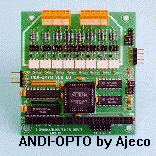
ANDI-OPTO Optoisolated Digital I/O Card
Click here to jump to ANDI-OPTO Specifications
The ANDI-OPTO is an industry proven, PC/104
multipurpose isolated digital input card. The card acts as an
interface for various digital signals in industrial environments.
The inputs accept a range from 5 to 48 volts.
The ANDI-OPTO features eight opto-isolated digital inputs and eight non-isolated digital outputs of TTL-level. State of the art electronics enables customer specific solutions to be implemented easily without added cost to the board. The card's architecture utilizes EPLD technology. This allows the card to be shipped upon request with extended features such asvarious counter functions, digital filtering and much more.
The ANDI-OPTO comes with standard digital
inputs in its basic configuration. The inputs are isolated with
industry proven optoisolators.
The card can be programmed to generate an interrupt when an input signal goes "high" or "low". Channels can also be masked to prevent interrupt generation. The interrupt signal can also be directed to the cards control connector. This signal can then be used as a trigger for various equipment or cards. The trigger signal can be used for starting an A/D conversion on
the ANDI-MM card and it can be used for
triggering the pre-load register on ANDI-PWR/DC and much more.
The ANDI-OPTO has field wiring connectors at
the inputs. These rugged connectors are spring-loaded, and endure
the rigors of industrial environments. The spring mechanism in
the connectors ensures that cables connected to the card will not
"slip" in vibrating installations. The digital outputs
are available from a 10 pin header connector.
| Power requirement: | +5 Vdc, �5%, 105 mA, 0.525 W |
| Dimensions: | 91 x 96 x 16 mm (3.6" x 3.8" x 0.6"), PC/104 |
| Operating environment: | 0...70�C, 5...95% relative humidity, non-condensing |
| Number of isolated inputs: | 8 channels |
| Input voltage range: | 5 through 48 Volts AC or DC |
| Input connectors: | Field wiring, spring loaded |
| Input wire thickness: | 0.08 - 0.5mm�, AWG30 - AWG22 |
| Isolation level in optocoupler: | 2500 Vrms |
| Number of digital outputs: | 8 channels, TTL-level, 100 Ohms in series |
| Control connector: | TTL-level trigger output |
| Software: | Examples routines in 'C', includes source code |
For more information, e-mail [email protected]
[Return to Zytronix Home Page] [Top of Page] [ANDI-DAS][ANDI-FG] [PCI+Grabber] [ANDI-MB] [ANDI-MM] [ANDI-OPTO] [ANDI-PWR/AC] [ANDI-PWR/DC] [ANDI-RTD] [ANDI-SERVO] [FrameLocker] [PowerFramer]
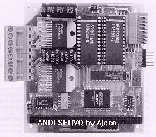
ANDI-SERVO Dual Servo Motor Controller
Click here to jump to ANDI-SERVO Specifications
The ANDI-SERVO is intended for driving and
controlling two DC, and brushless DC, servo motors, as well as,
other servomechanisms that provide quadrature incremental
feedback signals. Both position and velocity motion control
systems can be implemented using the ANDI-SERVO board.
The board features a dedicated motion control
processor, a quadrature encoder input and a H-bridge PWM output
driver stage for each channel. This makes a complete, two axis,
closed loop motor control system on a single PC/104 compatible
board. The board also features outputs for an external high power
motor driver stage, to be used in high current motor
applications.
To start a motion, the host computer downloads
trajectory information ie. acceleration, velocity and target
position values to the ANDI-SERVO board. The boards motion
control processors calculates new demand or "set point"
positions and combines these with the actual position feedback,
to form an error signal. The error signal is fed to the boards
PID (proportional, integral, derivative) control loop
compensator. The PID loop compensator monitors constantly the
error signal and adjusts the motors accordingly. The PID loop
compensator can be parametrized to allow a system to be tuned for
optimum performance in terms of accuracy, response time and
overshoot.
For a load that varies during the movement, new
coefficients can be downloaded to the PID loop compensator to
update it at the moment when the load changes. All trajectory
parameters except acceleration can also be updated while a
movement is in progress.
The ANDI-SERVO features shorted load
protection, a thermal warning flag and thermal shutdown to
prevent damages to occur at fault conditions. The board features
rugged field wiring connectors for all interface cabling.
| Power requirement: | +5Vdc, �5%, 320 mA, 1.6 W |
| Dimensions: | 91 x 96 x 16 mm (3.6" x 3.8" x 0.6"), PC/104 |
| Operating environment: | 0...70 �C, 5...95% relative humidity, non-condensing |
| Number of channels: | 2 independent motion controllers |
| Trajectory registers: | 32 bit position, velocity and acceleration registers, internal trapezoidal velocity profile generators. Velocity, target position and PID filter parameters may be changed during motion. |
| PID filter: | Programmable digital PID filter with 16-bit coefficients |
| PWM outputs: | 8 bit sign-magnitude outputs, TTL-level |
| Encoder inputs: | 2 Quadrature incremental encoder inputs (w/optional index) |
| Encoder input level: | TTL level |
| Encoder connectors: | Field wiring, spring loaded. 0.08-0.5mm� |
| Motor output: | Two H-bridge outputs for DC, and brushless DC motors |
| Motor current: | 0.5 A Max. 6 A peak, thermal shutdown |
| Motor supply voltage: | 50 VDC Max |
| Undervoltage lockout: | 9 V Min. 11 V Max (Outputs Turn OFF) |
| Motor connector: | Field wiring, screw terminal. Max 2.5mm� (AWG16) |
| Software: | Examples routines in 'C', including source |
For more information, e-mail [email protected]
[Return to Zytronix Home Page] [Top of Page] [ANDI-DAS][ANDI-FG] [PCI+Grabber] [ANDI-MB] [ANDI-MM] [ANDI-OPTO] [ANDI-PWR/AC] [ANDI-PWR/DC] [ANDI-RTD] [ANDI-SERVO] [FrameLocker] [PowerFramer]
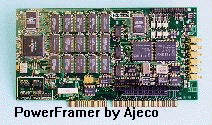
PowerFramer High Performance Color Video Frame Grabber with ISA and PC/104 bus
Click here to jump to PowerFramer Specifications
The PowerFramer is an efficient halfsize
PC-slotboard intended for color video frame capturing and image
processing. The card has high computing power and is suitable for
various image processing and enhancement tasks, including
character recognition, machine vision, compression and much more.
The PowerFramer card has an ISA and a PC/104
bus interface, both 16 bit wide and interconnected. This allows
the card to be used as a gateway between the two architectures:
It can be installed in any desktop PC, and/or used together with
any 16 bit PC/104-compatible CPU or module.
The PowerFramer digitizes images from six
software selectable inputs, accepting PAL, NTSC and SECAM color
video signals of S-VHS and Composite type. The images are
digitized in real time and stored in the cards image RAM.
The card also features a Video Look Up Table
(LUT), which enables real-time filtering and masking of incoming
image data.
The PowerFramer is equipped with a 40 MHz
digital signal processor. Programs can be written in 'C' and/or
DSP Assembler and they can be downloaded from the host PC to the
card. The card features 128 kWords of program memory and 1.5
MBytes of image memory - all zero wait state, with 20 ns access
time. The PowerFramer is also equipped with general purpose
digital I/O lines. The card has 8 digital output lines and 8
digital input lines, of which 3 in- and 3 out-lines are isolated
by optoisolators. The I/O lines can also trigger an image
capturing sequence. The digital I/O lines facilitates
installations, and removes the need for added I/O boards in the
system. The card also features a nonvolatile 256 byte EEPROM for
storing user data and parameters.
Optional JPEG compression software is also available, as well as powerful third party image processing, analysis and enhancement software packages.
| Power requirement: | +5 Vdc, �5%, 640 mA oper., 3.2 W |
| Dimensions: | 220 x 120 mm (8.6" x 4.7") |
| Bus Architecture: | ISA 16 bits, and PC/104 16 bits |
| Operating environment: | 0...70�C, 5...95% relative humidity, non-condensing |
| Number of video inputs: | 6 channels, 75 Ohms, software selectable |
| Video signal type: | S-VHS, Composite and Monochrome |
| Video signal level: | 1 Vpp nominal |
| Video look up table: | 256 locations |
| Digitation resolution: | 768 x 625 in PAL/SECAM, 640 x 525 in NTSC |
| Internal image representation: | 24 bit RGB, 4:2:2 YUV |
| Image uploading modes: | 24 bit RGB, 8 bit grayscale, 4:2:2 YUV and JPEG |
| Image memory: | Three 512 kByte banks (Red, Green and Blue) |
| Image memory access time: | 20 ns |
| Digital Signal Processor: | Motorola DSP56002, 40 MHz |
| DSP performance: | 20 MIPS |
| DSP programmability: | User programmable, Motorola DSP Assembler, C-compiler |
| DSP Program memory: | 128 k x 24 bit |
| Digital TTL-level outputs: | 5 channels |
| Digital TTL-level inputs: | 5 channels |
| Digital isolated outputs: | 3 channels, open collector output |
| Digital isolated inputs: | 3 channels, up to 24 Volts |
| EEPROM storage: | 256 bytes (optional 1K) |
| Software: | Library routines in 'C' and demo
programs, includes source code. Optional JPEG compression. Third party image processing software. |
For more information, e-mail [email protected]
[Return to Zytronix Home Page] [Top of Page] [ANDI-DAS][ANDI-FG] [PCI+Grabber] [ANDI-MB] [ANDI-MM] [ANDI-OPTO] [ANDI-PWR/AC] [ANDI-PWR/DC] [ANDI-RTD] [ANDI-SERVO] [FrameLocker] [PowerFramer]
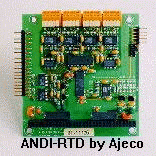
ANDI-RTD Isolated Instrumentation Preamplifier
Click here to jump to ANDI-RTD Specifications
The ANDI-RTD is an isolated instrumentation
pre-amplifier card, to be used together with the ANDI-MM data
acquisition card, or as a general purpose amplifier board. The
board can be used as a signal conditioning unit for sensors of
resistive type or as a sensitive general purpose pre-amplifier
and current loop receiver.
ANDI-RTD features four inputs and one output.
Each input is equipped with a high quality instrumentation
amplifier and a constant current source, providing excitation for
resistive type of sensors. Each input can also be equipped with a
resistor, enabling the board to be used as a current loop
receiver.
An onboard multiplexer selects one of the four
input amplifiers to be connected thorough an isolation amplifier
to the output stage. Up to four ANDI-RTD boards can be connected
to a single ANDI-MM board. This creates a system with 16 isolated
analog inputs.
The board is perfect for measuring temperatures
with Pt100/Pt500 type of resistive sensors. Linearization and
calibration software in 'C' is supplied with the board. Reading
of a temperature is done by a single software call to a function
returning the linearized value in degrees Celsius.
The board's inputs are differential. Connection of sensors is realized by a four wire method. This ensures that common mode hum and noise is efficiently removed from the measurements.
The sensors and signals connected to the board
are isolated from the computer system at the output by the means
of an isolation amplifier. The board is suitable for use in harsh
industrial environments where isolation of signals and sensors is
a prerequisite.
ANDI-RTD does not necessarily need to be mounted onto the PC/104 bus. It can be operated as a separate entity, serving as a field wiring unit, performing conditioning and isolation of the incoming signals.
| Power requirement: | +5Vdc �5%, 380 mA, 1.9W |
| Dimensions: | 91 x 96 x 16 mm (3.6" x 3.8" x 0.6"), PC/104 |
| Operating environment: | 0...70�C, 5...95% relative humidity, non-condensing |
| Inputs: | 4 input channels |
| Input connectors: | Spring loaded, field wiring |
| Wire thickness: | 0.08..0.5mm�, AWG30...AWG22 |
| Excitation current: | 100 uA, Max. drift 25ppm/�C |
| Output voltage range: | �10V |
| Measurement method: | Four wire connection for resistive devices |
| Common mode rejection: | 115 dB Min. |
| Non-linearity: | Max 0.015%, Typ. 0.008% of full scale readout |
| Signal-to-noise: | > 70 dB |
| Software: | Examples and calibration routines in 'C', with source |
For more information, e-mail [email protected]
[Return to Zytronix Home Page] [Top of Page] [ANDI-DAS][ANDI-FG] [PCI+Grabber] [ANDI-MB] [ANDI-MM] [ANDI-OPTO] [ANDI-PWR/AC] [ANDI-PWR/DC] [ANDI-RTD] [ANDI-SERVO] [FrameLocker] [PowerFramer]