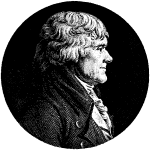
Thomas Jefferson was born at Shadwell, his father's home in Albemarle county, Va., on April 13 (April 2, Old Style), 1743. His father, Peter Jefferson, a man of legendary strength, was a successful planter and surveyor who gained minor title to fame as an explorer and mapmaker.
Thomas Jefferson was well educated. In small private schools, he was thoroughly grounded in the classics. He attended the College of William and Mary. He was admitted to the bar in 1767 and practiced until 1774, when the courts were closed by the American Revolution. He was a successful lawyer, though his professional income was only a supplement. He had inherited a considerable landed estate from his father, and doubled it by a happy marriage on Jan. 1, 1772, to Martha Wayles Skelton.
He served as magistrate and as county lieutenant of Albemarle county. Elected to the House of Burgesses when he was 25, he served there from 1769 to 1774, showing himself to be an effective committeeman and skillful draftsman, though not an able speaker.
As a member of the Continental Congress (1775-1776), Jefferson was chosen in 1776 to draft the Declaration of Independence. Jefferson left Congress in the autumn of 1776 and served in the Virginia legislature until his election as governor in 1779. As governor from 1779 to 1781, Jefferson had little power, and he suffered inevitable discredit when the British invaders overran Virginia.
Jefferson's stay in France (1784-1789), where he was first a commissioner to negotiate commercial treaties and then Benjamin Franklin's successor as minister, was in many ways the richest period of his life. Thomas Jefferson was supported by the Republicans for president in 1796, and, running second to John Adams by three Electoral Votes, he became Vice President.
Jefferson became president in the election of 1800. Jefferson's most notable act while president was the purchase of Louisiana in 1803.
Jefferson encountered greater difficulties in his second term than in his first.was succeeded as president in 1809 by his loyal lieutenant, James Madison. During the last 17 years of his life, Jefferson remained in Virginia. His failures tended to be forgotten, and as the "Sage of Monticello" he engaged in a vast and rich correspondence with John Adams and others.