|
Effect |
Reasoning |
| Temperature Change |
1 - 4.5 ° F increase
Proponents |
This is the best estimate made by the IPCC, a group of over 2,000
leading scientists from multiple nations. |
| ?? |
The climate changes naturally over time. The warming we are
now experiencing is due to the fact that we are emerging from an ice age. |
| Health |
Heat/cold related deaths, lung disease may
increase.
Tropical diseases will spread north.
Increased algae blooms will cause cholera |
Increased temperatures will cause more extremely hot days, which
will in turn lead to more heat related deaths.
Increased precipitation caused by warming will lead to more snowfalls in areas that
usually don't get much snow. This will cause more snow-related death.
As northern areas warm, tropical diseases such as malaria, dengue/yellow fever, and
encephalitis will move northward.
Warming oceans will increase algae blooms, and in turn cholera.
|
Natural Climate Cycle
-Critics |
The climate changes naturally over time. The warming
we are now experiencing is due to the fact that we are emerging from an ice age. |
| Ice caps/glaciers |
Ice caps, glaciers will melt, altering
habitats and worsening the enhanced greenhouse effect. |
The warming will occur more intensely toward the poles, where most
of the glaciers/ice caps are situated. These will melt, destroying the habitat of some
polar animals such as the polar bear and penguin.
Melting ice will also cause the thermohaline ocean circulation (which helps mediate
the temperature of the planet) to slow. |
Natural Climate Cycle
-Critics |
The climate changes naturally over time. The warming
we are now experiencing is due to the fact that we are emerging from an ice age. |
| Water |
Glaciers will melt, enhancing global warming.
Costal regions will get wetter, and inland areas drier.
Floods/droughts will be more frequent.
Oceans will rise between 3.5'' and 4' by 2100.
Water quality/supply will be reduced.
|
Melting ice will cause the thermohaline ocean circulation (which
helps mediate the temperature of the planet) to slow.
Precipitation and evaporation will increase, but inland evaporation will increase
more than precipitation, drying it out.
As the oceans warm, they will expand, causing the sea level to rise.
Ice/snowpack in mountains will thaw earlier, leaving less water available for
summer months. |
Natural Climate Cycle
-Critics |
The climate changes naturally over time. The warming
we are now experiencing is due to the fact that we are emerging from an ice age. |
| Plants |
Plant population/diversity may decrease.
|
Increasing temperatures will also increase evaporation, leading to
drier soil.
Fires will increase.
An increase in pests will kill off plants.
Many plants will be required to migrate faster than they are able, and this will
lead to a decrease in some populations.
Rises in sea level will cover many wetlands, killing some of the plants there. |
Natural Climate Cycle
-Critics |
The climate changes naturally over time. The warming
we are now experiencing is due to the fact that we are emerging from an ice age. |
| Animals |
Animal population/diversity may decrease. |
Changes in polar habitats make things more difficult for animals
like polar bears and penguins.
A sea level rise would destroy wetlands (habitats which are essential for many
animals), as well as increase salinity of estuaries and decrease the amount of sandy
beaches. . . leaving many animals without a home.
As rivers and lakes heat up, the water may become too warm for some species of
fish. While some may be able to migrate northward, some will not be able to.
Many bird species will be forced to move their popluations northward. While most
will be physically able to accomplish this, the plants may not be able to keep up, killing
off some populations.
|
Natural Climate Cycle
-Critics |
The climate changes naturally over time. The warming
we are now experiencing is due to the fact that we are emerging from an ice age. |
| Polar Regions |
Ice caps and glaciers may melt, enhancing
global warming.
The globe will warm most at the poles, disrupting habitat there. |
Melting ice will cause the thermohaline ocean circulation (which
helps mediate the temperature of the planet) to slow.
Changes in polar habitats make it harder for animals there, for example. . . polar
bears will have less time to hunt. |
Natural Climate Cycle
-Critics |
The climate changes naturally over time. The warming
we are now experiencing is due to the fact that we are emerging from an ice age. |
| Mountains |
Northern treelines would rise, reducing alpine
habitats. |
As the earth warms, trees will migrate northward and upward on
mountainsides. This will leave less room for the already rare alpine habitats. |
Natural Climate Cycle
-Critics |
The climate changes naturally over time. The warming
we are now experiencing is due to the fact that we are emerging from an ice age. |
| Forests |
Population/diversity of forests could decline
due to increasing fire, insect and migration problems. |
As the earth warms, and some areas dry out, forest fires will
increase.
Many insect populations will flourish, killing forest flora.
Temperature changes will require trees to migrate northward at a rate of 1.5 to 5.5
km per year. Fossil record indicate that the fastest a species has been able to
successfully migrate is between .4 and 2 km per year. |
Natural Climate Cycle
-Critics |
The climate changes naturally over time. The warming
we are now experiencing is due to the fact that we are emerging from an ice age. |
| Grasslands |
Dry areas may become drier, decreasing
grassland and increasing desert. |
The global mean surface tempera |
Natural Climate Cycle
-Critics |
The climate changes naturally o |
| Deserts |
Desert habitats in some areas may increase in
size, wheras those in other areas may decrease. |
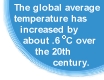
The global mean surface temperature has risen between .5 - |
Natural Climate Cycle
-Critics |
The climate changes naturally over time. The warming
we are now experiencing is due to the fact that we are emerging from an ice age. |
| Rainforests |
1 - 4.5 degree F increase |
The global mean surface temperature has risen between .5 - 1 degree
Farenheit over the 20th centu |
Natural Climate Cycle
-Critics |
The climate changes naturally over time. The warming
we are now experiencing is due to the fact that we are emerging from an ice age. |
| Wetlands |
Much wetland area may disappear due to rising
sea levels, and increasing evaporation. |
As sea levels rise, costal wetlands will be overcome by ocean,
leaving many animal and plant communities homeless.
As evaporation increases, inland wetlands will see lower and lower levels of water,
displacing flora/fauna. |
Natural Climate Cycle
-Critics |
The climate changes naturally over time. The warming
we are now experiencing is due to the fact that we are emerging from an ice age. |
| Costal Regions |
A great deal of coastline could be altered due
to sea-level rise. |
As the sea warms, it will expand, causing the sea level to rise.
The IPCC predicts a rise of between 3.5" and 3' by 2100.
A 2' rise would eliminate 17-43% of U.S. wetlands, and about 10,000 square miles of
U.S. land would disappear. Erosion in costal areas would also increase.
About 1/4 of the homes within 500 feet of the U.S. coastline will be overtaken by
erosion in the next 60 years. |
Natural Climate Cycle
-Critics |
The climate changes naturally over time. The warming
we are now experiencing is due to the fact that we are emerging from an ice age. |