Back to the Herbal
Back to Angel Magick
The native
country of ginger is unknown, though it is said to originate from Asia.
It is cultivated in the tropical regions of Asia, America, and Jamaica.
As well as at Sierra Leone, on the West Coast of Africa.The growth of the
ginger that is used in commerce, exhausts the soil to such an extent, that
in Jamaica, each succeeding season a new field is planted, for which the
ground is supplied by cutting down forests and burning the timber. (Will
we ever learn?) Encased in a silvery brown skin, the gnarled and
knobby rhizome, or underground stem, known as gingerroot, has been prized
since ancient times for its flavor and its medicinal properties. In ancient
India it was known by its Sanskrit name shingara, and the Greeks of the
first century AD wrote it as zingiberis. At that time and for several centuries
thereafter, Europeans obtained gingerroot in trade from the Arabs. (As
they did many spices.) By the early sixteenth century it was being grown
in Spain. Today it is cultivated wherever the climate is humid and frost-free,
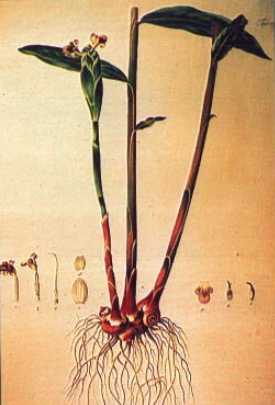
the best ginger coming from the island of Jamaica. The plant's long slender
leaves grow along 2 to 4 foot stalks, which arise like corn stalks from
the creeping rhizome, as do the separate flower stalks. The rhizome produces
a volatile oil that can be synthesized into such aromatic substances as
camphene, phellandrene, ziniberene, and zingerone. These along with several
other chemicals, have made ginger one of the worlds oldest and most popular
spices, it has been used in folk medicine everywhere. The tangy taste is
due to the oily liquid gingerol, also contained in the rhizome. In China,
the warm, pungent tang of ginger tea made by boiling pieces of fresh gingerroot
in water, has long been prescribed for colds, cough, flu, and hangovers.
The Chinese say that the tea has the power to strengthen the lungs, and
the kidneys. Tibetans use ginger to stimulate the vital energies of one
who is debilitated, lethargic, or convalescing from an illness. In Japan,
a ginger-oil massage is a traditional treatment for spinal and joint problems.
Other herbalists have recommended hot ginger compresses and baths to relieve
gout, arthritis, headaches, and spinal pain. Ginger compresses are also
used in many parts of the world to relieve sinus congestion, kidney problems,
menstrual cramps, and various other aches and pains. A warm ginger footbath
is said to invigorate the entire body, and a piece of cotton soaked in
ginger oil is a common treatment for earache. Some of the uses of this
herb that are recognized by "Western medicine" are as a stimulant, a rubefacient,
an errhine, and as a sialagogue. It has been proven to cleanse the colon,
reduce spasms and cramps, and to "stimulate" circulation. The root, is
a strong antioxidant and a poultice made from it is an effective antimicrobial
agent for sores and wounds. When chewed, it increases the flow of saliva,
and when swallowed acts as a stimulating tonic, a stomachic, and a carminative.
On the esoteric side of things, eating ginger before performing spells
is said to lend them power. In the Pacific, the Dobu islanders use ginger
extensively in their "magick". One of the ways it is employed is
for the root to be chewed and spit at oncoming storms to halt them.....