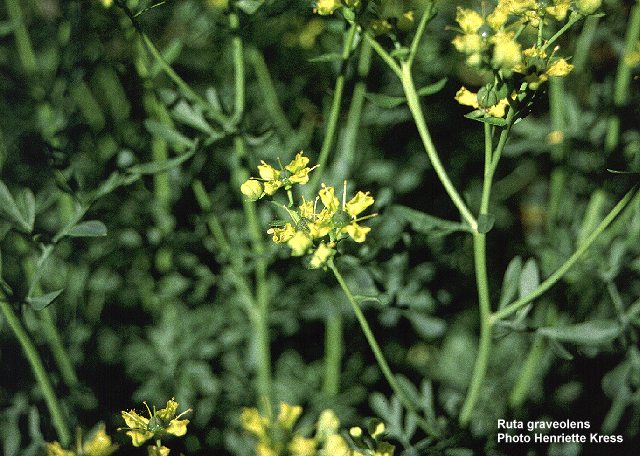
The medicinal part of this plant is the herb. Infusions of this herb are said to work as an anthelmintic, a carminative, an emmenagogue, a stimulant, and a stomachic. The main uses of Rue are to relieve gouty and rheumatic pains and to treat nervous heart problems, such as palpitations in women going through menopause. In European folk medicine, Rue serves to relieve gas pains and colic, improve appetite and digestion, and promote the onset of menstruation. Large doses of the herb will cause mild poisoning. Contact with the fresh plant may cause dermatitis in sensitive persons. Rue should not be used by pregnant women. The herb has been highly regarded since ancient times. Rue was recognized as medicinally helpful for more than 80 complaints by the time of the early Roman Empire. The first century scholar Pliny reported that it preserved the eyesight and noted that painters and engravers ate a good deal of Rue. In the 16th and 17th centuries, herbals advocated it as an antidote for all sorts of poisons, from toad stools to serpent bites. At one time the Catholic Church used brushes made of Rue to sprinkle holy water before Mass. (Yet another thing they "stole" from paganism. lol.) Which may explain one of the plants folk names, "Herb of Grace". On the Esoteric side of things, the herb is extremely useful. It is added to healing incenses and poppets. Rue like Angelica, (See the first herbal.) when added to the bath will help to remove all curses or hexes cast against you. The plant is one of many that is said to grow best when stolen. Just smelling the fresh plant will clear the head of "love matters" and improve the mental process.....