|
Feb. 20,
2003
— “Gods and Generals” feels like the first movie
to be funded and presented by the Confederate States of America.
Perhaps for a theme park called “Back With the Wind.” It’s a
“prequel” to “Gettysburg,” again produced by Ted Turner, again
directed by Ronald F. Maxwell, again from a book by Jeff
Shaara. THE 1993 FILM, meant for TV, but released in
some theaters before finding its main success on video, re-created the 1863
battle with force and clarity, and had some heartfelt acting by Jeff
Daniels, Tom Berenger, Kevin Conway,
Richard Jordan and Sam Elliott.
Now Robert
Duvall brings his rather gaunt but vinegar presence to the role of Gen.
Lee, instead of wistful, plump Martin Sheen. In this 216-minute epic, Lee
is sidelined by Gen. Thomas “Stonewall” Jackson, who is played by Stephen
Lang not as a stone wall but as a statue-in-progress.
When he
is shot in the hand, you expect a marble finger to hit the ground. Jackson
was a famously pious man, and Lang acts him as though he were a bearded
church pew.
He has an equally devout wife,
and a slave cook who joins him in prayer, smuggling in the idea (with
guilty eyes) of hope for freedom. Jackson twinkles benignly upon the idea,
but is so busy killing Yankee liberators that we see that the one freedom
he expects is his own death in battle (he would perish after a last
victory, wounded mistakenly by one of his men).
The Northerners exist mostly to die, like dutiful blue ants. They
and the less robotic rebs fall in almost bloodless clumps from cannon
blasts, or in buzzing swarms of riflery. Gore is lightly shown. In
surgery, a man dies without a whimper or groan, his blood dropping
delicately on piano keys.
DEVOTIONAL OF
DEATH
Prayers rise like incense.
There are poems and famous remarks, and even the admirable Daniels, as Lt.
Col. Chamberlain of the 10th Maine Regiment, declaims of Caesar’s glory as
if this were “Demetrius and the Gladiators.”
Staging the slaughters of Fredericksburg and Chancellorsville,
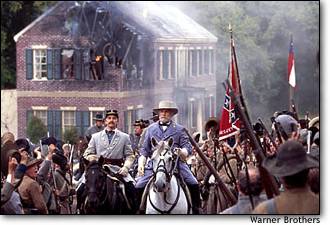
Maxwell can move large groups of men (many are Civil War re-enactors), but
his sense of drama is to pose people as stiffs even when alive; D.W.
Griffith achieved more dynamism 88 years ago in “The Birth of a Nation.”
It’s like an old history cyclorama
“brought to life” with a mixture of wax, starch and pulped hymnals. For
big, computerized vistas, Maxwell achieves almost none of the poetic power
of the 18th century that Eric Rohmer digitalized and stagecrafted in “The
Lady and the Duke.”
The main audience will
clearly be military buffs, armchair warriors and re-enactors. For them,
here is a devotional of death, inferior to “Gettysburg” and, of course, a
virtual cartoon of the war in its true and awful glory.
David Elliott is the movie critic
of The San Diego Union-Tribune. © 2002 by the Copley News Service.
Click the "Back" button on your browser
to return to the previous page. |
|