Click the "Back" button on your browser to return to the previous page.
MOVIES
Movie credits find new currency in retro images
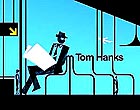
Animators use a variety of old and new techniques to create a stylish 60's feel for "Catch Me If You Can".
By Jon Burlingame
January 4 2003
A lean, silhouetted figure stays one step
ahead of his pursuer, a man wearing glasses and a fedora. Along the way he
metamorphoses into an airline pilot, a doctor and a lawyer, pausing briefly to
dally with girls around a pool and at a swank party.
The plot of "Catch Me if You Can," Steven Spielberg's film about a young con
artist? Well, yes, but it's also a tale that occupies the first 2 minutes and 40
seconds of the film, a fast-moving and clever title sequence whose style harks
back to the animated openings of several '60s classics.
Even the critics, who rarely discuss such things, are noticing. USA Today
referred to the animated opening as "the cutest of the year," while Variety
singled out the visuals and the jazzy John Williams music for "setting a fizzy
mood."
Says film historian Leonard Maltin: "A good title sequence puts you in the right
mood to enjoy the film. [This one] is a great marriage of picture and music --
visually arresting, really sharp, clever graphics that are retro looking, as
befits the movie, yet cutting edge at the same time."
The idea, according to producer Walter F. Parkes, was Spielberg's. "The first
impulse came from Steven, in keeping with the spirit of the movie and the
conventions of the times in which the movie is set," he says.
As early inspirations, Parkes cites the use of lines crisscrossing the screen in
Saul Bass' titles for "North by Northwest" (1959) and the DePatie-Freleng
cartoon over the opening of "The Pink Panther" (1964). But, as Maltin points
out, there are several fondly remembered animated sequences from that era, from
Bass' closing credits for "Around the World in Eighty Days" (1956) and his
opening titles for "It's a Mad Mad Mad Mad World" (1963) to Maurice Binder's
"After the Fox" (1966) and Richard Williams' "The Charge of the Light Brigade"
(1968), some of which are more entertaining than the movies they adorn.
The job of animating the "Catch Me" titles fell to London-based Nexus
Productions. Parkes and his wife, Laurie MacDonald, one of the film's executive
producers, sought out Nexus because they had been impressed by, of all things,
the animated flight-safety film shown on every Virgin Atlantic flight they took
to London while working on "Gladiator."
"It was done in this wonderful animation that was somehow simultaneously retro
and contemporary," Parkes said. "It felt like it could have been the title
sequence to a new version of 'The Avengers' or 'The Prisoner.' It had a great,
swinging '60s London quality."
Nexus' sample reel contained examples of work from several animators, including
those who did the Virgin piece, but Parkes was even more impressed with the work
of Olivier Kuntzel and Florence Deygas, a pair of French artists who are not
only animators, but also conceptual artists for everything from museum
exhibitions to restaurants.
Supervising, and acting as liaison between Parkes and Spielberg in Los Angeles
and Kuntzel and Deygas in Paris, was Nexus co-founder Chris O'Reilly. Speaking
by phone from London, O'Reilly recalled that the filmmakers "wanted us to create
a sense of the '60s, the period in which the film was set, a sense of
playfulness. Kuntzel and Deygas had a very strong sense of how it should look,
right off the bat."
Parkes concurs: "The style was pretty much intact with their initial
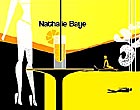
presentation," he says, "that kind of sexy silhouette quality, those very iconic
images of nurses in high heels, the FBI agent with the hat, the use of the palm
trees and that very abstract image of the airplane."
They were achieved, according to O'Reilly, through an old-fashioned technique.
"The actual characters are created by carving stamps, then putting them in ink
and reapplying them on paper over and over again to animate them." Parkes adds
that "they specifically went for a hand-stamped or woodblock look; it gives the
whole thing a handmade quality."
With the character designs and the overall look in place, conversations began
about transitions, movement and narrative. An early version of the sequence,
Parkes said, "tried to tell the story too specifically. In fact, it was very
difficult to follow. It was on the third go-round that we said what you want to
do is just identify two characters: the pursuer, the man with the hat -- we
added the glasses at the very end -- and the character that's being pursued, who
changes identities. And to make sure there is a chase. That's as much narrative
as we really needed."
The look may have been classic '60s, but the execution was very much 21st
century, said O'Reilly. "It was a combination of traditional and contemporary
digital animation," he explains. "Those print-block animations were taken into
computer, and then the backgrounds were all constructed digitally. The camera
moves within it were also created within a 3-D animation system."
While the animators were toiling in Paris and London, composer John Williams was
in Los Angeles composing and recording his theme, with its changing meters,
elaborate alto saxophone solo and very '60s-style finger-snaps.
"He played this amazing, modern-jazz suite that sounded like something from a
Jerome Robbins dance piece from 1969," Parkes said. "It was the final touch that
made the sequence sing."
After Nexus received the Williams track in September, "it was quite
inspirational for us," O'Reilly said. "When we got that music, we were starting
to animate in earnest, and we were able to heighten the sense of story and
drama." The actual animation work occupied about 15 people in London and Paris
through mid-November; Parkes and Spielberg were kept abreast of progress via
e-mailed computer files.
Spielberg pressed for a greater degree of integration between the letters in the
titles and the images, "so that the sweep of a J becomes the offramp of a
freeway, and a character will jump on a rope and slide down from one card into
another and it'll become the L of someone's name. Those kinds of elegant
transitions came into being after John's music," Parkes said.
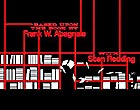
Some of the most striking effects are fleeting, like the flying books during
author Frank Abagnale's credit, the revolving mirrored doors for editor Michael
Kahn and the interplay of light and shadow for cinematographer Janusz Kaminski.
"We moved the camera around in a 3-D fashion," O'Reilly said.
Maltin hopes that these kinds of classy title sequences are making a comeback.
"It seems to go in and out of vogue. There was a period in the '70s and '80s
when titles became very low-key and functional, and the creative or flamboyant
title sequence fell out of favor. But as the pendulum swings, they came back in
the '90s, and now they're flourishing."
Click the "Back" button on your browser to return to the previous page.