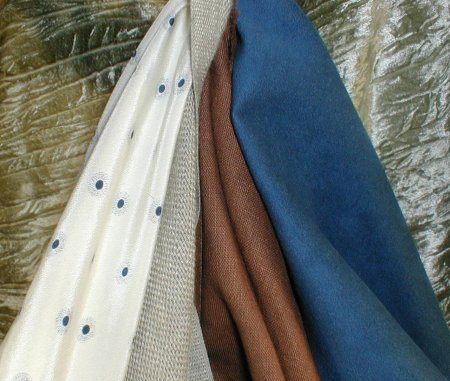
Selecting the fiber to fit your design:
General:
Fabrics that are soft and have a nice "hand"... (and if you grab a corner and kind of pleat it up and it flows and drapes down from there) need in general more ease than a fabric that is stiff, when pleated in the same manner bunches, or is thick .
Those stiffer fabrics need a more tailored, simple design to function well.
Take out some of your fabric... lay it on your lap.. see how it drapes as it
flows over your knees.. run your hand through it. .crease it.. does it wrinkle.. pull a little,
does it stretch...drape it over your shoulder...
How's it feel as a "blouse"..?
Get a good fabric book such as Sandra Bettzina's Fabric Savvy... which gives needle size, type of
thread, seam finishes, even laundering care.
For fanatics and those near a university with a textile/garment fashion design course check out the library for the big study (that costs 380 bucks!)
This gives details on about every current fiber used by man in manufacturing garments and home decorator products.
You probably can't check it out.. but may be able to photocopy some pages.
Now go to your closet. Look at your skirts, pants and blouses and finally dress'... feel the fabric ( not the style so much and not the color this time.. ) but the fiber.
How do your blouses drape.. which is your favorite?? which FEELS best on?
Compare a similar fiber in your collection to that blouse.
Now look carefully at the style line on that blouse.. get out a tape measure and measure the blouse at bust waist abd and hips.. look where the shoulder point falls on the blouse.
Consider what you would change on the blouse to make it nicer... ( move the shoulder point??)
Nothing works like success.. start there.. if the blouse you now own and enjoy or once owned and now have outgrown was made of "crepe" or made of Egyptian cotton or made of silk charmeuse made you feel good and wore great.. start there!
Then find "stuff" that feels like it. .for a similar style line and ease fit.
Do the same with pants, and dress's .. you will find most "bottom weight" fabrics to be weightier, and a bit stiffer.. these are great for skirts, pants, and summer shorts..
Lightweight wools ( summer weight is called tropical or super 120) linens of all types.. blends are my personal favorite cause whatever is mixed with it reduces wrinkles ..
A pure "poly" linen look is going to be hot.
Gabardines for long wearing trousers and dress slacks.. need a more fitted look and feel cause its heavier.
Novelty fabrics are great for vests... something like a tapestry or upholstery fabric.. but wouldn’t work at all as a dress.. Consider the weight of the fabric.. what you are going to wear it to.. work, play, gardening, kid's wedding...how are you going to launder /clean it.. no one would make a dry clean only something or other to wear in the garden..
But, on a hot summer day something light, cool, breathable ( cotton or other natural) will wick away moisture.
To me , sewing is decision making.
When you start with a blank screen or piece of paper... you start with the decision to design something... know in advance its proposed function.. Know how warm or cool you want it to keep you or if that is NOT going to be a factor..
Don’t make a fragile garment fiber too tight.. it will tear out at the seams.. you wanted it cause it draped... let it do it's thing..
Decide on the seam finish best for it... I usually French my blouse seams because I prefer very lightweight blouse fabrics...that adds stability to a fragile fiber and prevents any "raveling " on the seam edge.
Consider if that raw silk or natural linen is going to fray and ravel.. if so amend the construction to a seam finish that will protect the stitch line.
Boiled wool, microfibers in fact most fabrics on the bias are not going to ravel... and they have very different properties.. one will need the simplest lines almost what you would do with suede or ultra suede, the other will drape till the cows come home and need width and room to show off its qualities.
I give you permission to spend an hr ( or more) playing in your stash.. take some out and toss ‘em on the bed.. sort through into piles for different garments.. then sort through again for different levels of required ease.
I wouldn’t make anything tight or super fitted with polar fleece ..nor would I make anything loose( as in oversized) fitting other than a nightgown out of a heavy flannel.. ( and then it wouldn’t be too heavy) cause the flannel if heavy would over whelm my short stature.. so consider your size and shape and what you plan to use the garment in the final equation.
Heavy , thick fabrics may need you to make some small changes to your pattern to accommodate the “turn of cloth” and plans should be made to trim seam allowances and clip curves carefully.
Interfacings:
Now that you feel good about choosing the fabric think about interfacing. Interface jackets!!! Interface button plackets and waistbands, and behind zippers.
Think about Hong Kong finishing an arm hole !
Think about adding a little something to let the garment fabric be more of what its designed to be.
At the same time consider one of the new stabilizers when doing your button holes, or adding a bit of embroidery.
I’m finding hundreds of uses for water soluble laundry bags available from several websites. ( this is like 3 thickness of water soluble Solvay).
Layer the fashion fabric and the interfacing and feel it together... in some cases you will most likely use an iron on interfacing but there are still places where sew in works best (jackets and jacket collars, coats and other outerwear).
You can use different interfacings for different areas of your garments. Check out nylon tricot for your softer fabrics, whisper weft , fusi-knits and don’t forget some of these come in black as well as gray and white!
Interfacings come in both woven, non woven and knit varieties. Each has a specific application. Read the manufacturer’s instructions on application. Keep a supply of a variety of interfacings on hand so you have the right type for the right fabric.
The wrong interfacing can ruin a garment. and the right one can improve a garments hang in a dramatic fashion.
Linings:
Are generally made of light weight fabrics and are generally smooth and silky so they don’t drag on the fashion fabrics. They are used to make a garment hang better, wear smoothly, cover seam allowances . The hem of a jacket can be weighted with a small caliber chain. Linings are often cut 1/8th inch smaller than the fashion fabric so the face side of the garment is pulled inwards so the lining is not exposed. You would not want to sue a cotton batiste to line a silk dress, it would cause so much static the lining would ride up to the waist line. So rub the lining and the fashion fabric vigorously together and see if it produces static cling.
Interlinings: Provide weight and shape. A favorite on dress’s is organdy or flannel depending on the fashion fabric. A nice Satin dress needs an interlining to look as smooth as it should.
Trims and Emebllishments:
Trims and surface embellishment can change your fabric from plain to magnificent.
Heirloom sewing is simply a matter of applying a variety of laces, trims, beading and edgings . Stitches and embroidery on some very basic fabrics such as batiste, Dupioni and even broad cloth.
The color, application and positioning of these details changes a plain garment into wearable art
A little on color and textures:
There’s a cool quick way to figure your color palette. Take a picture of your head and neck and enter it into paint shop pro or similar program.
Use the color button on the top tool bar and edit color palette. You will be stunned by the number of colors in your head, hair and neck!!!
These are your base colors. You can view them via hue, luminance or palette order.
If the color is in your face or hair.. you can wear it!
You can then select a color and click on the little box and use the color wheel to find
complimentary colors to one that you have!!!
Note the color shade under the R_G_B ( red green blue ) lines in the program and select a color on the color wheel in dress shop.. dress your ME A (Mia with your head on) and use the bon bon/diet button to see what you think.
Textures..
If you are large and a bit fluffy stay away from the shaggy fibers with lots of fluff to them.. they will only make you look larger.
I have a gorgeous piece of "Berber" in red and black ( two colors I can wear) but I look like an inflatable barge in that fabric. It sits unmade in my stash as a collectable!
You can use color and texture in your design very effectively... take a length of the fabric
and drape it over your shoulder....does it work or do you get the unnnnnnnnnnnnh feeling.
Trust your instincts! Make your decisions carefully and enjoy your wonderful new wardrobe.
© 2001 / revised 2003 Kaaren Hoback, Dryden, New York