
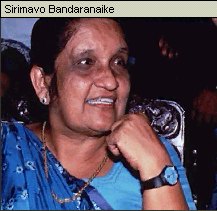
Bandaranaike, Sirimavo Ratwatte Dias
(1916- ), prime minister of Ceylon (now Sri Lanka) from 1960 to 1965 and 1970 to 1977, the first woman to hold such an office. She also served as prime minister of Sri Lanka (1994- ). She was born in Balangoda and attended convent schools. In 1940 she married Solomon Bandaranaike, who in 1956 became prime minister. After his assassination in 1959, she assumed the leadership of the Sri Lanka Freedom Party that Bandaranaike had formed. When the party won the elections of 1960, she became prime minister. She pursued the pro-Buddhist, pro-Sinhalese socialist policies that her husband had begun, but gradually lost support and was defeated at the polls in 1965. Returning to power in 1970, she nationalized certain industries and made the country a republic under the name of Sri Lanka. Her government, however, was plagued with ethnic dissension and economic deterioration, and it was thoroughly defeated in the elections of 1977. Charged with abuse of power while in office, she was expelled from the National Assembly and stripped of her civil rights in 1980; her rights were reinstated in 1986.
In November 1994 Bandaranaike's daughter, Chandrika Bandaranaike Kumaratunga, was elected president, as the candidate of the People's Alliance, a coalition party that included the Sri Lanka Freedom Party headed by Bandaranaike. One of her campaign pledges was to change a 1978 amendment that made the president head of the government with the power to dismiss parliament at will. Kumaratunga promised to change the position to a largely ceremonial one. As president, Kumaratunga had responsibility for appointing the prime minister; she appointed her mother in November 1994. Many believe that Kumaratunga appointed Bandaranaike so that they could easily switch positions if the presidency was made into a ceremonial position
Thanks To Microsoft Corporation &
Robert Frerck/Woodfin Camp & Associates, Inc From IGCAS