
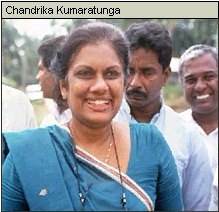
Kumaratunga, Chandrika Bandaranaike
Chandrika Kumaratunga
Chandrika Kumaratunga became the first female president of Sri Lanka in 1994. Both of her parents, Solomon and Sirimavo Bandaranaike, had served as prime minister.
(1945- ), president of
Sri Lanka (1994- ). Bandaranaike was born in Colombo, Sri Lanka (formerly Ceylon). She was educated in Sri Lanka and at the University of Paris, where she earned a degree in political science. Her family has been involved in politics since Sri Lanka’s independence in 1948; both of her parents served as prime minister. In the 1970s and early 1980s Kumaratunga held a number of important posts in the nationalist Sri Lanka Freedom Party (SLFP), which had been founded by her father, Solomon West Ridgeway Dias Bandaranaike, who was assassinated in 1959. In 1986 she became president of the Sri Lanka Mahajana Party (SLMP), which was founded in 1984 by her husband, Vijaya Kumaratunga. Following his assassination in 1988, she was chosen to head a new four-party coalition, the United Socialist Alliance (USA). In the 1990s she emerged as one of the principal leaders of the People’s Alliance, a coalition she formed to join the SLFP and a number of smaller parties.After the assassination of President Ranasinghe Premadasa in May 1993, Kamaratunga became chief minister of the Western Provincial Council. In August 1994 she was elected Sri Lanka’s prime minister, and People’s Alliance gained a majority in parliament. In the November 1994 presidential elections Kumaratunga was elected the country’s first female president. She appointed her mother,
Sirimavo Ratwatte Dias Bandaranaike, to serve as prime minister, a post her mother had held twice before.In a country that has seen a great deal of political violence in its brief history since independence, Kumaratunga’s campaign promise to end the bitter ethnic civil war between the Sinhalese and the Tamils helped her win a landslide victory in the election. Initially her efforts to call a truce with Tamil separatists met with some success, but the situation deteriorated with Sinhalese opposition against devolving more power to the Tamil minority and with the separatist Liberation Tigers of Tamil Eelam (LTTE) violating a 100-day truce offered by the government. Kumaratunga renewed the war against the LTTE, launching a military offensive that succeeded in capturing the Jaffna Peninsula, a stronghold of the LTTE. Kumaratunga devised a peace plan intended to give limited autonomy to Sri Lanka’s provinces—including Tamil areas. By mid-1997 the plan had yet to be voted on by parliament and the fighting continued.
Thanks To Microsoft Corporation &
Gartholomen/The Gamma Liaison Network From IGCAS